Voorvertoning
 Verstuur
 Delen
Delen
 Details bekijken
 Gids
Gids

 Download
 Vergelijkbare items
 Röntgenonderzoek
 Diavoorstelling
 Statistieken
Dans à la musique du temps
 Olieverf op canvas
- Wanddecoratie
- Baroque
 1638
1638- Renaissance
 82.0 x 104.0 cm
 De Walles Collectie
 Lees meer
Handgemaakte olieverfreproductie
Met de hand geschilderd in olieverf op canvas in uw gewenste maat en lijst, op bestelling gemaakt door onze kunstenaars. ( Schakel over naar print Schakel over naar digitale afbeeldingen)




P118B €10

P118H €10

P118W €10

P438Z €10

P508JH €12

P508YH €12

P805H €10

P805Z €10

P919BZ €10

P919G €10

P919XJ €10

P959ZH €10

P968JZ €12

W106C €8

W218G €10

W218JH €8

W218Y €10

W307PJ €10

W316G €10

W316PJ €8

W316Y €10

W398PJ €8

W4111J €10

W500HY €15

W500JH €15

W692G €12

W849H €8

W940BG €15

W953PJ €8




Kies uit onze vooraf ingestelde maten die overeenkomen met de originele verhoudingen van het kunstwerk.

Voer de breedte en hoogte in die u nodig heeft, passend bij uw lijst of uw muur. Omdat dit handgeschilderd is, kan de kunstenaar bij een afmeting met een andere beeldverhouding iets meer rondom het schilderij schilderen of juist iets meer weglaten — u kiest zelf. Wij sturen u een digitaal mockup ter goedkeuring voordat het schilderwerk begint. De afbeelding die op deze pagina wordt getoond, is niet het uiteindelijke resultaat — alleen de mockup geeft dit weer.
Na de bestelling zal het team van OriginalUniqueArt.com per e-mail contact opnemen met de klant voor instructies en een mockup-voorbeeld sturen.
Wereldwijde levering () binnen 3 tot 4 weken in plaats van de standaard 5 weken. (26 oktober). Zonder concessies aan de kwaliteit.

Gratis wereldwijde expressverzending

Hoogwaardig linnen canvas

Volledige verzendverzekering

Garantie op terugbetaling van invoerrechten

Garantie op exacte kleurweergave

Retourbeleid van 100 dagen (alleen bij defecten)

100% Geld-terug-garantie

Korting bij meerdere afnames
 De optie voor glas is alleen beschikbaar bij een formaat kleiner dan 110 cm.

Dans à la musique du temps
Druktechniek
Afmetingen reproductie
-


Eindtotaal
€ 263
A Dance to the Music of Time: Poussin's Masterpiece Unveiled
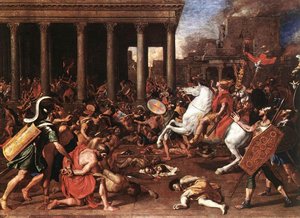
Nicolas Poussin’s “Dance to the Music of Time,” painted in 1638, isn’t merely a depiction of a festive gathering; it’s an intricate allegory woven with threads of classical philosophy, Renaissance ideals, and a profound meditation on the human condition. Initially commissioned by Cardinal Giulio Rospigliosi – later Pope Clement IX – the painting transcended its initial purpose to become one of the most celebrated works in the Wallace Collection in London, captivating viewers for centuries with its serene beauty and layered symbolism. Poussin, already establishing himself as a leading figure in the burgeoning classical style of French Baroque art, masterfully blended the grandeur of Roman antiquity with a distinctly modern sensibility, creating an image that continues to resonate deeply today. The scene unfolds outdoors, bathed in the soft light of dawn, suggesting a liminal space between day and night, chaos and order – mirroring the very essence of time itself.The Composition: A Harmonious Circle
At first glance, “Dance to the Music of Time” presents a seemingly simple tableau: a group of elegantly dressed figures engaged in a graceful dance before a stately statue. However, closer observation reveals a meticulously constructed composition governed by principles of balance and proportion, hallmarks of Poussin’s classical training. Nine individuals populate the scene, each rendered with exquisite detail and imbued with distinct character. They are not simply dancers; they represent stages of human existence – Poverty, Labour, Wealth, and Pleasure – locked in an eternal cycle, guided by Time himself, who plays a lyre, orchestrating their movements. The statue at the center serves as a silent witness to this ongoing drama, embodying timelessness and order amidst the fleeting nature of earthly pursuits. Notice how Poussin uses diagonal lines to draw the eye through the composition, creating a sense of movement and dynamism within the overall stillness. The careful arrangement of figures, their gestures, and their interactions contribute to a harmonious whole, reflecting the artist’s belief in the inherent beauty and order of the universe.Symbolism: Echoes of Antiquity and Renaissance Thought
The painting is rich with symbolic meaning, drawing heavily from classical mythology and philosophical concepts. Time, depicted as an elderly figure playing a lyre, represents the relentless passage of time and its influence on human affairs. The four dancers embody the stages of life – Poverty, Labour, Wealth, and Pleasure – each representing a distinct aspect of the human experience. Furthermore, the inclusion of Aurora, the goddess of dawn, symbolizes new beginnings and the promise of renewal. Poussin skillfully integrates elements from both classical antiquity and Renaissance humanism, creating an image that speaks to universal themes of mortality, aspiration, and the pursuit of happiness. The painting’s iconography also references Nonnus' Hymn to the Seasons, a Greek poem that provides a framework for understanding the relationships between these four figures. Poussin’s meticulous attention to detail ensures that every element contributes to the overarching narrative—a testament to his profound grasp of artistic principles and philosophical thought.Technique and Artistic Significance: A Masterclass in Light and Color
Poussin’s mastery is evident in his meticulous rendering of light and color. He employs a technique known as *chiaroscuro*, using dramatic contrasts between light and shadow to create depth, volume, and atmosphere. The soft, diffused light of dawn bathes the figures in a warm glow, while subtle shadows define their forms and enhance their sense of presence. Poussin’s use of color is equally refined, with muted tones and delicate gradations creating a harmonious palette that evokes a sense of serenity and timelessness. His brushwork is remarkably smooth and controlled, contributing to the painting’s overall sense of elegance and refinement. “Dance to the Music of Time” stands as a pivotal work in Poussin’s oeuvre and a cornerstone of French Baroque art, demonstrating his ability to synthesize classical ideals with contemporary sensibilities. It influenced generations of artists who followed, shaping the course of Western art history.Reproductions Available at OriginalUniqueArt: Bringing Poussin's Vision to Life
For those captivated by the beauty and profound symbolism of “Dance to the Music of Time,” handmade oil painting reproductions are available at OriginalUniqueArt. These meticulously crafted replicas capture the essence and detail of the original masterpiece, allowing you to bring Poussin’s timeless vision into your home or studio. Each reproduction is created by skilled artisans using traditional techniques and high-quality materials, ensuring that it faithfully reflects the artist’s intent. Whether displayed as a statement piece in a grand salon or a subtle accent in a cozy corner, an OriginalUniqueArt reproduction of “Dance to the Music of Time” will serve as a constant reminder of the enduring power of art to inspire contemplation and evoke emotion. Explore our collection today and discover the perfect way to celebrate this iconic work of art.- Harlequin and Columbine by Jean Antoine Watteau
- Gilles and his Family by Jean Antoine Watteau
- Marguerite Gérard by François Dumont
A Life Steeped in Classical Reverie
Nicolas Poussin, a name synonymous with the grandeur of French Baroque painting, was nonetheless a soul deeply rooted in Italian soil for much of his artistic life. Born in Le Havre, Normandy, in June 1594, his early years remain somewhat veiled in mystery, yet they undoubtedly laid the foundation for a career that would become pivotal in shaping the classical tradition within French art. Though he briefly studied in Paris during the early 1610s, absorbing influences from lesser-known artists of the time, it was his journey to Rome in 1624 that truly ignited his artistic destiny. This wasn’t merely a geographical relocation; it was an immersion into the heart of antiquity, a pilgrimage to the very source of inspiration that would define his aesthetic vision. Poussin's initial forays into painting were marked by a sensuous quality reminiscent of Venetian masters like Titian, yet even in these early works, a nascent sense of order and iVeelgestelde vragen
Uit welke periode stamt "Dans à la musique du temps"?
"Dans à la musique du temps" behoort tot de Renaissance-periode.
In welk jaar werd "Dans à la musique du temps" door Nicolas Poussin gemaakt?
"Dans à la musique du temps" door Nicolas Poussin werd gecreëerd in 1638.
Hoe past "Dans à la musique du temps" binnen de thema's en stijl van Nicolas Poussin?
Binnen het oeuvre van Nicolas Poussin past "Dans à la musique du temps" binnen de Baroque-stijl, samen met de thema's van classical antiquity inspiration, renaissance humanism values, moral philosophy reflection, symbolic representation depth, poussin’s signature style, roman mythology echoes, religious allegory significance.
Biografie kunstenaar
Nicolas Poussin – Een Symbool van Franse Barok Kunst
Nicolas Poussin, een naam die synoniem staat voor de grandeur van Franse Barok kunst, was echter een ziel die diep geworteld was in Italiaanse grond voor het grootste deel van zijn artistieke leven. Geboren in Les Andelys, Normandië, in juni 1594, blijven zijn vroegste jaren enigszins gehuld in mysterie, maar ze legden onmiskenbaar de basis voor een carrière die zou worden cruciaal bij het vormen van de klassieke traditie binnen Franse kunst. Hoewel hij kortstondig studeerde aan Parijs tijdens het begin van de 1610er jaren, waarbij hij invloed opnam van minder bekende kunstenaars van dat tijdperk, was zijn reis naar Rome in 1624 echt een vonkende kracht achter zijn artistieke bestemming. Dit was niet alleen een geografische verschuiving; het betekende een onderdompeling in het hart van de oudheid, een pelgrimstocht naar de bron van inspiratie die zijn esthetische visie zou definiëren. Zijn eerste pogingen tot schilderen werden gekenmerkt door een sensuele kwaliteit die doet denken aan Venetiaanse meesters zoals Titiaan, maar zelfs hierin begon een nieuwe vorm van ordening en intellectuele ernst te emergensen—een voorbode van de stijl waarin hij zo magistraal zou verbeteren.De Romeinse Jaren: Het Vormgeven van Een Klassieke Ideeel
Rome bleek meer dan alleen een atelier voor Poussin; het werd zijn intellectuele kruispunt. Hij bevond zich middenin een bruisende cirkel van geleerden, archeologen en mede kunstenaars, waaronder Cassiano dal Pozzo, wiens diepe kennis van klassieke oudheid de kunstenaar’s benadering enorm beïnvloedde. Dal Pozzo's toegewijdheid aan het zorgvuldig documenteren van oude resten gaf Poussin een diepe waardering voor historische nauwkeurigheid en een drang om zijn schilderijen te voorzien van een gevoel van tijdloosheid. Deze periode zag Poussin weg bewegen van de flamboyante exuberantie van sommige van zijn tijdgenoten, maar omarmde een stijl gekenmerkt door helderheid, balans en een bewuste nadruk op lijn compositie. Hij bestudeerde meticulëus Raphael’s werken, waarbij hij hun harmonieuze arrangementen en elegante vormen absorbeerde, terwijl hij tegelijkertijd inspiratie haalde uit oude sculpturen en literatuur bronnen zoals Ovid's *Metamorphoses*. Zijn schilderijen begonnen zich te bevinden met figuren getrokken uit klassieke geschiedenis en mythologie, afgebeeld niet alleen als decoratieve elementen maar als verkondigers van morele deugden en filosofische idealen. Hij werd bijzonder getroffen door het werk van Raphael, wiens stijl hij als een voorbeeld beschouwde voor harmonie en elegantie. Zijn aandacht voor licht en kleur was een directe echo van de Venetiaanse traditie, waarbij hij een gevoel voor atmosfeer en emotionele expressie nastreefte.De Invloed van Klassieke Oudheid
Poussin’s artistieke ontwikkeling werd sterk bepaald door zijn fascinatie voor het klassieke wereldbeeld. Hij volgde nauwlettend de ontwikkelingen binnen de wetenschap en archeologie van zijn tijd, waarbij hij zich liet leiden door nieuwe ontdekkingen die het beeld van het oude Griekenland en Italië verbreedden. Zijn studie van oude kunstwerken gaf hem een diepe waardering voor schoonheid en proportie, maar ook een kritische geest die hem aanmoedigde om bestaande conventies uit te dagen. Hij zag zichzelf als een voortzetter van de Renaissance Humanisme, waarbij hij zich liet inspireren door filosofen zoals Erasmus en Pico della Mirandola. Deze intellectuele zoektocht leidde tot een stijl die zowel technisch hoogstaand als filosofisch doordrongen was—een stijl die zou resulteren in werken die niet alleen prachtige schoonheid bezitten maar ook een diepe boodschap dragen over de menselijke natuur en het universum. Zijn kunstenaarschap werd gekenmerkt door een voortdurende zoektocht naar nieuwe vormen van expressie, terwijl hij zich steeds meer richtte op het verkennen van complexe thema’s zoals liefde, dood en religieuze contemplatie. Hij wilde niet alleen de wereld vastleggen maar ook een manier vinden om deze te begrijpen en te waarderen—een doel dat hem leidde tot een stijl die zowel technisch innovatief als artistiek doordrongen was.Een Laatste Legacy: Het Vormgeven van Franse Kunst
Ondanks dat hij het grootste deel van zijn werk buiten Frankrijk doorbracht, had Nicolas Poussin een enorme invloed op Franse kunst. Hij werd kortstondig aangesteld als eerste schilder aan het hof van Kardinaal Richelieu in 1640, maar vond zichzelf verstoken van de dynamiek en intriges van het koninklijk huis. Hij keerde snel terug naar Rome, waar hij bleef schilderen tot zijn dood in 1665. Zijn toegewijdheid aan klassieke principes hielp een standaard voor kunstenaarschap en praktijk binnen Frankrijk te vestigen, waardoor hij generaties van kunstenaars inspireerde die volgden. Hij werd een leidende figuur in de Académie Royale de Peinture et de Sculpture, waarbij hij zijn positie bevestigde als een hoeksteen van Franse Classicisme. Kunstenaars zoals Jacques-Louis David en Paul Cézanne bekroonden hun erkenning voor Poussin’s strenge benadering en intellectuele diepte met een directe verwijzing naar zijn stijl en filosofische visie. Zijn kunstwerken blijven een bron van inspiratie voor kunstenaars en critici tot op de dag van vandaag, waardoor hij een plaats heeft verdiend in de geschiedenis als een van de meest invloedrijke kunstenaars van zijn tijdperk.
Nicolas Poussin
1594 - 1665 , Frankrijk
Belangrijkste feiten
- Artistic Movement Or Style: Baroque, Classicisme
- Artists Who Influenced This Artist:
- Raphael
- Titian
- Date Of Birth: 1594
- Full Name: Nicolas Poussin
- Nationality: Frans
- Notable Artworks:
- De dood van Germanicus
- De Zevens Sacramenten Serie
- Een Romeinse Weg
- Orion Geblinderd Zoekt de Zon
- Place Of Birth: Les Andelys, Frankrijk
Gerelateerde artikelen
Nicolas Poussin: Classicism, Allegory & Order in 17th-Century French Painting
Explore the life & work of Nicolas Poussin, a master of French Classicism. Discover his allegorical paintings, Roman influences, and enduring impact on art history. Expert analysis & insights.

Barokke Pracht: Kunst die Grootsheid in Huis Brengt
Ontdek de barokke pracht! Leer over de geschiedenis, kenmerken en toepassingen van deze weelderige kunststijl in uw interieur. Laat u inspireren door meesters en breng grootsheid in huis.
Barok Schilderwerk: Top 10 Meesterwerken die een Beweging Definieerden | OriginalUniqueArt
Ontdek de 10 meest invloedrijke meesterwerken van het Barok schilderwerk! Caravaggio, Rembrandt & Rubens – leer over hun techniek en passie. Vind museumkwaliteit reproducties & interieurinspiratie op OriginalUniqueArt.com.
Baroque Classicism: Reconciling Drama & Order in 17th-Century Art
Explore the captivating world of Baroque Classicism! Discover its history, key artists like Caravaggio & Rubens, and defining characteristics. Expert insights & high-quality reproductions at OriginalUniqueArt.
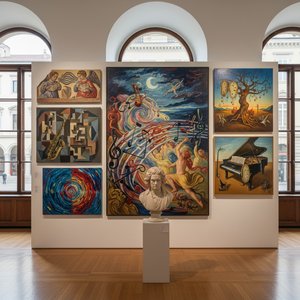
Harmonies on Canvas: Exploring the Visual Representation of Music in Art History
Explore the fascinating history of music's visual representation in art! From ancient symbolism to modern abstraction, discover how artists have captured sound and emotion on canvas. Expert insights & stunning examples.