

 Bekijk op ware grootte
 Verstuur
 Delen
Delen
 Details bekijken
 Gids voor studentenkunstwerken

 Download
 Vergelijkbare items
 Röntgenonderzoek
 Diavoorstelling
 Statistieken
Foxgloves
 Painting
- Neo-Romanticism
 1920
1920- Modern
 77.0 x 99.0 cm
 Bergen Kunstmuseum
 Lees meer
Giclée / Kunstafdrukken
Giclée- of canvasafdruk van museumkwaliteit met een snelle productie en flexibele afwerkingsmogelijkheden. ( Koop handgeschilderd kunstwerk Schakel over naar digitale afbeeldingen)




P118B €10

P118H €10

P118W €10

P438Z €10

P508JH €12

P508YH €12

P805H €10

P805Z €10

P919BZ €10

P919G €10

P919XJ €10

P959ZH €10

P968JZ €12

W106C €8

W218G €10

W218JH €8

W218Y €10

W307PJ €10

W316G €10

W316PJ €8

W316Y €10

W398PJ €8

W4111J €10

W500HY €15

W500JH €15

W692G €12

W849H €8

W940BG €15

W953PJ €8




Kies uit onze vooraf ingestelde maten die overeenkomen met de originele verhoudingen van het kunstwerk.

Voer de breedte en de hoogte in die u nodig heeft, passend bij uw lijst of uw muur. Een afdruk kan alleen worden ingekort, nooit groter worden gemaakt dan het origineel, waardoor een formaat met een andere verhouding een deel van de afbeelding verliest. Wij sturen u een digitaal mockup ter goedkeuring voordat we iets drukken. De afbeelding op deze pagina toont niet de werkelijke uitsnede — dit is alleen te zien op het mockup.
Wereldwijde levering () binnen 2 weken in plaats van de standaard 4/5 weken. (21 oktober)

Gratis wereldwijde expressverzending

Hoogwaardig linnen canvas

Volledige verzendverzekering

Garantie op terugbetaling van invoerrechten

Garantie op exacte kleurweergave

Retourbeleid van 100 dagen (alleen bij defecten)

100% Geld-terug-garantie

Korting bij meerdere afnames
 De optie voor glas is alleen beschikbaar bij een formaat kleiner dan 110 cm.

Foxgloves
Giclée / Kunstafdrukken
Formaat reproductie
-


Totaalprijs
€ 71
A Symphony of Verdant Life
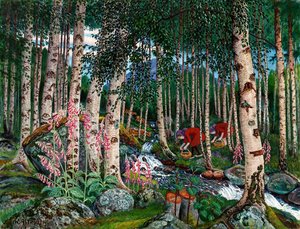
In the heart of the Norwegian landscape, where the mist clings to the valleys of Vestlandet, Nikolai Astrup captured a world that feels simultaneously grounded in reality and touched by magic. His 1920 masterpiece, Foxgloves, is far more than a mere botanical study; it is an immersive journey into a thriving, breathing ecosystem. The canvas unfolds as a lush forest sanctuary, where the dense canopy of healthy green leaves creates a cathedral of light and shadow. Within this verdant expanse, life moves in a quiet, rhythmic dance. A fox slips through the undergrowth, a silent observer of the scene, while a horse and dog add a sense of pastoral companionship to the wilder elements of the woods. The presence of people, scattered near the gentle flow of a passing river, suggests a harmonious coexistence between humanity and the untamed natural world.
The composition is anchored by the vibrant, bell-shaped blooms of the foxgloves themselves, which rise through the foliage like silent sentinels. There is an enchanting tension held within these flowers; while they possess an undeniable elegance and beauty, their inherent toxicity adds a layer of mysterious depth to the landscape. This duality—the marriage of the beautiful with the potent—is a hallmark of Astrup’s visionary approach, inviting the viewer to look closer at the subtle dangers and wonders hidden within the greenery.
The Mastery of Neo-Romantic Vision
Technically, Foxgloves exemplifies the unique style that Astrup developed away from the burgeoning movements of Cubism and Modernism. Instead of pursuing abstraction, he leaned into a form of magical realism, utilizing an intense and saturated color palette to elevate his surroundings. His technique breathes life into the textures of the bark, the translucency of the leaves, and the reflective surface of the river. The brushwork is deliberate yet fluid, capturing the "dark sunlight" that characterizes the Norwegian summer—a light that feels heavy with moisture and life.
For the discerning collector or interior designer, this piece offers a profound emotional resonance. It does not merely decorate a wall; it transforms a room into a portal to another time and place. The painting evokes a sense of nostalgia for a simpler, more connected era, making it an ideal centerpiece for spaces designed for contemplation, warmth, and organic elegance. Whether placed in a sunlit library or a contemporary living space, the deep greens and earthy tones of Foxgloves provide a grounding, restorative energy that celebrates the enduring spirit of the natural world.
Vragen & Antwoorden
Waarvoor wordt een afdruk van "Foxgloves" aanbevolen?
Het voorgestelde gebruik voor "Foxgloves" door Nikolai Astrup is Mood. Het kan ook voor andere doeleinden dienen.
Waar kan ik een handgeschilderde reproductie van "Foxgloves" door Nikolai Astrup kopen?
"Foxgloves" is verkrijgbaar als een met de hand geschilderde olieverfreproductie op linnen canvas. De bestelling kan worden geplaatst op de Met de hand geschilderde reproductie pagina, met een keuze uit verschillende formaten.
Waar kan ik kunstwerken vinden die lijken op "Foxgloves" door Nikolai Astrup?
Kunstwerken die lijken op "Foxgloves" door Nikolai Astrup zijn verzameld op de Vergelijkbare werken-pagina van het kunstwerk.
Biografie van de kunstenaar
Nikolai Astrup: Een Visionair van Vestlandet
Nikolai Astrup (1880 – 1928) staat als een uniek figuur in de Noorse kunstgeschiedenis—een schilder wiens diepgewortelde verbondenheid met het landschap en de tradities van Vestlandet zijn plaats verankerde onder de meest onderscheidende neo-romantische kunstenaars van zijn tijd. Geboren in Bremanger, Sogn og Fjordane, vormde Astrups opvoeding te midden van de ruige fjorden en serene valleien zijn artistieke gevoeligheid diepgaand. Dit dreef hem naar een stijl die werd gekenmerkt door intense kleurpaletten en een onwankelbare toewijding aan het afbeelden van het dagelijks leven op het Noorse platteland. Zijn nalatenschap schuilt niet alleen in esthetisch aangename doeken, maar ook in zijn pionierswerk om een ‘nationale "visuele taal" te vangen die de tradities en folklore van zijn vaderland deed herleven.’- Vroege jaren & Opleiding: De vormende jaren van Astrup werden gekenmerende door een familiale vroomheid, ingegeven door zijn vader, Christian Astrup, een dorpspastoor die hem aanmoedigde richting theologische studies. Ondanks zijn aanvankelijke neiging naar de geestelijkheid, leidde Astrups passie voor tekenen en schilderen hem uiteindelijk om de Trondheim Cathedral School te verlaten ten gunste van artistieke ambities in Kristiania (Oslo), waar hij zijn vaardigheden verfijnde onder het mentorschap van Harriet Backer.
- <Parijse Invloeden: Een kort verblijf in Parijs stelde Astrup bloot aan de opkomende avant-garde beweging, wat leidde tot connecties met medekunstenaars zoals Christian Krohg en zijn begrip van impressionistische technieken verrijkte. Deze periode verstevigde zijn toewijding aan experiment en verbreedde zijn artistische horizon.
- <Terugkeer naar Jølster & Artistieke Ontwikkeling: Bij zijn terugkeer naar zijn ouderlijk huis in Jølster in 1902, stichtte Astrup een gezin rond zijn vrouw, Engel Sunde, met wie hij acht kinderen kreeg. De economische ontberingen van hun leven voedden zijn artistieke drang en spoorden hem aan om zich volledig onder te dompelen in de weergave van zijn omgeving—een landschap dat diende als een blijvende bron van inspiratie.
- <Opmerkelijke Tentoonstellingen:} Astrups artistieke reputatie groeide gestaag door drie belangrijke tentoonstellingen in Kristiania (1905), Bergen (1908) en Oslo (1911). Deze exposities werden met kritisch lof ontvangen en vestigden hem als een leidende stem binnen de Noorse kunstwereld.
- <Grote Prestaties & Nalatenschap:} Astrups blijvende bijdrage aan de Noorse kunst ligt in zijn onvermoeibare streven naar artistieke authenticiteit—een toewijding om de schoonheid en de geest van Vestlandet met compromisloze eerlijkheid weer te geven. Zijn schilderijen blijven tot op de dag van vandaag resoneren als krachtige emblemen van nationaal erfgoed en belichamen de idealen van het neo-romantisme.
Nikolai Astrup
1880 - 1928 , Noorwegen
Snelle feiten
- Artistic Movement Or Style: Neo-romantiek
- Artists Or Movements Influenced By This Artist: ['Scandinavische kunst']
- Artists Who Influenced This Artist: ['Christian Krohg']
- Date Of Birth: 1880
- Date Of Death: 1928
- Full Name: Nikolai Johannes Astrup
- Nationality: Noors
- Notable Artworks:
- De vurige aanbidder
- Naakte bomen
- Spinnend meisje
- Place Of Birth: Bremanger, Noorwegen
Gerelateerde artikelen

Magic Realism Explained: Navigating the Enigmatic Intersection of Reality and the Extraordinary
Explore the profound depths of Magic Realism. Discover how this captivating movement blends everyday reality with the extraordinary through an expert art-historical lens. Perfect for collectors and enthusiasts seeking to understand the masters of the enigmatic.

Romantic Realism's Finest: 10 Masterpieces for Your Home | OriginalUniqueArt
Explore 10 defining masterpieces of Romantic Realism! Discover Courbet, Millet & Daumier's powerful paintings—capturing emotion and social realities. Find museum-quality reproductions for your home at OriginalUniqueArt.com.
The Poetic Truth of Observation: Exploring 19th-Century Realism in Painting
Explore the captivating world of 19th-century Realism! Discover key artists like Courbet & Millet, masterpieces, and the powerful social commentary behind this influential art movement. Expert insights at OriginalUniqueArt.

Echoes of Society: Exploring Social Realism's Enduring Legacy in Art
Explore the powerful world of Social Realism art! Discover key artists, masterpieces & its profound social commentary. Expert insights into this influential movement's history and enduring legacy.
The Enigmatic Realm of Magic Realism: Exploring Subconscious Narratives & Reality's Edge
Explore the captivating world of Magic Realism! Discover its origins, key artists like García Márquez & Colunga Marín, and how it blends reality with the fantastical. Expert insights & high-quality art reproductions at OriginalUniqueArt.