

 Verstuur
 Delen
Delen
 Details bekijken

 Download
 Vergelijkbare items
 Diavoorstelling
Dish
 Metalwork
- Sculpture
- Baroque
 1667
1667- Early Modern
 38.0 x 38.0 cm
 Museum Boijmans Van Beuningen
 Lees meer
Handgemaakte olieverfreproductie
Met de hand geschilderd in olieverf op canvas in uw gewenste maat en lijst, op bestelling gemaakt door onze kunstenaars. ( Bestel print Koop afbeelding)




































Kies uit onze vooraf ingestelde maten die overeenkomen met de originele verhoudingen van het kunstwerk.

U kunt uw eigen afmetingen invoeren om in een specifieke lijst of ruimte te passen. Als de door u gekozen maat niet overeenkomt met de verhoudingen van het originele beeld, zullen we het kunstwerk bijsnijden of het schilderij uitbreiden met extra handgeschilderde elementen. Een digitale mockup wordt ter goedkeuring naar u verzonden voordat de productie begint.
Houd er rekening mee dat de preview op het scherm niet de werkelijke uitsnede of uitbreiding weergeeft. Alleen de mockup toont de uiteindelijke compositie nauwkeurig.
Hoewel aangepaste afmetingen mogelijk zijn, raden we aan een maat uit de vooraf gedefinieerde lijst te selecteren om de originele verhoudingen te behouden.
Na de bestelling zal het team van OriginalUniqueArt.com per e-mail contact opnemen met de klant voor instructies en een mockup-voorbeeld sturen.
Wereldwijde levering () binnen 3 tot 4 weken in plaats van de standaard 5 weken. (28 augustus). Zonder concessies aan de kwaliteit.

Gratis wereldwijde expressverzending

Hoogwaardig linnen canvas

Volledige verzendverzekering

Garantie op terugbetaling van invoerrechten

Garantie op exacte kleurweergave

Retourbeleid van 60 dagen (alleen bij defecten)

100% Geld-terug-garantie

Korting bij meerdere afnames
 De optie voor glas is alleen beschikbaar bij een formaat kleiner dan 110 cm.

Dish
Druktechniek
Afmetingen reproductie
-


Eindtotaal
$ 300
A Glimpse into the Golden Age: The Intricacy of Keyser’s Silver Dish
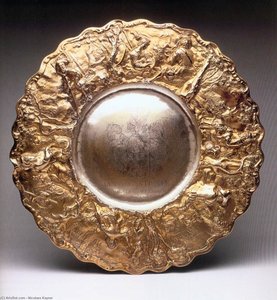
In the quiet, reflective moments of art appreciation, certain objects possess the power to transport us across centuries, acting as windows into a bygone era of opulence and meticulous craftsmanship. This exquisite silver dish, dating back to 1667, serves as such a portal. At first glance, the eye is drawn to the shimmering interplay between the cool, polished silver and the warm, regal glow of its gilded rim. It is not merely a functional object but a miniature stage where history unfolds in metallic detail. The piece captures the essence of the Dutch Golden Age, an era defined by a profound fascination with texture, light, and the celebration of worldly prosperity.
The artistry within this dish reveals a narrative complexity that rewards prolonged study. Upon closer inspection, the surface becomes a bustling tableau of 17th-century life. Intricate engravings depict a lively procession of figures; some are mounted upon spirited horses, while others stand or sit in poised contemplation. These figures are not mere decorations but characters in a silent drama, their movements frozen in silver. The technique required to achieve such fine detail on a metallic surface is nothing short of extraordinary, demanding a steady hand and an eye for the subtle nuances of anatomy and motion. This level of precision suggests a profound connection to the traditions of goldsmithing, a craft that deeply influenced the artist Nicolaes Keyser.
The Mastery of Light and Materiality
To understand this piece is to understand the soul of its creator, Nicolaes Keyser. Known for his ability to weave light into his works, Keyser brings a unique dimension to this silver medium. The way the light catches the raised edges of the engraved figures creates a sense of depth and movement, making the scene appear almost alive under shifting illumination. This mastery of "the golden hue" is evident in the gilded rim, which frames the silver narrative with a luxurious border, providing a structural elegance that anchors the composition.
For the discerning collector or interior designer, this dish represents more than just an antique; it is a masterclass in texture. The contrast between the smooth, reflective planes of the silver and the tactile, textured relief of the engravings offers a sensory experience that is rare in modern decor. When placed within a curated space—perhaps atop a dark mahogany sideboard or nestled within a collection of fine porcelain—the dish acts as a focal point of historical gravity. It brings an air of sophisticated antiquity to a room, inviting guests to lean in and discover the secrets held within its metallic folds.
A Legacy of Elegance for the Modern Collector
Owning or displaying a reproduction of such a significant piece allows one to inhabit the atmosphere of 1667. The emotional impact of the dish lies in its ability to evoke nostalgia for a time when every object was an opportunity for storytelling and artistic expression. It embodies a sense of permanence and prestige, making it an ideal choice for those looking to infuse their homes with pieces that possess both historical weight and aesthetic grace.
Whether you are an art historian captivated by the technical prowess of the Dutch masters or a decorator seeking to add a layer of storied luxury to a contemporary setting, this work offers endless inspiration. It stands as a testament to the enduring allure of the decorative arts—a reminder that true beauty lies in the delicate balance between precious materials and the human stories etched upon them.
Biografie van de kunstenaar
Nicolaes Keyser: The Golden Weaver of Delft
Nicolaes Keyser, a name often whispered in the halls of Dutch art history, remains an enigmatic figure despite his undeniable brilliance. Active primarily during the mid-17th century, he stands as one of Delft’s most significant portraitists, a master of light and texture whose canvases shimmer with a distinctive golden hue—a signature that has captivated viewers for centuries. More than just a painter, Keyser was a skilled goldsmith and dealer in Bluestone, a profession that profoundly shaped his artistic sensibilities and informed the rich materiality of his work. His life, intertwined with Delft’s vibrant mercantile scene and its burgeoning artistic community, offers a fascinating glimpse into the cultural landscape of the Dutch Golden Age.
Born around 1645 in Delft, Nicolaes Keyser's early life remains somewhat shrouded in mystery. He apprenticed under his father, Hendrik de Keyser, a renowned architect and sculptor, inheriting not only artistic talent but also a deep appreciation for craftsmanship and detail. This foundation proved crucial as he later transitioned into the world of portraiture, quickly establishing himself as a sought-after artist amongst the wealthy merchant families who dominated Delft’s economy. Unlike many of his contemporaries who focused solely on capturing likenesses, Keyser imbued his portraits with an almost theatrical quality, employing dramatic lighting and elaborate costumes to convey personality and status. His subjects weren't merely depicted; they were presented as embodiments of wealth, power, and social standing.
Keyser’s artistic development was profoundly influenced by the prevailing trends of the time, yet he forged a unique style that set him apart. The Baroque influence is undeniable—the dramatic chiaroscuro (contrast between light and dark), the opulent fabrics, and the dynamic compositions all echo the stylistic conventions of the era. However, Keyser’s work transcends mere imitation; he masterfully integrated these elements into a distinctly personal vision. His use of gold leaf – a technique honed during his time as a goldsmith – is particularly noteworthy. It wasn't simply decorative; it served to heighten the sense of luxury and prestige, creating an almost luminous effect that seems to emanate from within the canvas. This signature golden glow became synonymous with his work, instantly recognizable and deeply evocative.
A key element in understanding Keyser’s artistic trajectory is his connection to the Delft goldsmith's guild. Initially apprenticed as a goldsmith alongside his brother Pieter, he later became a master himself. This dual profession provided him with invaluable experience in manipulating materials – particularly gold and silver – which directly informed his painting technique. The meticulous attention to detail evident in his portraits—the intricate folds of velvet, the shimmering surfaces of jewelry, the delicate rendering of fabrics—are all testaments to this hands-on approach. Furthermore, his involvement in the guild fostered a deep understanding of social hierarchies and the importance of status symbols, themes that frequently appear in his commissioned portraits.
The Portrait as Social Commentary
Keyser’s portraits weren't simply representations of individuals; they were carefully constructed statements about their subjects’ position within society. He meticulously researched his clients, often consulting with family members and advisors to ensure an accurate portrayal of their wealth, lineage, and social standing. The choice of clothing, jewelry, and accessories—all rendered with exquisite detail—served as visual shorthand, communicating a complex web of information. For example, the inclusion of specific heraldic symbols or portraits of deceased ancestors underscored a subject’s noble heritage, while the display of expensive fabrics and precious stones demonstrated their financial prosperity.
Moreover, Keyser's portraits frequently engaged with broader social themes. He often depicted scenes of civic engagement—portraits of burgomasters presiding over town meetings, merchants negotiating contracts, or families hosting lavish banquets. These images not only celebrated the achievements of Delft’s elite but also subtly reinforced the values and norms of their society. His work offers a valuable window into the social dynamics of 17th-century Dutch life, revealing the intricate relationships between wealth, power, and status.
Key Works and Influences
Among Keyser's most celebrated works are “Dish” (circa 1654), currently housed in the Museum Boijmans Van Beuningen in Rotterdam, and a series of portraits commissioned by prominent families such as the van der Houts and the de Graeff. The "Dish" is particularly remarkable for its masterful use of light and texture, showcasing his signature golden glow and demonstrating his exceptional technical skill. His portrait of burgomaster Cornelis de Graeff and his family (circa 1638), now in the Mauritshuis in The Hague, exemplifies his ability to capture both individual personality and broader social context.
While Keyser’s style is undeniably rooted in Baroque conventions, he was also influenced by the work of other artists. Rembrandt van Rijn, a contemporary and rival, undoubtedly exerted a significant impact on his approach to lighting and composition. The dramatic chiaroscuro employed by Rembrandt—the stark contrast between light and dark—can be seen echoed in Keyser’s portraits. Furthermore, the influence of Jacob Isaackszoon van Ruisdael, a landscape painter known for his luminous effects, is evident in Keyser's use of color and texture.
Legacy and Historical Significance
Despite his undeniable talent and popularity during his lifetime, Nicolaes Keyser’s legacy was somewhat obscured following the rise of Rembrandt van Rijn. Many of his works were mistakenly attributed to the more famous painter, a phenomenon that persisted for centuries. However, in recent decades, there has been a renewed appreciation for Keyser's unique contribution to Dutch art history. His portraits are now recognized as masterpieces of their genre—remarkable examples of technical skill, social commentary, and artistic vision.
Keyser’s work serves as a powerful reminder of the vibrant cultural landscape of Delft during the Dutch Golden Age. His portraits offer a captivating glimpse into the lives of the wealthy merchant families who shaped the city's economy and society—and his signature golden glow continues to illuminate our understanding of this remarkable artist.
nicolaes keyser
Netherlands
Belangrijkste feiten
- Artistic Movement Or Style: Baroque Dutch portraiture
- Artists Or Movements Influenced By This Artist: ['Nicolaes Berchem']
- Artists Who Influenced This Artist: ['Rembrandt']
- Date Of Death: 1710 (Delft)
- Full Name: Nicolaes Keyser
- Nationality: Dutch
- Notable Artworks:
- Dish
- San Nicola da Tolentino
- Place Of Birth: Delft, Netherlands
Gerelateerde artikelen

Golden Glow: How to Use Metallic Gold Artworks to Elevate Your Home Decor with Timeless Luxury
Discover how to elevate your home with the timeless elegance of metallic gold artworks. From sculptural metal pieces to gilded oil paintings, learn expert interior design tips for integrating luxurious gold accents into your space with sophistication and grace.
The Sacred Glow: Mastering Gold Leaf and Gilding in Byzantine Art
Explore the divine mastery of Byzantine gold leaf and gilding. Discover how ancient artisans used gold ground and mosaics to create celestial light, a timeless legacy of spiritual splendor and technical excellence in sacred art history.
The Allure of Gold in Art History: Symbolism, Technique & Cultural Significance
Explore the rich history of gold in art! Discover symbolism, techniques & cultural significance from ancient civilizations to Klimt's masterpieces. Expert insights for collectors at OriginalUniqueArt.
Golden Splendor: An Editorial Journey Through Art's Most Radiant Masterpieces
Embark on a visual journey through the world's most radiant masterpieces. Discover how gold leaf, impasto textures, and gilded tones define luxury in fine art, from Byzantine icons to modern abstracts. Explore the eternal allure of gold in curated, museum-quality art collections.
The Noble Steed on Canvas: A Historical & Artistic Exploration of Horse Painting Across Cultures
Explore the rich history of horse painting! Discover masterpieces from Stubbs to Munnings & learn about symbolism, techniques & artists. Find museum-quality reproductions at OriginalUniqueArt.

