

 Voorvertoning
 Verstuur
 Delen
Delen
 Details bekijken
 Gids
Gids

 Download
 Vergelijkbare items
 Röntgenonderzoek
 Diavoorstelling
 Statistieken
Πολυκράτης


 Lees meer
Ontvang een bestand dat klaar is voor drukwerk en de kwaliteit van het online voorbeeld ver overstijgt. Elke digitale afbeelding die wij verkopen, is afkomstig van een high-resolution master uit onze database — meestal tussen de 5.000 en 15.000 pixels breed — zodat u met vertrouwen groot kunt afdrukken, nauwkeurig kunt bijsnijden of fijne details kunt reproduceren.
Geen enkel bestand verlaat ons atelier onbewerkt. Een digitaal expert controleert de kleuren aan de hand van het originele schilderij en corrigeert deze indien nodig, om vervolgens de helderheid en details te verbeteren met professionele retoucheertechnieken — waarbij de penseelstreek en stijl van de kunstenaar altijd strikt worden gerespecteerd. Het resultaat is een afbeelding die oogt als het schilderij zelf, en niet als een gescande foto met een filter.
U keurt goed voordat het proces wordt afgerond: onze expert stuurt de afbeelding binnen 72 uur per e-mail naar u toe ter beoordeling. Niet tevreden? Vraag om verbeteringen of correcties, of vraag een terugbetaling aan als de kwaliteit niet voldoet.
Dit is de kwaliteit waarop uitgevers, designstudio's, galeries en drukkerijen vertrouwen.
Digitale afbeeldingen
Download een bestand met hoge resolutie voor persoonlijke weergave, afdrukken en creatieve projecten. ( Schakel over naar print Bestel handgeschilderde reproductie)
Inbegrepen bij elke bestelling van een digitale afbeelding
Professionele digitale levering, gegarandeerd
Wanneer u kiest voor OriginalUniqueArt.com, ontvangt u niet alleen een afbeelding – u krijgt een professioneel verbeterd digitaal kunstwerk, met precisie vervaardigd en voorzien van een tevredenheidsgarantie. Dit is alles wat automatisch bij uw bestelling is inbegrepen:

Snelle levering per e-mail
Uw hoogwaardige digitale afbeeldingsbestand wordt binnen 72 uur na bestelling naar u gemaild – klaar voor direct gebruik.

AI-verbeterd digitaal bestand
Uw kunstwerk wordt professioneel geoptimaliseerd met behulp van geavanceerde AI-tools en handmatige bewerkingen, waardoor maximale details, helderheid en kleurnauwkeurigheid worden gegarandeerd.

Gratis levenslange herlevering van digitale bestanden
Je bestand per ongeluk verwijderd of kwijtgeraakt? Geen zorgen – we sturen het u op elk gewenst moment gratis opnieuw toe.

Geen invoerkosten – nooit
Geniet direct van uw kunstwerk zonder invoerrechten, belastingen of verzendkosten – digitale downloads zijn altijd belastingvrij.

Garantie op kleurgetrouwheid
Met behulp van professionele hulpmiddelen en kleurbeheer zorgen wij ervoor dat uw digitale afbeelding de originele kleuren zo nauwkeurig mogelijk weergeeft.

100 dagen tevredenheidsgarantie
Mocht u niet tevreden zijn met uw digitale afbeelding, dan passen wij deze aan of storten wij 100% terug binnen 100 dagen – zonder vragen te stellen.

100% Geld-terug-garantie
Niet tevreden? Ontvang een volledige terugbetaling binnen 100 dagen na ontvangst van uw digitale bestand – zonder vragen te stellen.

Korting bij grote bestellingen
Koop 3 afbeeldingen, bespaar 10% - Koop 5, bespaar 15% - Koop 10+, bespaar 20%. Ideaal voor creatieve projecten, galerieën en bureaus.
Polycrates: A Titan’s Struggle Embodied in Marble
The sculpture of Polycrates by Mikhail Kozlovsky, created in 1790, stands as a testament to the Romantic spirit of its time—a period obsessed with heroic narratives and dramatic emotion. More than just a depiction of a figure, it's an exploration of human resilience against overwhelming odds, captured with remarkable precision and imbued with palpable tension. Kozlovsky’s masterful execution elevates this historical subject matter into a timeless meditation on mortality and the pursuit of virtue.- Subject Matter: The statue portrays Polycrates, King of Samos, a ruler renowned for his intellect and military prowess but tragically undone by ambition and betrayal. Herodotus recounts Polycrates’s reign as marked by both opulent grandeur and ruthless pragmatism – a duality that Kozlovsky skillfully conveys through the sculpture's posture and expression.
- Style: Strongly influenced by Neoclassical ideals, Kozlovsky adheres to the stylistic conventions established by artists like Antonio Canova. The figure’s musculature is idealized, reflecting the classical preoccupation with anatomical perfection, yet simultaneously imbued with a sense of dynamism that transcends mere representation.
- Technique: Crafted from gypsum—a material favored for its ability to capture subtle nuances of form—the sculpture exemplifies Kozlovsky's meticulous approach to carving and polishing. The surface texture is remarkably smooth, achieved through painstaking labor, revealing the sculptor’s dedication to replicating the natural beauty of marble with exceptional fidelity.
- Historical Context: Produced during the Enlightenment, Polycrates embodies the era’s fascination with heroic figures and moral dilemmas. Kozlovsky's work aligns with the broader artistic movement that sought inspiration from antiquity—a deliberate harkening back to Greco-Roman virtues and ideals of nobility.
- Material: Gypsum
- Date: 1790
- Artist: Mikhail Ivanovich Kozlovsky
- Location: State Russian Museum, St. Petersburg
Veelgestelde vragen
Wat stelt "Πολυκράτης" voor en welke sfeer straalt het uit?
"Πολυκράτης" door Mikhail Ivanovich Kozlovsky verbeeldt classical sculpture, greek mythology, human anatomy, dynamic pose, marble material, roman influence, monumental art in een Dramatisch stemming. Het onderwerp en de atmosfeer beschrijven samen het werk.
Hoe harmonieren de kleuren van "Πολυκράτης" met elkaar?
De kleuren van "Πολυκράτης" door Mikhail Ivanovich Kozlovsky vertonen een Harmonieus palet harmonie. Harmonie beschrijft de onderlinge relatie tussen de kleuren.
In welk museum is het originele werk "Πολυκράτης" te zien?
Het originele "Πολυκράτης" door Mikhail Ivanovich Kozlovsky wordt bewaard in Staatelijk Russisch Museum, Saint Petersburg, Rusland. Een reproductie maakt het mogelijk om het werk thuis tentoon te stellen.
Kunstenaarsbiografie
The Sculptor of Enlightenment Ideals
Mikhail Ivanovich Kozlovsky stands as a preeminent figure in the landscape of Russian Neoclassical sculpture, a master whose hands shaped the very essence of the Age of Enlightenment. Born in Saint Petersburg, Russia, his artistic journey began within the prestigious halls of the Imperial Academy of Arts. Under the tutelage of Anton Losenko, Kozlovsky embarked on a path that would eventually lead him far beyond the borders of his homeland, seeking inspiration in the great art capitals of Europe. His travels to Rome and Paris were not merely educational excursions but transformative odysseys that allowed him to absorb the burgeoning Neoclassical spirit sweeping through the continent.
The evolution of Kozlovsky’s style is a fascinating study in artistic maturation. His earliest endeavors retained a lingering connection to the dramatic, emotive sensibilities of the Baroque period. However, as he matured, his work underwent a profound metamorphosis, shedding ornamental excess in favor of Neoclassical monumentality and clarity. This transition saw him embracing the ideals of reason, order, and anatomical precision, mirroring the intellectual shifts of his era. By the time he returned to Paris in 1788 to supervise Russian students abroad, he had emerged as a sculptor capable of translating complex mythological narratives into enduring, dignified forms.
Mastery of Form and Mythological Narrative
Kozlovsky’s oeuvre is characterized by an extraordinary ability to breathe life into bronze and marble, capturing both the physical prowess of heroes and the ethereal grace of the divine. His works often serve as profound emblems of classical mythology, utilized to convey contemporary values of strength and wisdom. In pieces such as Hercules on Horseback, one observes a masterclass in realism; the meticulous rendering of equine and human musculature creates a sense of dynamic vitality that draws the viewer into the heart of the legend. His use of composition, often employing powerful diagonal thrusts, directs the eye through scenes of intense action and heroic struggle.
Beyond the depiction of raw power, Kozlovsky possessed a delicate touch for allegorical subjects. His sculpture Minerva and the Genius of the Arts, commissioned during the reign of Catherine II, exemplifies his ability to embody Enlightenment thought. Through the figures of the Roman goddess of wisdom and her artistic companion, he sculpted more than just myth; he captured the very aspiration of human intellect toward higher truth and order. His technical repertoire was equally diverse, ranging from the dramatic, gilded bronze of Samson Rending the Lion's Jaws—a centerpiece for the Grand Cascade at Peterhof Palace—to the expressive, martial character of the Suvorov Monument.
Legacy and Artistic Significance
The historical significance of Mikhail Kozlovsky lies in his role as a bridge between eras and a foundational pillar of Russian sculptural tradition. As a professor at the Academy of Arts, he played a crucial role in shaping the next generation of sculptors, ensuring that the principles of Neoclassicism would flourish in Saint Petersburg long after his passing. His contributions to the decorative splendor of imperial sites like Pavlovsk and Peterhof helped define the visual identity of the Russian Empire during a period of immense cultural growth.
His life's work remains a testament to the power of classical influence when wedded to technical mastery. Through his ability to adapt his manner from Baroque sensibility to Neoclassical grandeur, Kozlovsky achieved a level of permanence that transcends time. His sculptures continue to be celebrated for their:
- Anatomical Precision: A remarkable skill in rendering the complexities of human and animal forms with photographic realism.
- Symbolic Depth: The use of mythological figures to represent the enduring ideals of heroism, wisdom, and national triumph.
- Technical Versatility: An expert command over diverse media, including bronze casting and marble carving.
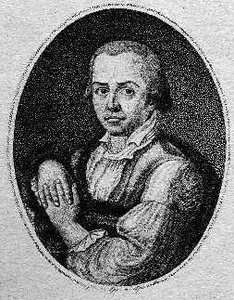
Mikhail Ivanovich Kozlovsky
1753 - 1802 , Rusland