Early Netherlandish Painting · 1485
Vanity (Hans Memling, 1485)
Hans Memling (1435–1494) maakte Vanity. Het dateert uit 1485. Het behoort tot de Early Netherlandish Painting-stroming. Het is gemaakt van Oil. Het is te vinden in Musée des Beaux-Arts in Strasbourg, Frankrijk. De afmetingen zijn 22 × 14 cm.
- 1485
- Oil
- 22 × 14 cm
- Musée des Beaux-Arts, Strasbourg

 Voorvertoning

 Met de hand geschilderd olieverfwerk
 Verstuur
 Delen
 Informatieblad


 Download
 Vergelijkbare items
 Röntgenonderzoek
 Diavoorstelling
 Vraag & antwoord

 Statistieken
Vanity, in het kort
- Titel
- Vanity
- Kunstenaar
- Hans Memling (1435–1494)
- Geboren in [jaar]
- Seligenstadt, Duitsland
- Datum
- 1485
- Medium
- Oil
- Afmetingen
- 22 × 14 cm
- Te zien in
- Musée des Beaux-Arts, Strasbourg, Frankrijk
- Beweging
- Early Netherlandish Painting
- Periode
- Renaissance
- Onderwerp
- vanity, mirror, reflection, symbolism, mortality, salvation
Wat stelt Vanity voor?
Hans Memling’s “Vanity”: A Mirror to Mortality
In the realm of Early Netherlandish painting, few works possess the haunting beauty and profound contemplation of Hans Memling's "Vanity," a small yet remarkably powerful oil on wood panel housed within the Musée des Beaux-Arts in Strasbourg. Measuring just 22 x 14 cm, this intimate piece transcends its modest size to deliver a complex meditation on human nature, mortality, and the elusive pursuit of earthly pleasure. It’s part of a larger triptych, “Earthly Vanity and Divine Salvation,” a visual narrative that invites viewers to confront their own desires and aspirations alongside the promise of spiritual redemption.
At first glance, "Vanity" presents a deceptively simple scene: a young woman stands before a mirror, her reflection gazing back at her with an expression of serene contemplation. She is adorned with a delicate necklace – a potent symbol of material wealth and worldly possessions – yet her gaze remains fixed on the image presented to her. However, the painting’s true depth lies in its carefully orchestrated symbolism. A dog sits attentively on the left, while two cats occupy the right side, adding layers of interpretation to the composition. Crucially, a bird is positioned near the center, often interpreted as representing the soul, poised between the allure of earthly pleasures and the potential for spiritual ascension.
The historical context surrounding “Vanity” is fascinatingly debated among art historians. Initially attributed to Hans Memling himself, the painting was later reassigned to Simon Marmion in 1890 by Wilhelm von Bode. A thorough examination conducted in 1994 definitively confirmed Memling’s authorship, solidifying its place as a cornerstone of his artistic legacy. This attribution is particularly significant because it highlights the meticulous detail and emotional resonance characteristic of Memling's work – qualities that distinguish him from many of his contemporaries. The painting exemplifies his mastery of oil painting techniques, particularly in the remarkably realistic rendering of the woman’s reflection within the mirror, a feat achieved through careful layering and blending of colors.
The Language of Symbols
“Vanity” is not merely a portrait; it's a carefully constructed allegory. The mirror itself serves as a central metaphor – a potent symbol of self-reflection, but also of the transience of earthly beauty. Memling masterfully uses light and shadow to emphasize this duality, creating an atmosphere that is both alluring and melancholic. The woman’s long, flowing hair contributes to her elegant appearance, yet it also hints at the fleeting nature of youth and beauty. The presence of the dog and cats further enriches the symbolism, suggesting a contemplation on loyalty, instinct, and perhaps even the duality of human nature – the animal within us.
The necklace, a clear representation of material wealth, stands in stark contrast to the spiritual themes explored through the bird and the overall composition. Memling’s deliberate arrangement of these elements creates a visually engaging image that compels viewers to consider the relative importance of earthly possessions versus spiritual values. The painting isn't simply about vanity; it’s an invitation to examine one’s own motivations and desires, prompting a deeper understanding of the human condition.
A Testament to Early Netherlandish Art
“Vanity” stands as a remarkable example of the artistic innovations that defined Early Netherlandish painting. Memling's work embodies the period’s emphasis on realism, meticulous detail, and symbolic depth – qualities that set it apart from its Italian counterparts. The use of oil paints allowed for unprecedented levels of subtlety and nuance in color and texture, contributing to the painting’s luminous quality and lifelike appearance. It is a testament to Memling's ability to convey complex moral themes through visually striking compositions.
Bringing “Vanity” Home
At OriginalUniqueArt, we are dedicated to preserving the artistic legacy of masters like Hans Memling. Our skilled artisans meticulously recreate "Vanity" in exquisite detail, ensuring that every nuance and subtlety of the original is faithfully reproduced. Whether you’re an art enthusiast, a collector seeking a unique addition to your collection, or simply someone drawn to the beauty and contemplation of this timeless masterpiece, our hand-painted reproductions offer an unparalleled opportunity to own a piece of history. Explore the full reproduction here.
Furthermore, you can delve deeper into the world of “Earthly Vanity and Divine Salvation” through this comprehensive article: Wikipedia Article. And for a closer look at Memling’s life and work, visit the Hans Memling: Vanity page on OriginalUniqueArt.
In welk museum bevindt Vanity zich?
Musée des Beaux-Arts
Strasbourg, Frankrijk
Een Paleiswandeling Door de Kunstgeschiedenis van Elzas Het Musée des Beaux-Arts de Strasbourg is veel meer dan een loutere bewaarplaats voor canvas en steen; het is de levende belichaming van de Elzasser ziel, een diepgaand getuigenis van eeuwenlange culturele uitwisseling en creatieve evolutie. Genesteld in het weelderige Palais Rohan, een bouwwerk dat in de 18e eeuw door Kardinaal Rohan werd in opdracht gegeven als symbool van de Bourbon-grandeur, nodigt het museum bezoekers uit voor een onvergetelijke verkenning van de Europese schilderkunstgeschiedenis. Het overschrijden van de drempel betekent het betreden van een rijk waar de architecturale pracht van de Barok de transformerende kracht van de kunst ontmoet.


Hoogwaardige afbeeldingen van Vanity

Auteursrechtelijk beschermd: deze bestanden zijn uitsluitend voor persoonlijk gebruik en vormen geen licentie voor herpublicatie.
Hans Memling, Vanity (1485), Musée des Beaux-Arts.
Veelgestelde vragen over Vanity
Waar kan ik het originele werk "Vanity" door Hans Memling bewonderen?
Het originele werk "Vanity" is te bewonderen in Musée des Beaux-Arts, Strasbourg, Frankrijk.
In welk jaar werd "Vanity" door Hans Memling gemaakt?
"Vanity" door Hans Memling werd gecreëerd in 1485.
Met welk medium is "Vanity" door Hans Memling uitgevoerd?
"Vanity" is uitgevoerd in Oil.
Wat zijn de afmetingen van het originele "Vanity" door Hans Memling?
"Vanity" heeft in zijn originele vorm de afmetingen 22 x 14 cm. De originele afmetingen dienen als een handig referentiepunt bij het kiezen van de juiste afmeting voor een reproductie.
Wat wordt er afgebeeld in "Vanity" door Hans Memling?
De onderwerpen van "Vanity" zijn vanity, mirror, reflection, symbolism, mortality, salvation, dog, cats.
Is de afbeelding van "Vanity" door Hans Memling vrij van auteursrecht?
"Vanity" door Hans Memling valt onder nog steeds auteursrechtelijk beschermd. Deze status bepaalt hoe de afbeelding van het werk mag worden gereproduceerd.
Aan welke kunstenaar wordt "Vanity" toegeschreven?
"Vanity" wordt toegeschreven aan Hans Memling.
Bij welke kunststroming behoort "Vanity" door Hans Memling?
"Vanity" door Hans Memling behoort tot de Early Netherlandish Painting-stroming. Deze stroming biedt de stilistische context van het werk.
In welke periode van de carrière van Hans Memling valt "Vanity"?
"Vanity" behoort tot de Mature Period in de carrière van Hans Memling. Deze classificatie plaatst het werk in de context van de ontwikkeling van de kunstenaar.
Over de kunstenaar, Hans Memling

1435–1494, Duitsland
Hans Memling
Vroege Leven, Familie en Opleiding Het verhaal van Hans Memling begint in de regio van de Midden-Rijn, waar hij rond 1430 werd geboren. Zijn eerste levensjaren bracht hij door in Seligenstadt, nabij Frankfurt, een plek die uiteindelijk ver verwijderd zou zijn van de Vlaamse gronden die hij zijn thuis zou noemen. Voordat hij zijn stempel kon drukken in de grote steden van het noorden, moest hij de geheimen van zijn ambacht ontdekken. Hij zocht zijn eerste vorming in de ateliers van Mainz of Keulen, waar de fundamenten van zijn technische vaardigheid werden gelegd door jarenlange, geduldige arbeid en nauwgezette observatie.
Ook van Hans Memling
 Het Laatste Oordeel1471
 Scènes de la Passion du Christ (côté gauche)1470
 Scènes de la vie de Marie1480
 Passion (Greverade) Altarpiece (central panel)1491
Essays over Vanity
 25 Masterpieces by Rogier van der Weyden: The Pinnacle of Emotional ArtImmerse yourself in the profound emotion of Rogier van der Weyden’s greatest works. From Northern Renaissance mastery to exquisite textures…
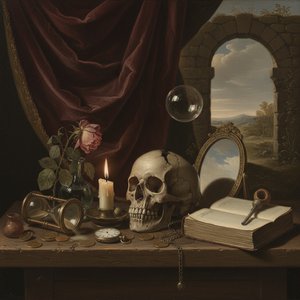 The Memento Mori Aesthetic: Decoding the Profound Symbolism of Vanitas ArtExplore the profound symbolism of Vanitas art. From Dutch Golden Age masterpieces to the haunting beauty of Memento Mori, uncover how class…
 10 Iconic Early Netherlandish Masterpieces That Changed Art HistoryJourney through the Northern Renaissance with our guide to 10 Early Netherlandish masterpieces. From Jan van Eyck to Rogier van der Weyden,…