Surrealist Expressionism · 1927
The Forest (Max Ernst, 1927)
Max Ernst (1891–1976) maakte The Forest. Het dateert uit 1927. Het behoort tot de Surrealist Expressionism-stroming. Het is gemaakt van Acrylic On Canvas. Het is te vinden in Tel Aviv Museum of Art in Tel Aviv, Israël. De afmetingen zijn 25 × 36 cm.
- 1927
- Acrylic On Canvas
- 25 × 36 cm
- Tel Aviv Museum of Art

 Voorvertoning

 Met de hand geschilderd olieverfwerk
 Verstuur
 Delen
 Informatieblad


 Download
 Vergelijkbare items
 Röntgenonderzoek
 Diavoorstelling
 Vraag & antwoord

 Statistieken
The Forest, in het kort
- Titel
- The Forest
- Kunstenaar
- Max Ernst (1891–1976)
- Geboren in [jaar]
- Brühl, Duitsland
- Datum
- 1927
- Medium
- Acrylic On Canvas
- Afmetingen
- 25 × 36 cm
- Te zien in
- Tel Aviv Museum of Art, Tel Aviv, Israël
- Beweging
- Surrealist Expressionism
- Periode
- Early Modern
- Onderwerp
- moonlit cityscape, surreal forest, urban night, max ernst, german art, 1927 painting
Wat stelt The Forest voor?
A Nocturne of Dreams: Max Ernst’s “The Forest”
Max Ernst's "The Forest," painted in 1927, isn’t merely a depiction of a landscape; it’s an immersion into the subconscious, a carefully constructed dreamscape rendered with the unsettling beauty characteristic of the artist’s early Surrealist explorations. This intimate canvas – measuring just 25 x 36 cm – holds within its borders a potent collision of natural and urban elements, inviting viewers to contemplate the anxieties and aspirations simmering beneath the surface of modern life. The painting immediately draws the eye upward to a luminous moon dominating the sky, casting an ethereal glow upon the sprawling cityscape below. Buildings rise from the darkness, not as symbols of progress or order, but as strangely distorted monoliths, hinting at a world both familiar and profoundly alien.
Ernst’s technique is deliberately evocative, employing a layered approach that anticipates techniques he would later refine in his collage work. He utilizes loose, expressive brushstrokes, building up the forms of trees and buildings with a sense of urgency and movement. The color palette leans heavily into cool blues and greens, punctuated by the stark white of the moon and the muted tones of the city lights – colors that contribute to the painting’s nocturnal atmosphere and imbue it with a feeling of quiet mystery. Notice how he doesn't meticulously render detail; instead, he favors suggestion and mood, allowing the viewer’s imagination to fill in the gaps.
The Seeds of Surrealism: Ernst’s Intellectual Landscape
Understanding “The Forest” requires acknowledging Max Ernst’s unique artistic trajectory. Born in Brühl, Germany, in 1891, Ernst wasn't a traditional painter; his path was forged through rigorous academic study – philosophy, art history, literature, psychology, and psychiatry at the University of Bonn. This intellectual grounding profoundly shaped his approach to art, moving him beyond mere representation towards exploring the realm of dreams, memory, and the irrational. His father, a teacher of the deaf, instilled in him a sensitivity to the world and a rebellious spirit – qualities that would become central to Ernst’s artistic vision. He was deeply influenced by thinkers like Freud and Jung, particularly their theories on the unconscious mind, which he sought to translate into visual form.
The year 1927 is crucial within this context. It represents a pivotal moment in Ernst's development as a Surrealist, a period marked by experimentation with automatism – a technique of spontaneous creation designed to bypass conscious control and tap directly into the subconscious. "The Forest," therefore, can be seen as a product of this process, a visual manifestation of his inner world.
Symbolic Echoes: Nature Versus Urbanity
The juxtaposition of the forest and the city is laden with symbolic weight. The forest, traditionally associated with nature, instinct, and the primal, stands in stark contrast to the rigid geometry and artificial light of the urban landscape. This isn’t a harmonious blend; rather, it's a tension – a suggestion that the encroachment of modernity threatens to overwhelm the natural world. The moon itself is a potent symbol, often linked to cycles, intuition, and the hidden realms of the unconscious. Its presence elevates the scene beyond a simple cityscape, transforming it into a dreamlike tableau.
Furthermore, consider the distorted forms of the buildings. They aren’t simply architectural structures; they seem to lean inward, almost collapsing under their own weight, mirroring perhaps a sense of unease or anxiety about the future. The trees, though present, are somewhat obscured by the city's glow, hinting at a diminishing connection with nature.
A Timeless Resonance: Reproduction and Artistic Legacy
"The Forest" continues to resonate with viewers today because it taps into fundamental human experiences – the longing for escape, the anxieties of urban life, and the enduring power of the subconscious. OriginalUniqueArt’s meticulously crafted hand-painted reproductions capture not only the visual details of Ernst's original but also its emotional depth and atmospheric quality. Each reproduction is created with the same attention to texture and color as the original, ensuring a faithful representation of this iconic Surrealist masterpiece. Whether you are an art collector seeking to expand your collection or an interior designer searching for a unique piece to elevate a space, a OriginalUniqueArt reproduction of “The Forest” offers a captivating glimpse into the mind of one of 20th-century’s most visionary artists.
In welk museum bevindt The Forest zich?
Tel Aviv Museum of Art
Tel Aviv, Israël
Een baken van creativiteit aan de Middellandse kust Genesteld in het levendige hart van Tel Aviv, een stad die pulseert van artistieke energie en historische betekenis, staat het Tel Aviv Museum of Art —een waar testament van het bloeiende culturele landschap van Israël. Meer dan slechts een bewaarplaats voor meesterwerken, ademt TAMA, zoals het liefkozend wordt genoemd, leven in de kunst; het stimuleert de dialoog, inspireert generaties en dient als een vitale schakel tussen het verleden van de natie en haar dynamische heden. Het verhaal begint niet in imposante zalen, maar binnen de bescheiden muren van de woning van de eerste burgemeester van Tel Aviv, een ruimte doordrenkt met de echo's van een natie die haar identiteit vormgevoed.


Hoogwaardige afbeeldingen van The Forest

Auteursrechtelijk beschermd: deze bestanden zijn uitsluitend voor persoonlijk gebruik en vormen geen licentie voor herpublicatie.
Max Ernst, The Forest (1927), Tel Aviv Museum of Art.
Veelgestelde vragen over The Forest
Waar is "The Forest" door Max Ernst tegenwoordig te zien?
Het originele werk "The Forest" is te bewonderen in Tel Aviv Museum of Art, Tel Aviv, Israël.
In welk jaar werd "The Forest" door Max Ernst gemaakt?
"The Forest" door Max Ernst werd gecreëerd in 1927.
Met welke techniek is "The Forest" gemaakt?
Max Ernst gebruikte de Acrylic On Canvas-techniek voor "The Forest". De techniek bepaalt de materiële aard van het originele werk.
Wat zijn de afmetingen van het originele "The Forest" door Max Ernst?
De afmetingen van "The Forest" door Max Ernst zijn 25 x 36 cm. Reproducties kunnen in andere formaten worden besteld met behoud van dezelfde verhoudingen.
Wat stelt "The Forest" voor?
De thema's die aanwezig zijn in "The Forest" door Max Ernst omvatten moonlit cityscape, surreal forest, urban night, max ernst, german art, 1927 painting, dreamlike scene. Samen vatten zij de onderwerpen van het kunstwerk samen.
Is de afbeelding van "The Forest" door Max Ernst vrij van auteursrecht?
Wat betreft het auteursrecht valt "The Forest" onder nog steeds auteursrechtelijk beschermd.
Wie is de kunstenaar achter "The Forest"?
"The Forest" wordt toegeschreven aan Max Ernst.
Tot welke stijl behoort "The Forest"?
De kunststroming die verbonden is aan "The Forest" door Max Ernst is Surrealist Expressionism. Deze classificatie plaatst het werk binnen een context van verwante kunstenaars en kunstwerken.
In welke periode van de carrière van Max Ernst valt "The Forest"?
"The Forest" vertegenwoordigt de Early Surrealism van Max Ernst.
Over de kunstenaar, Max Ernst

1891–1976, Duitsland
Max Ernst
Het Leven en de Oorsprong van Max Ernst Max Ernst kwam op 2 april 1891 ter wereld in Brühl, Duitsland. Hij groeide op in een katholiek gezin uit de middenklasse als het derde van negen kinderen. Zijn opvoeding werd gevormd door de rustige, gedisciplineerde sfeer van zijn thuis, waar zijn vader, Philipp, werkzaam was als leraar voor doven. Philipp was tevens een amateur-schilder, en het was via hem dat de jongen voor het eerst kennismaakte met de instrumenten en de praktijk van het maken van kunst.
Ook van Max Ernst
 Célèbes of Elefant Célèbes1921
 De Elefant Celebes1921
 Europa na regen II1942
 Van Dit Weten Geen Mensen1923
Essays over The Forest
 Symphony of Sunlight: The Luminous Legacy of Pine Tree Landscapes in Art HistoryExplore the luminous history of pine landscapes through Sorolla and Shishkin. Discover the magic of forest art today.
 Unlocking the Unconscious: The Top 25 Surrealist Masterpieces by Max ErnstStep into the dreamscapes of Max Ernst. Explore 25 iconic Surrealist masterpieces, from pioneering collages to haunting landscapes. Find in…
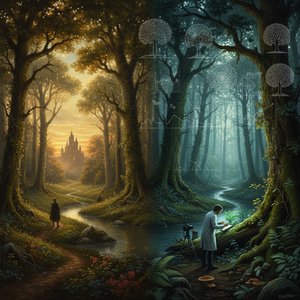 The Enchanted Canopy: Exploring Forests in Art History – From Romantic Idealization to Ecological ConsciousnessExplore the rich history of forests in art! Discover Romantic masterpieces by Friedrich & Monet, Symbolist depths, and contemporary visions…