- Home

- Reproductie van olieverfschilderij
- Max Ernst
- Illustration to "A Week of Kindness"
 Print kopen Koop afbeelding in hoge resolutie
 Verstuur
 Delen
Delen
 Details bekijken
 Toevoegen aan favorieten

 Download
 Vergelijkbare werken
 Röntgenonderzoek
 Diavoorstelling
Illustration to "A Week of Kindness"
 Acrylic On Canvas
- WallArt
- Surrealist Movement
 1934
1934- High Medieval
 18.0 x 13.0 cm
 Staatsgalerie Stuttgart
 Lees meer
Handgemaakte olieverfreproductie
Met de hand geschilderd in olieverf op canvas in uw gewenste maat en lijst, op bestelling gemaakt door onze kunstenaars.




P118B $10

P118H $10

P118W $10

P438Z $10

P508JH $12

P508YH $12

P805H $10

P805Z $10

P919BZ $10

P919G $10

P919XJ $10

P959ZH $10

P968JZ $12

W106C $8

W218G $10

W218JH $8

W218Y $10

W307PJ $10

W316G $10

W316PJ $8

W316Y $10

W398PJ $8

W4111J $10

W500HY $15

W500JH $15

W692G $12

W849H $8

W940BG $15

W953PJ $8




Kies uit onze vooraf ingestelde maten die overeenkomen met de originele verhoudingen van het kunstwerk.

U kunt uw eigen afmetingen invoeren om in een specifieke lijst of ruimte te passen. Als de door u gekozen maat niet overeenkomt met de verhoudingen van het originele beeld, zullen we het kunstwerk bijsnijden of het schilderij uitbreiden met extra handgeschilderde elementen. Een digitale mockup wordt ter goedkeuring naar u verzonden voordat de productie begint.
Houd er rekening mee dat de preview op het scherm niet de werkelijke uitsnede of uitbreiding weergeeft. Alleen de mockup toont de uiteindelijke compositie nauwkeurig.
Hoewel aangepaste afmetingen mogelijk zijn, raden we aan een maat uit de vooraf gedefinieerde lijst te selecteren om de originele verhoudingen te behouden.
Na de bestelling zal het team van OriginalUniqueArt.com per e-mail contact opnemen voor instructies en een mockup-voorbeeld sturen.
Wereldwijde levering () binnen 3/4 weken in plaats van de standaard 5 weken. (16 juli). Geen concessies aan de kwaliteit.

Gratis wereldwijde expressverzending

Hoogwaardig linnen canvas

Volledige verzendverzekering

Garantie op terugbetaling van invoerrechten

Garantie op exacte kleurweergave

60 dagen retourbeleid (alleen bij defecten)

100% Geld-terug-garantie

Korting bij meerdere afnames
 De optie voor glas is alleen beschikbaar bij een formaat kleiner dan 110 cm.

Illustration to "A Week of Kindness"
Techniek reproductie
Afmetingen reproductie
-


Eindtotaal
-
Beschrijving kunstwerk
A Surreal Seed of Kindness: Max Ernst’s “Illustration to ‘A Week of Kindness’”
Max Ernst's 1934 drawing, "Illustration to 'A Week of Kindness'," isn’t merely a depiction; it’s an invitation into the unsettling yet profoundly moving landscape of the Surrealist mind. Born Maximilian Maria Ernst in Brühl, Germany, in 1891, Ernst wasn’t simply a painter; he was a relentless investigator of the subconscious, driven by a desire to dismantle conventional thought and expose the hidden currents beneath the surface of reality. His early life, marked by his father's dedication to educating the deaf and Ernst’s own rebellious spirit, laid the groundwork for an artistic approach that prioritized psychological exploration over straightforward representation. This piece, part of a series titled “Une semaine de bonté” (A Week of Kindness), exemplifies this deeply personal and often unsettling vision.
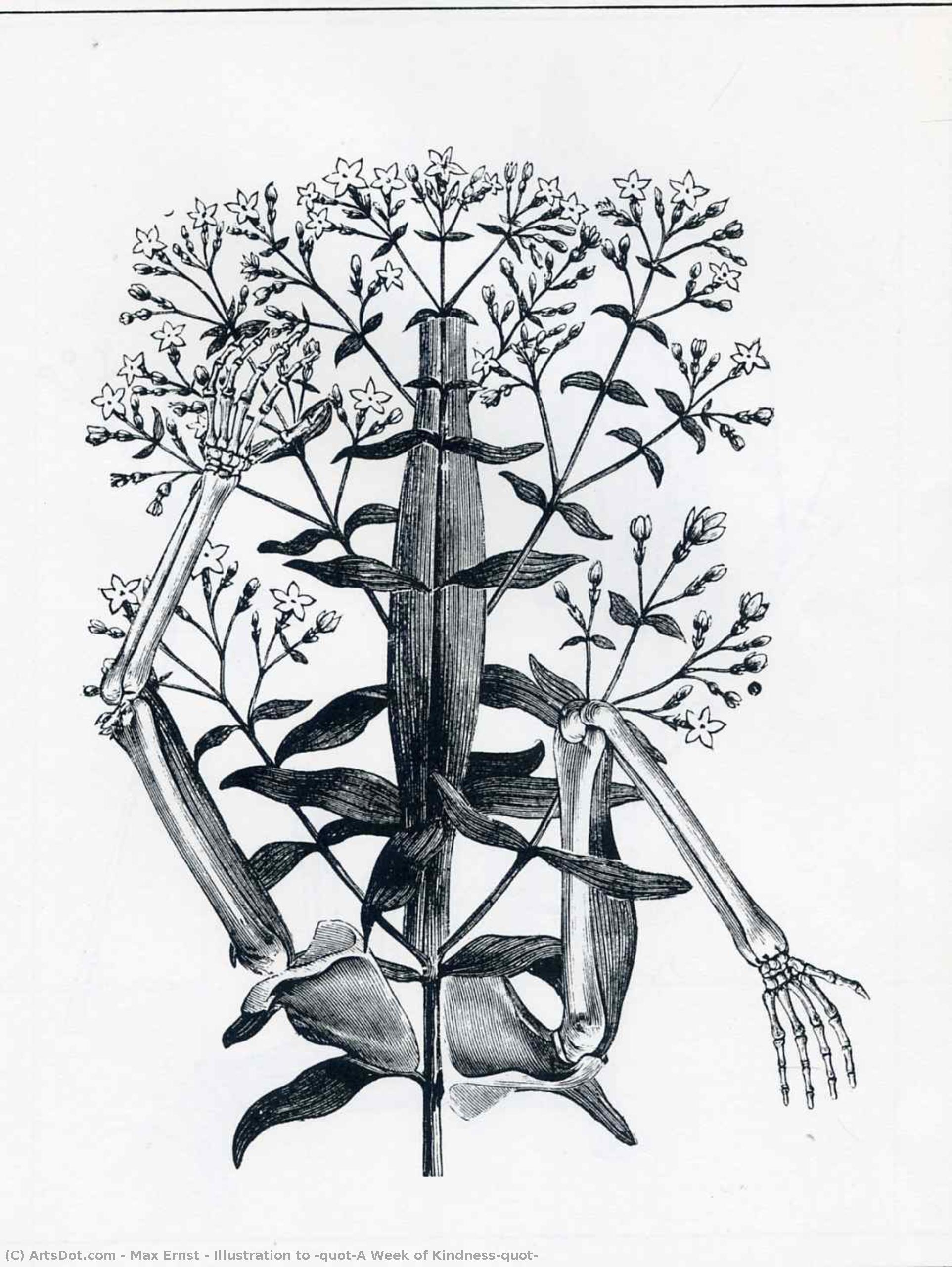
The image itself presents a striking juxtaposition: a skeletal figure, rendered with meticulous detail in fine lines, emerges from the tangled embrace of a plant. The skeleton’s limbs extend outwards, seemingly supporting or even growing out of the plant's stem – a visual metaphor for the cyclical nature of life and death, growth and decay. The fork held by the skeletal hand is particularly arresting; it’s an object of both utility and unsettling ambiguity, hinting at nourishment, perhaps, but also suggesting a deliberate act of division or even judgment. The monochrome palette—a carefully orchestrated range of grays—amplifies the artwork's starkness and emphasizes the textural contrasts between bone and foliage. Ernst masterfully utilizes hatching and cross-hatching to build depth and create a sense of tangible materiality, mimicking the look of an etching while retaining the fluidity of a drawing.
Decoding the Symbolism: Death, Regeneration, and the Human Condition
“Illustration to ‘A Week of Kindness’” is steeped in symbolism that invites multiple interpretations. The skeleton, a universal emblem of mortality, isn't presented as a morbid spectacle but rather as an integral part of the plant’s life cycle. This suggests a meditation on regeneration – death feeding into new growth, a potent reminder of the interconnectedness of all things. The fork, frequently associated with sustenance and generosity, here carries a darker connotation; it could represent the choices we make, the divisions we create within ourselves and our relationships. The plant itself, bursting forth from the skeletal frame, embodies resilience and the persistent drive to live, even in the face of inevitable decline.
The artwork’s title, “A Week of Kindness,” adds another layer of complexity. It's a deliberate provocation, challenging viewers to consider what constitutes kindness – is it simply acts of generosity, or does it encompass a deeper understanding and acceptance of the inherent fragility of existence? Ernst, known for his exploration of psychological themes, likely intended this piece as an invitation to contemplate our own mortality and the importance of compassion in navigating life’s uncertainties. The Surrealist movement, of which Ernst was a key figure, often sought to unlock the unconscious mind through dreamlike imagery and unexpected juxtapositions – this work perfectly embodies that ethos.
Technique and Context: The Legacy of Dada and Surrealism
Ernst’s technique is characterized by a remarkable control over line and texture. The precise, almost obsessive rendering of the skeletal structure contrasts sharply with the organic forms of the plant, creating a dynamic tension within the composition. This meticulous detail, combined with the deliberate use of monochrome, evokes the look of an etching or woodcut – a medium that allowed for both intricate precision and subtle tonal variations. The artwork’s creation occurred during the height of the Surrealist movement, a period marked by experimentation and rebellion against traditional artistic conventions. Influenced by Dadaism's rejection of logic and reason, Ernst sought to tap into the realm of dreams, anxieties, and repressed desires.
Further research reveals that “Une semaine de bonté” was part of a larger project exploring themes of compassion and human connection. The series, published in 1934, aimed to promote empathy and understanding during a turbulent period in European history. (See the Wikipedia link for more context on this broader project). Ernst’s work continues to resonate today, offering a timeless meditation on mortality, regeneration, and the enduring power of human kindness – a potent reminder that even within darkness, there is always the potential for growth and renewal.
Collecting and Experiencing: A Reproduction Worth Considering
Reproductions of “Illustration to ‘A Week of Kindness’” offer a compelling way to bring this evocative artwork into your home or office. The original drawing, measuring 18 x 13 cm, is a testament to Ernst's meticulous craftsmanship and his profound understanding of symbolism. When selecting a reproduction, consider the quality of the print – a high-resolution digital print on archival paper will best capture the nuances of Ernst’s line work and tonal variations. This piece isn’t simply a decorative object; it’s an invitation to contemplate complex themes and engage with the enduring legacy of Surrealism. (See links for further exploration of Max Ernst's art and related artists).
Biografie van de kunstenaar
A Life Immersed in the Surreal
Max Ernst, geboren Maximilian Maria Ernst op 1 april 1891 in Brühl, Duitsland, was een onrustige geest die tot een van de meest invloedrijke figuren van de 20e-eeuwse kunst werd. Zijn reis was geen van conventionele artistieke opleiding; eerder een zelfgeleide verkenning aangedreven door filosofische reflectie, psychologische fascinatie en een diepe teleurstelling met maatschappelijke normen. Ernst’s vader, leraar van de doven en amateur schilder, instilledde hem zowel gevoeligheid voor de wereld als een rebellie tegen gevestigde autoriteit. Deze vroege dualiteit zou een kenmerkende eigenschap worden van zijn artistieke visie.
Ernst’s academische inspanningen aan de Universiteit van Bonn – omvatten filosofie, kunstgeschiedenis, literatuur, psychologie en psychiatrie – waren niet alleen afleidingen maar fundamentele elementen die zijn latere werk diepgaand beïnvloedden. Hij was niet simpelweg geïnteresseerd in *hoe* te schilderen; hij worstelde met *waarom*. Deze intellectuele nieuwsgierigheid leidde hem tot het ontmoeten van baanbrekende werken van Picasso, Van Gogh en Gauguin op de Sonderbund tentoonstelling in Keulen in 1912, een moment dat zijn artistieke traject onherstelbaar veranderde. De zaden van modernisme waren gezaaid.
Dada’s Disruptie en de Geboorte van Surrealistische Visies
De catastrofe van de Eerste Wereldoorlog bleek een keerpunt te zijn voor Ernst. Zijn ervaringen als soldaat aan zowel het Oost- als Westfront lieten hem diepgaand gekwetst achter, wat leidde tot een diepe scepsis ten opzichte van gevestigde orde en een verlangen naar nieuwe vormen van expressie. Deze teleurstelling vond vruchtbare grond in de opkomende Dada beweging, waar hij vol overtuiging aanleunde na zijn terugkeer naar Keulen in 1918. Samen met Hans Arp – een levenslange vriend en collaborateur – werd Ernst een centrale figuur in de Keulse Dada groep, die traditionele artistieke conventies verwerkte en absurditeit, kans en anti-rationaliteit omarmde.
Dada was echter slechts een tussenstap. In het begin van de jaren 1920 migreerde Ernst naar Parijs en voegde hij zich bij de Surrealistische kring, geleid door André Breton. Dit markeerde een verschuiving richting het verkennen van het rijk van dromen, het onbewuste en de irrationele. Invloedrijk waren de psychoanalytische theorieën van Sigmund Freud, waarnaar Ernst op zoek ging om de verborgen dieptes van de menselijke ervaring te ontgrendelen door zijn kunst. Hij was niet geïnteresseerd in het weergeven van de werkelijkheid zoals deze voorkwam, maar eerder in het onthullen van de onderliggende psychologische krachten die deze vormden.
Pioniers Technieken: Frottage, Grattage en Collage
Ernst’s artistieke innovatie strekte zich uit voor de onderwerpkeuze; hij was een meesterlijke experimentator met techniek. Hij nam niet simpelweg bestaande methoden aan—hij verzinsde nieuwe. Misschien zijn meest bekende bijdragen is frottage, een proces van wrijven met potlood of houtskoor over getextureerde oppervlakken om onverwachte en evocatieve beelden te creëren. Deze techniek, geboren uit een moment van verveling terwijl hij naar houtnerf keek, stelde Ernst in staat om in de diepten van het onderbewustzijn te duiken en vormen te genereren die zich verzetten tegen bewuste controle. Dicht gerelateerd was grattage, waarbij verf over een doek wordt geschraapt om onderliggende lagen te onthullen.
Hij gebruikte ook meesterlijk collage, het samenstellen van uiteenlopende elementen – beelden uit tijdschriften, wetenschappelijke illustraties, foto’s – in surrealistische composities die conventionele ideeën over representatie uitdaagden. Deze technieken waren niet simpelweg stijlicheden—ze waren integraal aan zijn verkenning van het onbewuste en zijn wens om traditionele artistieke grenzen te verstoren. Zijn schilderijen bevatten vaak terugkerende symbolische beelden: vogels (vooral zijn alter ego Loplop), desolate landschappen, verontrustende juxtaposities en een doordringende mystiek.
Een Erfgoed van Innovatie en Invloed
De uitbraak van de Tweede Wereldoorlog dwong Ernst tot vlucht uit Europa, waar hij onderdak vond in de Verenigde Staten. Hij bleef schilderen en experimenteren met nieuwe technieken gedurende zijn ballingschap, uiteindelijk terugkeerend naar Frankrijk na de oorlog, waar hij actief bleef tot zijn dood op 1 april 1976, een dag voor zijn 85e verjaardag.
Ernst’s bijdragen aan Dada en Surrealisme waren niets minder dan baanbrekend. Hij daagde artistieke normen uit, duikelde in de diepten van het onbewuste en verzinsde innovatieve technieken die nog steeds kunstenaars inspireren. Hij was niet simpelweg een schilder—hij was een ontdekkingsreiziger, een provocateur en een visionair die de grenzen van de kunst zelf uitbreidde.
- Belangrijke Werken: The Entire City, Euclides, Ofrenda funeraria, The Equivocal Woman, L’Ange du foyer
- Invloeden: Pablo Picasso, Vincent van Gogh, Paul Gauguin, Sigmund Freud, Giorgio de Chirico
- Bewegingen: Dada, Surrealisme
Max Ernst
1891 - 1976 , Duitsland
Belangrijkste feiten
- Artistic Movement Or Style: Dada, Surrealisme
- Artists Or Movements Influenced By This Artist:
- Surrealisme
- Dada
- Artists Who Influenced This Artist:
- Picasso
- Van Gogh
- Gauguin
- Date Of Birth: 1 apr 1891
- Date Of Death: 1 apr 1976
- Full Name: Max Ernst
- Nationality: Duits/Amerikaans, Frans
- Notable Artworks:
- The Entire City
- Euclides
- Place Of Birth: Brühl, Duitsland
Gerelateerde artikelen
André Masson: Automatism, Surrealism & Primal Expression in 20th-Century Art
Explore the revolutionary art of André Masson – pioneer of automatism & Surrealist expression. Discover his powerful imagery, innovative techniques, and lasting influence on modern art. Learn more at OriginalUniqueArt.

Beyond Reality's Grasp: Exploring the Philosophical Foundations of Surrealism
Explore the philosophical roots & artistic innovations of Surrealism with OriginalUniqueArt. Discover Dalí, Ernst, Delvaux & Freud's influence on this revolutionary movement. High-quality art reproductions available.
Arthur Rackham: A Master of British Illustration & the Enchanted Realm of Fairy Tales
Explore the enchanting world of Arthur Rackham (1867-1939), a leading figure in British Golden Age illustration. Discover his iconic fairy tale art, classic book illustrations & lasting legacy. Learn more at OriginalUniqueArt.

The Precision of Perception: Scientific Illustration as Art & Epistemology
Explore the fascinating history of scientific illustration – where art meets accuracy. Discover key artists like Karl Blossfeldt & Maud H. Purdy, and delve into its profound epistemological roots. OriginalUniqueArt offers museum-quality reproductions.

Angelo Chiacchio: A Mid-Century American Illustration Master & the Rise of Commercial Art
Explore the captivating world of Angelo Chiacchio, a master of mid-century American illustration. Discover his evolution, signature style, and lasting impact on commercial art & design. Learn about his legacy at the Museum of American Illustration.