Early Renaissance · 1425
Trinity (Masaccio, 1425)
Masaccio (1401–1428) maakte Trinity. Het dateert uit 1425. Het behoort tot de Early Renaissance-stroming. Het is gemaakt van Fresco. Het is te vinden in Santa Maria Novella in Florence, Italië. De afmetingen zijn 640 × 317 cm.
- 1425
- Fresco
- 640 × 317 cm
- Santa Maria Novella, Florence

 Met de hand geschilderd olieverfwerk
 Verstuur
 Delen
 Informatieblad


 Download
 Vergelijkbare items
 Diavoorstelling
 Vraag & antwoord

 Statistieken
Trinity, in het kort
- Titel
- Trinity
- Kunstenaar
- Masaccio (1401–1428)
- Geboren in [jaar]
- San Giovanni Valdarno, Italië
- Datum
- 1425
- Medium
- Fresco
- Afmetingen
- 640 × 317 cm
- Te zien in
- Santa Maria Novella, Florence, Italië
- Beweging
- Early Renaissance
- Periode
- Renaissance
- Onderwerp
- perspective, religion, humanism, classicalelements, florence, biblicalscene
Wat stelt Trinity voor?
A Portal to the Divine: The Dawn of Renaissance Realism
To step before Masaccio’s Holy Trinity is to witness the exact moment when the flattened, symbolic world of the Middle Ages dissolved into the profound, breathing reality of the Renaissance. Painted between 1425 and 1427 within the hallowed walls of Santa Maria Novella in Florence, this fresco does not merely depict a religious scene; it carves a hole in the very wall of the chapel, inviting the viewer to step into a sacred, three-dimensional space. At its heart lies a revolutionary commitment to humanism—the belief that the divine can be understood through the lens of human experience and physical truth. Through his masterful command of light and form, Masaccio transformed a static icon into a living drama of salvation.
The composition is anchored by the central figure of Jesus Christ, depicted with a startling naturalism that was unprecedented for his era. He stands as the axis of the universe, flanked by the Virgin Mary and Saint John the Evangelist. Unlike the ethereal, weightless figures of the preceding Gothic period, Masaccio’s subjects possess a palpable sense of mass and gravity. Their robes fall with heavy, realistic folds, and their faces carry an emotional depth that speaks to the viewer across centuries. This is not art meant for distant adoration alone; it is art designed to resonate with the human soul, making the theological mysteries of the Trinity feel intimately present within our own physical realm.
The Architecture of Illusion: Mastery of Perspective
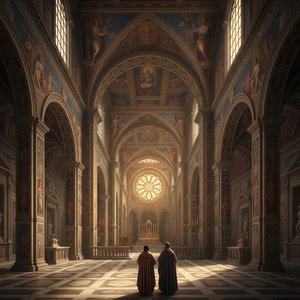
Perhaps the most enduring legacy of this masterpiece is Masaccio’s pioneering use of linear perspective. By employing a single vanishing point, he created an architectural illusion so convincing that contemporary viewers felt they were looking into a real, deep chapel rather than at a painted surface. The coffered barrel vault above the figures recedes with mathematical precision, guiding the eye upward and inward. This technical triumph was not merely a display of skill; it served a profound symbolic purpose. By placing the holy figures within a believable, structured environment, Masaccio bridged the gap between the earthly and the divine, suggesting that the sacred exists within the very geometry of our world.
This sense of depth is further enhanced by his sophisticated use of chiaroscuro. The subtle interplay of light and shadow—the way light seems to strike the figures from a consistent source—gives them a sculptural quality. This technique breathes life into the flesh, defining the musculature of Christ and the gentle contours of Mary’s face. For the modern collector or interior designer, this mastery of volume offers a sense of structural elegance and intellectual depth, making it a piece that commands attention through its quiet, commanding presence.
A Timeless Legacy for the Discerning Collector
Beyond the technical brilliance, the Holy Trinity remains an emotional powerhouse. It captures the tension between human mortality and eternal hope. At the base of the composition, the inclusion of the donors—the mortal figures who commissioned the work—serves as a poignant reminder of our own place in the grand tapestry of history. They stand at the threshold, looking up toward the divine, mirroring the journey of every viewer who encounters this fresco.
For those seeking to adorn a space with art that inspires contemplation and awe, a high-quality reproduction of this Masaccio masterpiece offers more than mere decoration. It brings into a home or gallery a piece of the very foundation of Western art. Whether placed in a study filled with books or as a focal point in a grand living space, the Holy Trinity provides an atmosphere of profound stability, historical richness, and enduring beauty. It is an invitation to pause, to look deeper, and to rediscover the breathtaking realism that first ignited the Renaissance.
In welk museum bevindt Trinity zich?
Santa Maria Novella
Florence, Italië
Het Gebouw en de Architectuur De basiliek wordt beschouwd als de belangrijkste Romano-Gotische kerk in Toscane. De structuur weerspiegelt een lange periode van ontwikkeling, waarbij het onderste deel van de Romano-Gotische gevel in 1350 werd gestart en pas in 1920 definitief werd voltooid. De gevel zelf presenteert een kenmerkend uiterlijk door geometrische patronen van wit en groen marmer.


Hoogwaardige afbeeldingen van Trinity

Publiek domein: de kunstenaar is overleden in 1428.
Andere formaten, uitsneden en citatie →Masaccio, Trinity (1425), Santa Maria Novella. Publiek domein
Vragen over Trinity, beantwoord
In welk museum is het originele werk "Trinity" te zien?
Het originele werk "Trinity" is te bewonderen in Santa Maria Novella, Florence, Italië.
Met welke techniek is "Trinity" door Masaccio vervaardigd?
Wat zijn de afmetingen van het originele "Trinity"?
"Trinity" heeft in zijn originele vorm de afmetingen 640 x 317 cm. De originele afmetingen dienen als een handig referentiepunt bij het kiezen van de juiste afmeting voor een reproductie.
Wat stelt "Trinity" voor?
Is de afbeelding van "Trinity" door Masaccio vrij van auteursrecht?
Bij welke kunststroming behoort "Trinity" door Masaccio?
Over de kunstenaar, Masaccio

1401–1428, Italië
Masaccio
Masaccio (1401-1428): De Ontstaan van Renaissance Realisme Tommaso di Ser Giovanni di Simone, beter bekend als Masaccio (betekend "sloddervos"), was een baanbrekende figuur in de Vroege Italiaanse Renaissance. Geboren op 21 december 1401, in San Giovanni Valdarno, Italië, en sterven tragisch jong in 1428, zijn korte carrière revolutioneerde schilderkunst met baanbrekende realisme, perspectief en chiaroscuro (het gebruik van sterke lichtschaduwcontrasten). Ondanks zijn korte leven had Masaccio een diepgaande invloed op latere generaties kunstenaars, waardoor hij een nieuwe standaard vestigde voor naturalisme en de looplijn van Westerse kunst beïnvloedde. Vroege Levensloop en Opleiding Oorsprong: Geboren uit Giovanni di Simone Cassai, een notaris, en Jacopa di Martinozzo.
Ook van Masaccio
 De Heilige Drie-eenheid1428
 Het Belastinggeld1425
 De verdrijving uit het paradijs1426
 Rendering van het Tribute Money (detail)
Essays over Trinity
 Understanding Gothic and Renaissance Art: Key Differences and FeaturesMaster the differences between Gothic and Renaissance art through expert analysis of technique and style. Discover the evolution of art tod…
 25 Masterpieces by Duccio di Buoninsegna: The Dawn of Sienese ArtJourney through the Sienese School with our curated guide to Duccio di Buoninsegna’s top 25 masterpieces. From the Maesta to iconic Madonna…
 Mastering Depth: The Architectural Power of Linear Perspective in Renaissance MasterpiecesExplore the profound impact of linear perspective on Renaissance art. Discover how masters like Brunelleschi and Uccello used mathematical …