

 Voorvertoning
 Verstuur
 Delen
Delen
 Details bekijken
 Gids
Gids

 Download
 Vergelijkbare items
 Röntgenonderzoek
 Diavoorstelling
 Statistieken
The student


 Lees meer
De kunstwerken die op deze pagina worden weergegeven, zijn beschermd door de auteursrechtwetgeving, wat betekent dat het ons wettelijk niet is toegestaan om identieke reproducties te maken of te verkopen. Deze bescherming wordt gehandhaafd onder internationale overeenkomsten zoals de Conventie van Bern en door nationale wetgeving, waaronder de bepalingen van de Amerikaanse auteurswet - Titel 17. Alle rechten voorbehouden. Reproduceren of distribueren van afbeeldingen is niet toegestaan zonder uitdrukkelijke schriftelijke toestemming van WahooArt.com en de rechthebbenden.
Deze methode voldoet volledig aan de auteursrechtwetgeving, omdat het niet gaat om het kopiëren of dupliceren van het beschermde kunstwerk. In plaats daarvan is er sprake van een creatieve herinterpretatie — een nieuw schilderij dat door het origineel wordt geïnspireerd, maar er niet identiek aan is.
Giclée / Kunstafdrukken
Giclée- of canvasafdruk van museumkwaliteit met een snelle productie en flexibele afwerkingsmogelijkheden. ( Bestel handgeschilderde reproductie Schakel over naar digitale afbeeldingen)




P118B €10

P118H €10

P118W €10

P438Z €10

P508JH €12

P508YH €12

P805H €10

P805Z €10

P919BZ €10

P919G €10

P919XJ €10

P959ZH €10

P968JZ €12

W106C €8

W218G €10

W218JH €8

W218Y €10

W307PJ €10

W316G €10

W316PJ €8

W316Y €10

W398PJ €8

W4111J €10

W500HY €15

W500JH €15

W692G €12

W849H €8

W940BG €15

W953PJ €8




Kies uit onze vooraf ingestelde maten die overeenkomen met de originele verhoudingen van het kunstwerk.

Voer de gewenste breedte en hoogte in, passend bij uw lijst of muur. Een afdruk kan alleen worden ingekort en nooit groter worden gemaakt dan het origineel; een formaat met andere verhoudingen zal daarom een deel van de afbeelding verliezen. Wij sturen u een digitaal mockup ter goedkeuring voordat we tot drukwerk overgaan. De afbeelding op deze pagina toont niet de werkelijke uitsnede — dit is alleen te zien op het mockup.
Wereldwijde levering () binnen 2 weken in plaats van de standaard 4/5 weken. (26 oktober)

Gratis wereldwijde expressverzending

Hoogwaardig linnen canvas

Volledige verzendverzekering

Garantie op terugbetaling van invoerrechten

Garantie op exacte kleurweergave

Retourbeleid van 100 dagen (alleen bij defecten)

100% Geld-terug-garantie

Korting bij meerdere afnames
 De optie voor glas is alleen beschikbaar bij een formaat kleiner dan 110 cm.

The student
Giclée / Kunstafdrukken
Afmetingen reproductie
-


Eindtotaal
€ 71
A Quiet Introspection: The Soul of Mario Sironi’s The Student
In the quiet corners of art history, certain works possess the power to halt time, inviting the viewer into a sanctuary of thought and stillness. The Student, a masterful creation by the Italian maestro Mario Sironi, is one such masterpiece. This evocative portrait captures a woman lost in a moment of profound introspection, seated at a table that serves as an altar to intellect and solitude. Clad in somber black attire, her dark hair framing a face of contemplative depth, she sits before a mirror—a classic symbol of self-reflection and the duality of identity. The scene is not merely a depiction of a person, but an invitation into a private, cerebral world where the boundaries between the physical room and the internal mind begin to blur.
The composition is rich with an atmosphere of scholarly elegance. Surrounding the central figure is a curated landscape of artistic and intellectual artifacts: statues that stand like silent sentin Riens, vases that anchor the space with classical grace, and a single book resting near her hand, suggesting a life dedicated to the pursuit of knowledge. The presence of these objects transforms the setting from a simple room into an atelier of the soul. For the discerning collector or interior designer, this painting offers more than just visual beauty; it provides a focal point of sophisticated gravity, making it an ideal centerpiece for spaces dedicated to study, libraries, or refined living areas where conversation and thought are encouraged.
Technique and the Luminosity of Divisionism
To understand the emotional weight of The Student, one must look closely at Sironi’s early mastery of Divisionism. Before his later shifts toward more monumental and architectural styles, Sironi utilized this technique to breathe life into his subjects through a delicate interplay of light. Rather than blending colors on the palette, he applied small, distinct strokes of pigment that, when viewed from a distance, coalesce in the eye of the beholder to create a shimmering, luminous effect. This method allows the shadows in the woman's black clothing to feel deep and velvety, while simultaneously capturing the subtle glints of light reflecting off the porcelain vases and the smooth surfaces of the surrounding sculptures.
This meticulous approach to color and light creates a sense of vibrating stillness. The technique lends a dreamlike quality to the scene, where the air itself feels heavy with the scent of old paper and the quiet dust of a sunlit studio. For those seeking a high-quality reproduction, this complexity of texture is what makes a hand-painted version so captivating; the physical layering of paint recreates the rhythmic energy of Sironi’s brushwork, ensuring that the light seems to dance across the canvas just as it does in the original work.
A Legacy of Intellectual Elegance
Mario Sironi’s journey from a student of engineering to a titan of modern Italian art is reflected in the structural integrity of this piece. There is an architectural precision to how he places the statues and objects within the frame, creating a balanced, harmonious environment that feels both grounded and ethereal. The Student serves as a bridge between the classical traditions of his heritage and the burgeoning modernism of the early 20th century. It captures a moment of transition—much like the subject herself—between the external world of objects and the internal world of ideas.
Integrating a reproduction of this caliber into a contemporary interior allows for a profound connection to the history of European modernism. It is a piece that speaks to the timelessness of human curiosity and the beauty found in solitude. Whether placed in a sun-drenched gallery or a moody, dark-toned study, The Student brings with it an aura of prestige and a deep, resonant emotional intelligence that continues to inspire art lovers and decorators across the globe.
Veelgestelde vragen
Zijn de kleuren van "The student" door Mario Sironi levendig of gedempt?
De kleuren van "The student" door Mario Sironi vertonen een Muted verzadiging met een Monochromatic intensiteit.
Hoe kan ik de afbeelding van "The student" door Mario Sironi downloaden?
Er is een download beschikbaar voor "The student": de Downloaden pagina van het kunstwerk biedt de mogelijkheid om een digitale afbeelding in hoge resolutie om te downloaden.
Welk onderwerp en welke sfeer combineert "The student" door Mario Sironi?
"The student" toont woman, black clothing, mirror, statues, vases, book, table en de vastgelegde stemming is Classic.
Biografie kunstenaar
Mario Sironi: Een Leven in Moderne Italiaanse Kunst
Mario Sironi (1885-1961) was een Italiaanse kunstenaar die actief was als schilder, beeldhouwer, illustrator en ontwerper. Zijn werk wordt gekenmerkt door een sombere stijl waarin enorme vormen en geometrische vormen domineren. Hij staat bekend om zijn bijdrage aan het Novecento Italiano beweging en zijn persoonlijke ontwikkeling als kunstenaar.Oudheid en Onderwijs
Sironi werd geboren op 12 mei 1885 in Sassari, Sardinië. Zijn vader was een ingenieur en zijn maternaanse grootvader Ignazio Villa een gerespecteerde architect en beeldhouwer – wat vroeg artistieke stimulans bood. Hij begon aanvankelijk zijn studie aan de Universiteit van Rome maar liet deze achter zich in 1903 na een psychose. Dit betekende een keerpunt naar kunst. Hij begon zijn formele kunstopleiding aan de Scuola Libera del Nudo van de Accademia di Belle Arti di Roma, waar hij zijn eerste belangrijke leraren ontmoette, Giacomo Balla en Gino Severini. Deze leerlingen hadden een grote invloed op zijn stijl en wereldbeeld.Artistieke Ontwikkeling en Invloeden
Zijn vroeg werk werd sterk beïnvloed door Divisionisme, een techniek waarbij kleuren worden gescheiden om lichtheid te creëren – zoals blijkt uit werken als “De Student”. Hij verkende kortstondig Futurisme rond 1914 en exposeerde bij de Galleria Sprovieri in Rome. Ondanks het feit dat hij zich niet volledig identificeerde met de beweging, waren zijn schilderijen van deze periode vaak gericht op moderne stadslleven en gebruikten hij geometrische vormen om emotie en gevoelens weer te geven. Een belangrijke verschuiving vond plaats na WOI, waarbij hij een stijl ontwikkelde gekenmerkt door enorme, immobiele vormen en geometrische vormen. Deze werd beïnvloed door zijn oorlogservaringen en een groeiend gevoel van isolatie. Hij stond onder invloed van Giacomo Balla (eerste opleiding), Giorgio de Chirico & Carlo Carrà (invloed van metafysische schilderkunst op vorm) en elementen van Neoclassicisme en Primitivist Classicisme. Deze kunstenaars waren belangrijke inspiraties voor zijn persoonlijke stijl en artistieke visie.Het Novecento Italiano en Volwassen Stijl
In 1922 werd Sironi een medeoprichter van het Novecento Italiano beweging – een terugkeer naar orde in Europese kunst na de oorlog, waarbij duidelijkheid en traditie centraal staan. Hij ontwikkelde een stijl die zich onderscheidt door zijn eenvoudige vormen en zijn aandacht voor kleurgebruik. Zijn werk verkondigde een gevoel van melancholie en introspectie, waardoor het een belangrijke bijdrage leverde aan de Italiaanse kunstgeschiedenis. Een aantal bekende werken uit deze periode zijn “Venere” (1921-1923) en “Solitudine” (“Eenzaamheid,” 1925). Deze schilderijen staan bekend om hun grootte en hun emotionele kracht, waardoor ze een blijvende plaats hebben gevonden in de kunstgeschiedenis. Zijn stijl werd gekenmerkt door een combinatie van geometrische vormen en natuurlijke kleuren, wat een unieke visuele ervaring creëerde voor het publiek.Politieke Affilaties en Laatste Leven
Sironi was een sympathisant van Benito Mussolini en werkte als kunstenaar en illustrator voor de Fascistische staat. Hij zag kunst als een manier om de ideale wereld vorm te geven en hij wilde bijdragen aan het creëren van monumentale werken die het nationale bewustzijn aanspraken. Zijn werk werd bekritiseerd door sommige kunstcritici vanwege zijn politieke achtergrond, maar hij bleef actief als kunstenaar tot aan zijn dood in 1961. Hij stond bekend om zijn persoonlijke stijl en zijn betrokkenheid bij de Italiaanse kunstscene. Een belangrijke bijdrage aan zijn artistieke nalatenschap is zijn werk tijdens WOII, waarin hij een belangrijke rol speelde bij het vormgeven van de kunstgeschiedenis van het tijdperk. Zijn stijl werd gekenmerkt door een combinatie van eenvoudige vormen en emotionele expressie, waardoor hij een blijvende plaats heeft gevonden in de kunstgeschiedenis. Hij stierf vredig op 13 augustus 1961 in Milaan.
Mario Sironi
1885 - 1961 , Italië
Belangrijkste feiten
- Artistic Movement Or Style: Novecento Italiano; Futurisme
- Artists Or Movements Influenced By This Artist: ['Giorgio de Chirico']
- Artists Who Influenced This Artist: ['Giacomo Balla']
- Date Of Birth: 1885-05-12
- Date Of Death: 1961-08-13
- Full Name: Mario Sironi
- Nationality: Italiaans
- Notable Artworks:
- Venere
- Solitudine
- Place Of Birth: Sassari, Italië
Gerelateerde artikelen
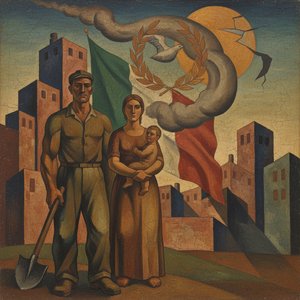
Mario Sironi: A Poetic of Modern Italian Identity Through Symbolism & Social Commentary
Explore the profound works of Mario Sironi, a key figure in Italian Modernism. Discover his evolution from Futurism to Metaphysical painting and his powerful social commentary. Learn about his legacy at OriginalUniqueArt.
Reflections of Reality: Exploring the Metaphysical Power of Mirror Images in Fine Art
Explore the profound symbolism of mirror images in fine art. From Surrealist distortions to classical self-portraits, discover how masters use reflections to explore reality, identity, and the infinite through a sophisticated art-historical lens.
Reflections of Reality: The Metaphysical Power of Mirrors in Fine Art History
Explore the profound symbolism of mirrors in fine art history. From Surrealist distortions to Vanitas themes, discover how masters use reflections to capture reality and the metaphysical soul.
The Mirror Stage of Art History: Exploring Reflection & Identity in Painting
Explore the captivating history of reflection in art! Discover symbolism, technique & psychological depth in masterpieces from Renaissance self-portraits to modern works. Expert insights for discerning collectors.

Mirroring the Soul: A Curated Exploration of Reflection and Self-Perception in Art History
Embark on a sophisticated journey through art history's most captivating masterpieces of reflection. Explore how legendary artists used mirrors to explore identity, surrealism, and the soul through expert art historical analysis.
