- Home

- Reproductie van olieverfschilderij
- Marc Chagall
- Moses receiving the Tablets of Law (9)

 Print kopen Koop afbeelding in hoge resolutie
 Verstuur
 Delen
Delen
 Details bekijken
 Toevoegen aan favorieten

 Download
 Vergelijkbare werken
 Röntgenonderzoek
 Diavoorstelling
Moses receiving the Tablets of Law (9)
 Acryl op canvas
- Wandkunst
- Naïve Art (Primitivism)
 1963
1963- Modern
 46.0 x 38.0 cm
 Lees meer
Handgemaakte olieverfreproductie
Met de hand geschilderd in olieverf op canvas in uw gewenste maat en lijst, op bestelling gemaakt door onze kunstenaars.




P118B $10

P118H $10

P118W $10

P438Z $10

P508JH $12

P508YH $12

P805H $10

P805Z $10

P919BZ $10

P919G $10

P919XJ $10

P959ZH $10

P968JZ $12

W106C $8

W218G $10

W218JH $8

W218Y $10

W307PJ $10

W316G $10

W316PJ $8

W316Y $10

W398PJ $8

W4111J $10

W500HY $15

W500JH $15

W692G $12

W849H $8

W940BG $15

W953PJ $8




Kies uit onze vooraf ingestelde maten die overeenkomen met de originele verhoudingen van het kunstwerk.

U kunt uw eigen afmetingen invoeren om in een specifieke lijst of ruimte te passen. Als de door u gekozen maat niet overeenkomt met de verhoudingen van het originele beeld, zullen we het kunstwerk bijsnijden of het schilderij uitbreiden met extra handgeschilderde elementen. Een digitale mockup wordt ter goedkeuring naar u verzonden voordat de productie begint.
Houd er rekening mee dat de preview op het scherm niet de werkelijke uitsnede of uitbreiding weergeeft. Alleen de mockup toont de uiteindelijke compositie nauwkeurig.
Hoewel aangepaste afmetingen mogelijk zijn, raden we aan een maat uit de vooraf gedefinieerde lijst te selecteren om de originele verhoudingen te behouden.
Na de bestelling zal het team van OriginalUniqueArt.com per e-mail contact opnemen voor instructies en een mockup-voorbeeld sturen.
Wereldwijde levering () binnen 3/4 weken in plaats van de standaard 5 weken. (16 juli). Geen concessies aan de kwaliteit.

Gratis wereldwijde expressverzending

Hoogwaardig linnen canvas

Volledige verzendverzekering

Garantie op terugbetaling van invoerrechten

Garantie op exacte kleurweergave

60 dagen retourbeleid (alleen bij defecten)

100% Geld-terug-garantie

Korting bij meerdere afnames
 De optie voor glas is alleen beschikbaar bij een formaat kleiner dan 110 cm.

Moses receiving the Tablets of Law (9)
Techniek reproductie
Afmetingen reproductie
-


Eindtotaal
-
Beschrijving kunstwerk
Marc Chagall en de Verering van Mozes: Een Symfonie van Kleur en Droom
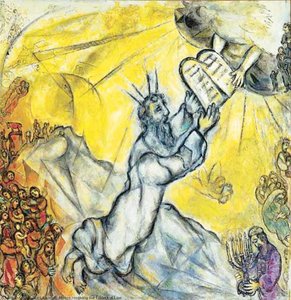
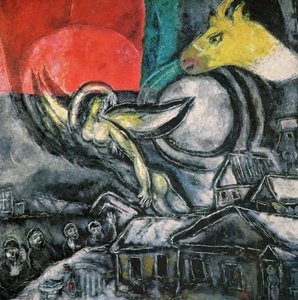
Marc Chagall (1887-1985) was een kunstenaar wiens leven en werk synoniemen werden met kleur, dromen en een onwrikbare band met zijn roots. Deze Russische en Franse kunstenaar, geboren Moishe Shagal in Liozna, Belarus, creëerde een universum waarin de realiteit en het fantasie elkaar vermengden tot een unieke visuele taal. Zijn ‘Moses Receiving the Tablets of Law’ (9), geschilderd in 1963, is meer dan een afbeelding; het is een emotionele reis terug naar de kern van geloof, traditie en menselijke verbeelding. Het werk ademt de essentie van Chagall's artistieke visie: een waarachtig naïeve kunst, doordrenkt met symboliek en een diep respect voor zowel de Joodse folklore als de klassieke religieuze thema’s. De compositie van het schilderij is opvallend. Moses, centraal geplaatst, staat niet als een machtige koning of profeet, maar als een mens – kwetsbaar, open en ontvankelijk voor de goddelijke boodschap. Om hem heen danst een menigte figuren, elk met hun eigen expressie, waardoor het moment van ontvangst van de tafelen van de Wet wordt omgetoverd tot een levendige scène vol emotie en spiritualiteit. De kleuren – helderblauw, goud, geel en rood – zijn niet louter decoratief; ze dragen een diepere betekenis. Het blauw symboliseert de hemel, het goud de goddelijke verlichting, het geel de hoop en het rood de kracht van de wet. Chagall’s benadering van de naïeve kunst is bijzonder intrigerend. Hij omarmde een eenvoudige stijl, waarbij hij vaak platte perspectieven, vervormde figuren en fantastische landschappen gebruikte. Dit was echter geen simplistische benadering; het was een bewuste keuze die hem in staat stelde om de emotionele impact van het verhaal te versterken. De ‘naïviteit’ van het schilderij – de afwezigheid van technische perfectie – creëert een gevoel van onschuld en puurheid, waardoor de kijker direct verbonden wordt met de kern van de boodschap. Het is alsof Chagall ons meeneemt naar een droom, waar de grenzen tussen werkelijkheid en fantasie vervagen.De Symboliek van Licht en Beweging
Het schilderij zit vol met symbolische elementen die het verhaal van Mozes en de Tafelen van de Wet verdiepen. De twee vogels, één in de linker bovenhoek en een andere rechts, zijn niet zomaar decoratieve toevoegingen; ze staan symbool voor vrijheid en spirituele opstijging – essentiële thema’s in het Joodse geloof. Moses' uitgestrekte handen, die de tafelen ontvangen, vertegenwoordigen nederigheid en openheid voor de goddelijke wil. De menigte om hem heen symboliseert de gemeenschap, de collectieve ervaring van het ontvangen van een heilige boodschap. De compositie zelf is cruciaal voor het begrip van het schilderij. Chagall gebruikt een asymmetrische lay-out, waardoor het beeld dynamisch en bewegelijk aanvoelt. Het lijkt alsof de scène zich ontvouwt, alsof we getuige zijn van een moment dat nooit stilstaan kan. De figuren zijn niet rigide of statisch; ze lijken te dansen, te bewegen in harmonie met de goddelijke energie die door het schilderij vloeit.Een Erfenis van Dromerij en Inspiratie
Marc Chagall’s ‘Moses Receiving the Tablets of Law’ is een bewijs van zijn unieke visie en zijn vermogen om complexe thema's te vertalen naar een krachtige, emotionele kunstwerk. Zijn werk heeft een blijvende impact gehad op de kunstwereld, en hij wordt beschouwd als een van de belangrijkste figuren in de naïeve kunstbeweging. De schildering is meer dan alleen een reproductie; het is een portaal naar een wereld van dromen, symboliek en spirituele reflectie. De precieze afmetingen van dit werk – 46 x 38 cm – maken het een toegankelijke toevoeging aan elke collectie, of het nu een klein kunstwerk in een intieme setting is, of een statement piece in een grotere ruimte. De heldere kleuren en de levendige compositie zorgen ervoor dat het schilderij altijd een bron van inspiratie zal zijn.Overweeg deze Reproduktie voor uw Interieur
Deze handgeschilderde reproductie biedt u de mogelijkheid om de schoonheid en de kracht van Chagall’s ‘Moses Receiving the Tablets of Law’ in huis te brengen. Het is een uniek kunstwerk dat uw interieur zal verrijken met zijn symbolische betekenis en zijn onmiskenbare emotionele impact. Laat u meevoeren op deze reis naar een wereld van dromen en geloof – een wereld die Marc Chagall zo magistraal heeft vastgelegd in dit iconische schilderij. Photo Description: The painting is a colorful depiction of Moses receiving the tablets from God. The scene features several people in various positions, including one person holding a book above their head. There are also two birds visible in the painting, with one located near the top left corner and another towards the center-right area. The main focus is on Moses, who appears to be standing in front of a crowd of people. He is holding his hands up as if he's receiving the tablets from God. The image captures the essence of faith and spirituality through its vibrant colors and detailed composition. Size: 46 x 38 cm Date: 1963 ARTIST INFORMATION: ================== Artist: Marc Chagall Birth Year: 1887 Death Year: 1985 Birth City: Vitebsk, Belarus Death City: Saint Paul de Vence, France movement: Naïve Art (Primitivism), Cubism, Surrealism, Expressionism style: Vibrant Colors, Symbolic Composition, Dreamlike ImageryBiografie van de kunstenaar
A Life Painted in Dreams: The World of Marc Chagall
Marc Chagall, born Moishe Shagal in 1887 in the small Belarussian town of Liozna near Vitebsk, wasn’t merely a painter; he was a poet of color, a weaver of dreams, and a chronicler of memory. His life, spanning nearly a century, mirrored the tumultuous currents of the twentieth century, yet his art remained steadfastly rooted in a deeply personal vision—one infused with the folklore of his Hasidic Jewish upbringing and an unwavering belief in the power of imagination. Vitebsk itself was more than just a birthplace; it became the emotional core of his artistic universe, a recurring motif populated by flying figures, whimsical animals, and the vibrant hues of remembered landscapes. The town’s unique blend of cultures—Russian Orthodox churches alongside bustling Jewish marketplaces—forged an aesthetic sensibility that would defy easy categorization throughout his long career. Though he sought formal training first with a local sign painter and later in St. Petersburg under Léon Bakst, and then in Paris at the Académie de la Grande Chaumière, Chagall never fully embraced any single artistic movement. He absorbed elements of Cubism, Symbolism, and Fauvism, but always filtered them through his own intensely personal lens, creating a style that was uniquely, unmistakably Chagall.Early Influences and Artistic Beginnings
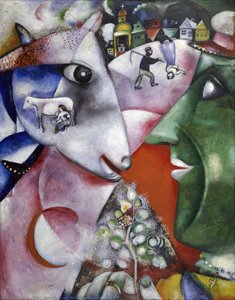
Chagall’s formative years were marked by the traditions of Vitebsk’s Jewish community—a vibrant tapestry woven with religious rituals, folk tales, and ancestral memories. These influences would permeate his artistic vision throughout his life, informing his use of symbolism and his fascination with biblical narratives. His initial training was modest, focusing on practical skills as a sign painter – a craft that instilled in him an appreciation for visual communication and meticulous attention to detail. However, he quickly recognized the limitations of realism and sought inspiration in the expressive techniques championed by Impressionists like Léon Bakst, whose theatrical productions captivated him with their bold colors and dynamic compositions. This exposure to avant-garde aesthetics broadened his artistic horizons and propelled him toward experimentation with new forms of expression. His early canvases—such as I and the Village (1911)—already demonstrated his ability to distill complex emotions into simplified visual language, prioritizing feeling over precise representation. The village isn’t rendered realistically but as a fragmented collection of recollections, imbued with symbolic meaning – a technique that would become central to his distinctive style.The Symbolism of Flight and Memory
Chagall's artistic breakthrough arrived in the wake of World War I, during which he served briefly in the Russian army. This experience instilled in him a profound awareness of human suffering and loss—themes that would recur throughout his oeuvre. His paintings from this period are characterized by an ethereal quality, achieved through masterful use of color and perspective. Figures float effortlessly against backgrounds of luminous hues, defying gravity and logic – a deliberate departure from traditional artistic conventions. This fascination with flight symbolizes liberation from earthly constraints and represents Chagall’s yearning for transcendence—a recurring motif that appears in numerous works throughout his career. Equally important is his preoccupation with memory—the way in which past experiences shape our perceptions of the present. Landscapes are often depicted as dreamlike visions, blending elements of reality with fantastical imagery – reflecting Chagall's belief that art can capture the elusive essence of human experience.Exploring Formal Movements and Personal Vision
Despite rejecting rigid artistic doctrines, Chagall remained attuned to developments in European modernism. He experimented with Cubist techniques—particularly in his early portraits—to dissect forms and explore multiple viewpoints simultaneously. However, he quickly abandoned this approach in favor of a more expressive style that prioritized emotional impact over intellectual rigor. His embrace of Fauvist color palettes – bold splashes of pigment divorced from naturalistic representation – further solidified his artistic identity. Yet, Chagall’s true genius lay in his ability to synthesize these influences into a wholly original vision—one rooted in his Jewish heritage and informed by the spiritual traditions of Vitebsk. He sought to convey not just what he saw but what he felt—a quest for beauty and truth that permeated every aspect of his artistic practice.Later Years and Legacy
The Russian Revolution profoundly impacted Chagall’s life, returning him to Vitebsk where he established an art school dedicated to fostering creativity and cultural exchange. This period was marked by both artistic productivity and political disillusionment—a tension that would continue to shape his creative output. Following the outbreak of World War II, Chagall fled occupied France for New York City, where he found refuge amidst a thriving artistic community. During his time in America, he produced some of his most ambitious canvases – monumental works that explored themes of exile and displacement. He received numerous prestigious commissions, including the ceiling of the Paris Opera (1964), which showcased his unparalleled mastery of color and form—a testament to his enduring influence on subsequent generations of artists. Chagall’s stained glass windows for Jerusalem's Hadassah Hebrew University Medical Center synagogue stand as a poignant reminder of his commitment to Jewish faith and culture. His art continues to inspire awe and wonder, inviting viewers to contemplate the mysteries of existence and celebrating the transformative power of imagination. Marc Chagall died in 1985 at the age of 97, leaving behind an unparalleled legacy—a body of work that transcends stylistic boundaries and speaks directly to the human spirit.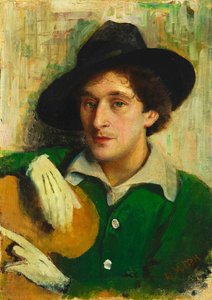
Marc Chagall
1887 - 1985 , Belarus
Belangrijkste feiten
- Artistic Movement Or Style: Modernisme, Cubisme
- Artists Or Movements Influenced By This Artist:
- Surrealisme
- Kunstenaars
- Artists Who Influenced This Artist:
- Bakst
- Delaunay
- Borovikovsky
- Date Of Birth: 6 juli 1887
- Date Of Death: 28 maart 1985
- Full Name: Marc Chagall
- Nationality: Russisch, later Frans
- Notable Artworks:
- I en het dorp
- Over Vitebsk
- Het witte kruis
- Place Of Birth: Liozna, Belarus
Gerelateerde artikelen
Sacred Narratives on Canvas: Exploring Biblical Art Across Centuries
Explore the rich history of biblical art from Giotto to the Renaissance masters. Discover symbolism, techniques & enduring legacies with OriginalUniqueArt – your source for museum-quality reproductions and expert art insights.
Illuminating Faith: Biblical Scenes & Their Enduring Legacy in Art History
Explore the profound history of biblical art! Discover Renaissance masterpieces by Giotto & more. Uncover symbolism, artistic techniques, and lasting influence. Expert insights at OriginalUniqueArt.
Alfred Wallis: Rediscovering the Naïve Visionary of Cornish Life
Discover the captivating world of Alfred Wallis, the self-taught Cornish painter championed by modernists. Explore his unique naive style, maritime scenes & lasting legacy with OriginalUniqueArt.

Jean-Marc Nattier: Rococo Portraiture & Aristocratic Patronage
Explore the exquisite Rococo portraits of Jean-Marc Nattier, favored by French aristocracy. Discover his artistic techniques, patronage network, and lasting legacy – a guide for discerning collectors.
Primitivism in Art: Exploring the Roots of Modern Expression & its Enduring Legacy
Explore the fascinating history of Primitivism in art – its origins, key artists like Gauguin & Picasso, and lasting impact on modern expression. Uncover the complexities of this influential movement with OriginalUniqueArt.