
 Voorvertoning
 Verstuur
 Delen
Delen
 Details bekijken
 Gids
Gids

 Download
 Vergelijkbare items
 Röntgenonderzoek
 Diavoorstelling
 Q&A
Q&A Statistieken
La Création de l'homme

- 43.0 x 27.0 cm


 Lees meer
Ontvang een bestand dat klaar is voor drukwerk en de kwaliteit van het online voorbeeld ver overstijgt. Elke digitale afbeelding die wij verkopen, is afkomstig van een high-resolution master uit onze database — meestal tussen de 5.000 en 15.000 pixels breed — zodat u met vertrouwen groot kunt afdrukken, nauwkeurig kunt bijsnijden of fijne details kunt reproduceren.
Geen enkel bestand verlaat ons atelier onbewerkt. Een digitaal expert controleert de kleuren aan de hand van het originele schilderij en corrigeert deze indien nodig, om vervolgens de helderheid en details te verbeteren met professionele retoucheertechnieken — waarbij de penseelstreek en stijl van de kunstenaar altijd strikt worden gerespecteerd. Het resultaat is een afbeelding die oogt als het schilderij zelf, en niet als een gescande foto met een filter.
U keurt de afbeelding goed voordat de bestelling wordt afgerond: onze expert stuurt u binnen 72 uur een e-mail ter beoordeling. Niet tevreden? Vraag om aanpassingen of correcties, of vraag een terugbetaling aan als de kwaliteit niet aan de verwachtingen voldoet.
Dit is de kwaliteit waarop uitgevers, designstudio's, galeries en drukkerijen vertrouwen.
Digitale afbeeldingen
Download een bestand met hoge resolutie voor persoonlijke weergave, afdrukken en creatieve projecten. ( Schakel over naar print Bestel handgeschilderde reproductie)
Inbegrepen bij elke bestelling van een digitale afbeelding
Professionele digitale levering, gegarandeerd
Wanneer u kiest voor OriginalUniqueArt.com, ontvangt u niet alleen een afbeelding – u krijgt een professioneel verbeterd digitaal kunstwerk, met precisie vervaardigd en voorzien van een tevredenheidsgarantie. Dit is alles wat automatisch bij uw bestelling is inbegrepen:

Snelle levering per e-mail
Uw hoogwaardige digitale afbeeldingsbestand wordt binnen 72 uur na bestelling naar u gemaild – klaar voor direct gebruik.

AI-verbeterd digitaal bestand
Uw kunstwerk wordt professioneel geoptimaliseerd met behulp van geavanceerde AI-tools en handmatige bewerkingen, waardoor maximale details, helderheid en kleurnauwkeurigheid worden gegarandeerd.

Gratis levenslange herlevering van digitale bestanden
Je bestand per ongeluk verwijderd of kwijtgeraakt? Geen zorgen – we sturen het u op elk gewenst moment gratis opnieuw toe.

Geen invoerkosten – nooit
Geniet direct van uw kunstwerk zonder invoerrechten, belastingen of verzendkosten – digitale downloads zijn altijd belastingvrij.

Garantie op kleurgetrouwheid
Met behulp van professionele hulpmiddelen en kleurbeheer zorgen wij ervoor dat uw digitale afbeelding de originele kleuren zo nauwkeurig mogelijk weergeeft.

100 dagen tevredenheidsgarantie
Mocht u niet tevreden zijn met uw digitale afbeelding, dan passen wij deze aan of storten wij 100% terug binnen 100 dagen – zonder vragen te stellen.

100% Geld-terug-garantie
Niet tevreden? Ontvang een volledige terugbetaling binnen 100 dagen na ontvangst van uw digitale bestand – zonder vragen te stellen.

Korting bij grote bestellingen
Koop 3 afbeeldingen, bespaar 10% - Koop 5, bespaar 15% - Koop 10+, bespaar 20%. Ideaal voor creatieve projecten, galerieën en bureaus.
The Creation of Man: A Journey Through Chagall’s Dreamscape
Marc Chagall’s *The Creation of Man*, painted in 1958, isn’t merely a depiction of the biblical narrative; it’s an immersive journey into the artist’s deeply personal and profoundly symbolic world. This vibrant pastel masterpiece, executed in the style of Naïve Art – a movement characterized by its directness, emotional intensity, and rejection of academic conventions – immediately captivates with its swirling colors and fantastical imagery. It's a testament to Chagall’s ability to distill complex religious themes into a powerfully emotive visual language, drawing on his Jewish heritage and lifelong fascination with folklore and dreams. The painting pulsates with life, inviting the viewer to step into a world where earthly concerns dissolve amidst a celestial dance of figures and symbols. The composition itself is remarkably dynamic. At its heart stands a winged man, an embodiment of Adam, reaching towards a radiant sun – a potent symbol of divine light and creative energy. This central figure isn’t depicted as a stoic patriarch but rather as a joyous participant in the act of creation, his posture suggesting both vulnerability and exhilaration. Surrounding him is a constellation of figures: a woman representing Eve, a scattering of birds symbolizing freedom and spirituality, musicians playing violins – an echo of Chagall’s own love for music and its ability to transcend earthly boundaries, and even a miniature representation of the artist himself, gazing out from within the scene. These aren’t simply illustrations of biblical events; they are fragments of Chagall’s memory, his emotions, and his deeply held beliefs woven together into a single, unified vision. The use of flattened perspective and simplified forms, hallmarks of Naïve Art, further enhances this sense of immediacy and emotional resonance. Chagall’s embrace of Naïve Art wasn’t simply an aesthetic choice; it was a deliberate rejection of the formal constraints of academic painting. He sought to bypass intellectual analysis and tap directly into the wellspring of intuition and emotion. This approach is evident in the painting’s bold color palette – yellows, blues, reds, and greens swirling together in a joyous, almost hallucinatory manner. These colors aren’t used realistically; instead, they are employed expressively, conveying mood and atmosphere with remarkable power. The loose brushstrokes contribute to this sense of movement and spontaneity, mirroring the feeling of a dream unfolding before the viewer’s eyes. The influence of Delaunay’s Orphism is subtly present in the use of color fields and the blurring of boundaries, adding another layer of complexity to the painting's visual language. Born in 1887 in Liozna, Belarus – a region steeped in Jewish history and folklore – Chagall’s artistic vision was profoundly shaped by his childhood experiences. Vitebsk, his birthplace, provided a rich tapestry of cultural influences: the vibrant marketplace, the imposing churches, and the close-knit community of Jews and Christians coexisting alongside one another. This environment fueled his imagination and informed his distinctive style, which often drew upon Jewish mythology, biblical stories, and personal memories. *The Creation of Man* is therefore not just a representation of Genesis; it’s a deeply rooted expression of Chagall’s own cultural identity and spiritual journey. His association with Expressionism, Cubism, and Surrealism further demonstrates his willingness to experiment with new forms and techniques while retaining his unique artistic voice. ## Symbolic Layers: Unpacking the Visual Language The painting is rich in symbolism, inviting multiple interpretations. The winged man represents not just Adam but also humanity’s aspiration towards transcendence – a yearning for connection with the divine. The sun, as a source of light and life, symbolizes God's creative power. The birds, often associated with freedom and spirituality, suggest the possibility of spiritual liberation through faith. The musical instruments represent the harmony between earthly existence and the realm of the divine. Even the inclusion of Chagall himself within the scene underscores the artist’s role as both creator and observer, inviting us to contemplate our own place in the grand scheme of things. The use of a circular composition further reinforces this sense of unity and interconnectedness, suggesting that all elements are part of a single, harmonious whole. ## A Legacy of Emotion: Chagall's Enduring Influence Marc Chagall’s *The Creation of Man* stands as a powerful testament to the enduring power of art to evoke emotion, stimulate imagination, and explore profound spiritual themes. His distinctive style – characterized by its simplicity, directness, and vibrant color palette – continues to inspire artists today. His work transcends stylistic boundaries, blending elements of Naïve Art with influences from Expressionism, Cubism, and Surrealism. Chagall’s legacy extends far beyond the canvas; his art has touched countless lives and remains a source of wonder and inspiration for generations to come. His exploration of Jewish identity, folklore, and religious themes offers a unique perspective on universal human experiences. ## Experience the Magic: Reproductions Available OriginalUniqueArt is proud to offer meticulously crafted hand-painted reproductions of Marc Chagall’s *The Creation of Man*. Each reproduction captures the painting's vibrant colors, dynamic composition, and emotional intensity with exceptional detail and fidelity. Available in a range of sizes and mediums – from luxurious oil on canvas to high-quality giclee prints – these reproductions provide an accessible way to bring this masterpiece into your home or office. View the 5” reproduction here, or explore our other sizes and options at [OriginalUniqueArt Website Link]. Let Chagall’s *The Creation of Man* illuminate your space with its timeless beauty and profound symbolism.
Veelgestelde vragen
Uit welke fase van de carrière van Marc Chagall is "La Création de l'homme"?
"La Création de l'homme" behoort tot de Mature Period in de carrière van Marc Chagall. Deze classificatie plaatst het werk in de context van de ontwikkeling van de kunstenaar.
Wat is de techniek en de afmeting van "La Création de l'homme"?
"La Création de l'homme" is vervaardigd in Olieverf en heeft in zijn originele vorm de afmetingen 43 x 27 cm.
Onder welke andere namen is Marc Chagall bekend?
Andere namen waaronder Marc Chagall, maker van "La Création de l'homme", bekend is, zijn onder andere Movsja Zacharovitsj Sjagal, Mark Zakharovich Shagal.
Kunstenaarsbiografie
A Life Painted in Dreams: The World of Marc Chagall
Marc Chagall, born Moishe Shagal in 1887 in the small Belarussian town of Liozna near Vitebsk, wasn’t merely a painter; he was a poet of color, a weaver of dreams, and a chronicler of memory. His life, spanning nearly a century, mirrored the tumultuous currents of the twentieth century, yet his art remained steadfastly rooted in a deeply personal vision—one infused with the folklore of his Hasidic Jewish upbringing and an unwavering belief in the power of imagination. Vitebsk itself was more than just a birthplace; it became the emotional core of his artistic universe, a recurring motif populated by flying figures, whimsical animals, and the vibrant hues of remembered landscapes. The town’s unique blend of cultures—Russian Orthodox churches alongside bustling Jewish marketplaces—forged an aesthetic sensibility that would defy easy categorization throughout his long career. Though he sought formal training first with a local sign painter and later in St. Petersburg under Léon Bakst, and then in Paris at the Académie de la Grande Chaumière, Chagall never fully embraced any single artistic movement. He absorbed elements of Cubism, Symbolism, and Fauvism, but always filtered them through his own intensely personal lens, creating a style that was uniquely, unmistakably Chagall.Early Influences and Artistic Beginnings
Chagall’s formative years were marked by the traditions of Vitebsk’s Jewish community—a vibrant tapestry woven with religious rituals, folk tales, and ancestral memories. These influences would permeate his artistic vision throughout his life, informing his use of symbolism and his fascination with biblical narratives. His initial training was modest, focusing on practical skills as a sign painter – a craft that instilled in him an appreciation for visual communication and meticulous attention to detail. However, he quickly recognized the limitations of realism and sought inspiration in the expressive techniques championed by Impressionists like Léon Bakst, whose theatrical productions captivated him with their bold colors and dynamic compositions. This exposure to avant-garde aesthetics broadened his artistic horizons and propelled him toward experimentation with new forms of expression. His early canvases—such as I and the Village (1911)—already demonstrated his ability to distill complex emotions into simplified visual language, prioritizing feeling over precise representation. The village isn’t rendered realistically but as a fragmented collection of recollections, imbued with symbolic meaning – a technique that would become central to his distinctive style.The Symbolism of Flight and Memory
Chagall's artistic breakthrough arrived in the wake of World War I, during which he served briefly in the Russian army. This experience instilled in him a profound awareness of human suffering and loss—themes that would recur throughout his oeuvre. His paintings from this period are characterized by an ethereal quality, achieved through masterful use of color and perspective. Figures float effortlessly against backgrounds of luminous hues, defying gravity and logic – a deliberate departure from traditional artistic conventions. This fascination with flight symbolizes liberation from earthly constraints and represents Chagall’s yearning for transcendence—a recurring motif that appears in numerous works throughout his career. Equally important is his preoccupation with memory—the way in which past experiences shape our perceptions of the present. Landscapes are often depicted as dreamlike visions, blending elements of reality with fantastical imagery – reflecting Chagall's belief that art can capture the elusive essence of human experience.Exploring Formal Movements and Personal Vision
Despite rejecting rigid artistic doctrines, Chagall remained attuned to developments in European modernism. He experimented with Cubist techniques—particularly in his early portraits—to dissect forms and explore multiple viewpoints simultaneously. However, he quickly abandoned this approach in favor of a more expressive style that prioritized emotional impact over intellectual rigor. His embrace of Fauvist color palettes – bold splashes of pigment divorced from naturalistic representation – further solidified his artistic identity. Yet, Chagall’s true genius lay in his ability to synthesize these influences into a wholly original vision—one rooted in his Jewish heritage and informed by the spiritual traditions of Vitebsk. He sought to convey not just what he saw but what he felt—a quest for beauty and truth that permeated every aspect of his artistic practice.Later Years and Legacy
The Russian Revolution profoundly impacted Chagall’s life, returning him to Vitebsk where he established an art school dedicated to fostering creativity and cultural exchange. This period was marked by both artistic productivity and political disillusionment—a tension that would continue to shape his creative output. Following the outbreak of World War II, Chagall fled occupied France for New York City, where he found refuge amidst a thriving artistic community. During his time in America, he produced some of his most ambitious canvases – monumental works that explored themes of exile and displacement. He received numerous prestigious commissions, including the ceiling of the Paris Opera (1964), which showcased his unparalleled mastery of color and form—a testament to his enduring influence on subsequent generations of artists. Chagall’s stained glass windows for Jerusalem's Hadassah Hebrew University Medical Center synagogue stand as a poignant reminder of his commitment to Jewish faith and culture. His art continues to inspire awe and wonder, inviting viewers to contemplate the mysteries of existence and celebrating the transformative power of imagination. Marc Chagall died in 1985 at the age of 97, leaving behind an unparalleled legacy—a body of work that transcends stylistic boundaries and speaks directly to the human spirit.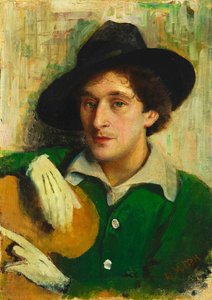
Marc Chagall
1887 - 1985 , Belarus
Belangrijkste feiten
- Artistic Movement Or Style: Modernisme, Cubisme
- Artists Or Movements Influenced By This Artist:
- Surrealisme
- Kunstenaars
- Artists Who Influenced This Artist:
- Bakst
- Delaunay
- Borovikovsky
- Date Of Birth: 6 juli 1887
- Date Of Death: 28 maart 1985
- Full Name: Marc Chagall
- Nationality: Russisch, later Frans
- Notable Artworks:
- I en het dorp
- Over Vitebsk
- Het witte kruis
- Place Of Birth: Liozna, Belarus