Surrealist Dreamscape · 1947
A rooster (Marc Chagall, 1947)
Marc Chagall (1887–1985) maakte A rooster. Het dateert uit 1947. Het behoort tot de Surrealist Dreamscape-stroming. Het is gemaakt van Tempera.
- 1947
- Tempera

 Voorvertoning

 Met de hand geschilderd olieverfwerk
 Verstuur
 Delen
 Informatieblad


 Download
 Vergelijkbare items
 Röntgenonderzoek
 Diavoorstelling
 Vraag & antwoord

 Statistieken
A rooster, in het kort
- Titel
- A rooster
- Kunstenaar
- Marc Chagall (1887–1985)
- Geboren in [jaar]
- Liozna, Wit-Rusland
- Datum
- 1947
- Medium
- Tempera
- Beweging
- Surrealist Dreamscape
- Periode
- Modern
- Onderwerp
- rooster symbolism, fantasy imagery, sphere composition, jewish folklore, dreamlike quality, color palette
Wat stelt A rooster voor?
A Visionary Dance of Color and Spirit
In the quiet, profound depths of Marc Chagall's 1947 masterpiece, "A Rooster Among Spheres," we encounter more than a mere depiction of nature; we step into a dreamscape where the boundaries between reality and the subconscious dissolve. This evocative work serves as a cornerstone of Chagall’s distinctive surrealist language, acting as a distillation of memory, folklore, and raw emotion. The painting presents a striking, deceptively simple composition: a vibrant rooster perched atop a luminous sphere, set against an enveloping dark backdrop. Yet, beneath this surface simplicity lies a complex tapestry of meaning that invites the viewer to linger within its celestial atmosphere. For the collector or the enthusiast of fine art, this piece offers a window into a universe where gravity is optional and color speaks the language of the soul.
Chagall’s technique in this work is nothing short of poetic. Utilizing tempera on canvas, he achieved a remarkable luminosity that allows the central figures to glow with an ethereal light, as if illuminated from within. His brushstrokes are bold and purposeful, characteristic of his ability to blend the structural lessons of Cubism with the raw, emotive energy of Fauvism. The contrast between the deep, shadowy background and the brilliant, saturated hues of the rooster creates a dramatic tension that commands attention in any space. This interplay of light and dark does more than provide depth; it creates a sense of cosmic theater, making the artwork an ideal focal point for sophisticated interior designs that seek to evoke mystery and intellectual depth.
Symbolism and the Surrealist Soul
To understand "A Rooster Among Spheres," one must look beyond the physical forms to the symbolic weight Chagall carries within his imagery. The sphere, a recurring motif in his oeuvre, serves as a powerful emblem of wholeness, unity, and perhaps even spiritual transcendence. By placing the rooster atop this orb, Chagall suggests a state of dominance that is simultaneously fragile and elevated. This tension reflects the artist's own life—a journey shaped by the cultural crucible of Vitebsk and the profound influence of his Hasidic Jewish heritage. The rooster itself, often a symbol of dawn and renewal in folklore, stands as a sentinel of hope amidst the darkness.
Historically, this painting emerged from a period of immense global upheaval. Created in the aftermath of World War II, the work resonates with the burgeoning Surrealist movement's desire to liberate art from the constraints of rational thought. Influenced by figures like André Breton, Chagall embraced the irrational and the dreamlike as a sanctuary from the anxieties of the era. For those looking to adorn their homes with a piece that transcends mere decoration, this artwork offers an enduring optimism. It is a testament to the resilience of the human imagination—a vibrant, floating ballet of color that promises that even in the darkest of nights, there is a light that refuses to be extinguished.
Hoogwaardige afbeeldingen van A rooster
Protected by copyright: these files are for personal reference, not a licence to republish.
Marc Chagall, A rooster (1947).
Vragen over A rooster, beantwoord
In welk jaar werd "A rooster" door Marc Chagall gemaakt?
"A rooster" door Marc Chagall werd gemaakt in 1947.
Met welke techniek is "A rooster" door Marc Chagall vervaardigd?
"A rooster" is uitgevoerd in Tempera.
Wat wordt er afgebeeld in "A rooster" door Marc Chagall?
De thema's die aanwezig zijn in "A rooster" door Marc Chagall omvatten rooster symbolism, fantasy imagery, sphere composition, jewish folklore, dreamlike quality, color palette, biblical allusion. Samen vatten zij de onderwerpen van het kunstwerk samen.
Is "A rooster" vrij van auteursrecht?
De auteursrechtelijke status van "A rooster" door Marc Chagall: het werk is nog steeds auteursrechtelijk beschermd. Dit bepaalt of reproducties van de afbeelding vrijelijk mogen worden gemaakt.
Wie is de kunstenaar achter "A rooster"?
De kunstenaar achter "A rooster" is Marc Chagall. Het werk is gecatalogiseerd onder de naam van Marc Chagall.
Tot welke stijl behoort "A rooster"?
"A rooster" is een werk uit de Surrealist Dreamscape. De stroming geeft de artistieke traditie aan waartoe het werk behoort.
Uit welke fase van de carrière van Marc Chagall is "A rooster"?
Binnen de carrière van Marc Chagall valt "A rooster" in de Mature Surrealism. Deze fase helpt om het werk te vergelijken met andere werken van de kunstenaar.
Hoe oud was Marc Chagall bij het creëren van "A rooster" in 1947?
Toen "A rooster" werd gemaakt in 1947, was Marc Chagall - geboren in 1887 - 60 jaar oud.
Behoort "A rooster" van Marc Chagall tot het publiek domein, en zo ja, waarom?
"A rooster" door Marc Chagall is nog steeds auteursrechtelijk beschermd. De auteursrechtelijke bescherming loopt vanaf het overlijden van de kunstenaar, dat plaatsvond in 1985.
Over de kunstenaar, Marc Chagall
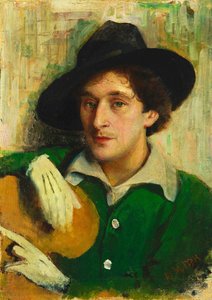
1887–1985, Wit-Rusland
Marc Chagall
Het Vroege Leven, Familie en Opleiding Marc Chagall kwam op 7 juli 1887 ter wereld in Vitebsk, in het Russische Rijk, geboren als Moishe Segal. Als eerste van negen kinderen in een bescheiden Joods gezin werd zijn leven gevormd door de ritmes van arbeid en kleinschalige handel. Zijn vader, Khatskel Segal, werkte als haringenpijper in een pakhuis, terwijl zijn moeder, Feïga-Ita Tchernina, een kleine kruidenierij runde. Deze vroege jaren zijn diep geworteld in de specifieke texturen van een provinciestad, waar de grenzen van zijn wereld werden bepaald door de behoeften van een groot huishouden en de rijke tradities van zijn gemeenschap.
Ook van Marc Chagall
 Ik en het Dorp1911
 Witte Kruisiging1938
 Het Verjaartje1915
 Over de stad1918
Essays over A rooster
 Belarusian artworks of the 1960sIconic Belarusian artworks of the 1960s, including masterpieces by Marc Chagall. Explore the full collection online at OriginalUniqueArt.co…
 Dreaming in Color: The 25 Most Iconic Masterpieces by Marc ChagallExplore 25 iconic Marc Chagall masterpieces. Discover the dreamlike stories behind his colors on OriginalUniqueArt.com.
 Belarusian artworks of the 1950s1950s Belarusian art features masterpieces by Marc Chagall, including works like The Prophet. Find museum-quality reproductions on Original…