Schakel over naar print
 Lees meer







































 Voor kunstwerken of reproducties die aan één zijde groter zijn dan 105 cm (ongeveer 41 inch), wordt de lijst als een losse set verzonden. Deze methode garandeert een veilige levering en voorkomt schade tijdens het transport.


A Gaze Through the Veil of Expressionism
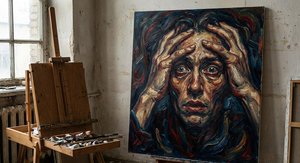
In the quiet intensity of Lovis Corinth’s "Portrait of Herbert Eulenberg," we encounter more than just a likeness; we enter a psychological landscape sculpted by light and shadow. Completed in 1918, this masterpiece serves as a profound window into the soul of a man and the turbulent era that shaped him. The subject, captured in a moment of heavy, downward contemplation, sits enveloped by a textured atmosphere that seems to vibrate with unspoken thoughts. Corinth, a master who bridged the gap between the delicate luminosity of Impressionism and the raw, visceral energy of Expressionism, utilizes his brush to create a surface where every stroke carries emotional weight. The man’s gaze, averted from the viewer, invites us not to observe him, but to feel the weight of his melancholy, making the painting an intimate encounter with the human condition.
The technique employed in this work is nothing short of transformative. Eschewing the polished, idealized surfaces of academic tradition, Corinth embraces a deliberate distortion that amplifies the subject's inner turmoil. Through the masterful application of oil on canvas, he builds layers of muted tones and bold, energetic brushwork that lend the piece an incredible tactile complexity. The interplay of light across the man’s features—the subtle highlights on his glasses and the deep, somber shadows of his suit—creates a sense of three-dimensional presence that is both grounded and ethereal. For the discerning collector or interior designer, this painting offers a sophisticated depth; its textured surface catches the light in ways that bring a dynamic, living energy to any curated space.
The Echoes of a Turbulent Era
To understand the gravity of this portrait, one must look toward the historical currents flowing through Germany during the waning years of the Weimar Republic. The painting is steeped in the anxieties and uncertainties of a society in flux. As the old world crumbled, the Expressionist movement emerged as a powerful reaction against superficiality, seeking instead to expose the raw, often painful truths of existence. Corinth’s style, which loosened significantly following a personal stroke in 1911, perfectly mirrors this societal shift toward emotional honesty and psychological depth. The portrait of Eulenberg becomes a symbol of this era—a moment of stillness caught amidst the encroaching chaos of the early 20th century.
For those seeking to adorn a home or gallery with art that inspires profound reflection, this reproduction offers an unparalleled opportunity. It is a piece that demands attention through its quietude rather than through clamor. The muted palette and somber subject matter provide a grounding element in modern decor, acting as a focal point of intellectual and emotional sophistication. Whether placed in a sunlit study or a moody, dimly lit library, the "Portrait of Herbert Eulenberg" brings with it a legacy of German Modernism, offering a timeless connection to the spirit of artistic evolution and the enduring power of the human gaze.
Veelgestelde vragen
Hoe verhoudt "Portrait of Herbert Eulenberg" zich tot de terugkerende thema's van Lovers Corinth?
"Portrait of Herbert Eulenberg" verbeeldt portraiture, german art, expressionism, male figure, literature, amsterdam museum, oil painting, terwijl de bekende thema's van Lovers Corinth symbolic expressionism, german literature, human condition, artist legacy, museum collection zijn. Een vergelijking tussen beide laat zien hoe het werk zich verhoudt tot de gebruikelijke onderwerpen van de kunstenaar.
Wie is de maker van "Portrait of Herbert Eulenberg" en bij welke stroming hoort dit werk?
Lovers Corinth creëerde "Portrait of Herbert Eulenberg" binnen de German Expressionism-stroming.
Kan ik augmented reality gebruiken om "Portrait of Herbert Eulenberg" door Lovers Corinth in mijn eigen ruimte te bekijken?
"Portrait of Herbert Eulenberg" heeft een augmented reality-preview: de AR-weergave-pagina van het kunstwerk toont het in uw eigen ruimte op een compatibel apparaat.
 Voorvertoning
 Verstuur
 Delen
Delen
 Details bekijken
 Gids
Gids

 Download
 Vergelijkbare items
 Röntgenonderzoek
 Diavoorstelling
 Q&A
Q&A Statistieken