() ·
Een schilderij speciaal voor u gemaakt, met de hand
Handgemaakte olieverfreproductie
Met de hand geschilderd in olieverf op canvas in uw gewenste maat en lijst, op bestelling gemaakt door onze kunstenaars. ( Schakel over naar print Schakel over naar digitale afbeeldingen)
Beschrijving verzamelobject
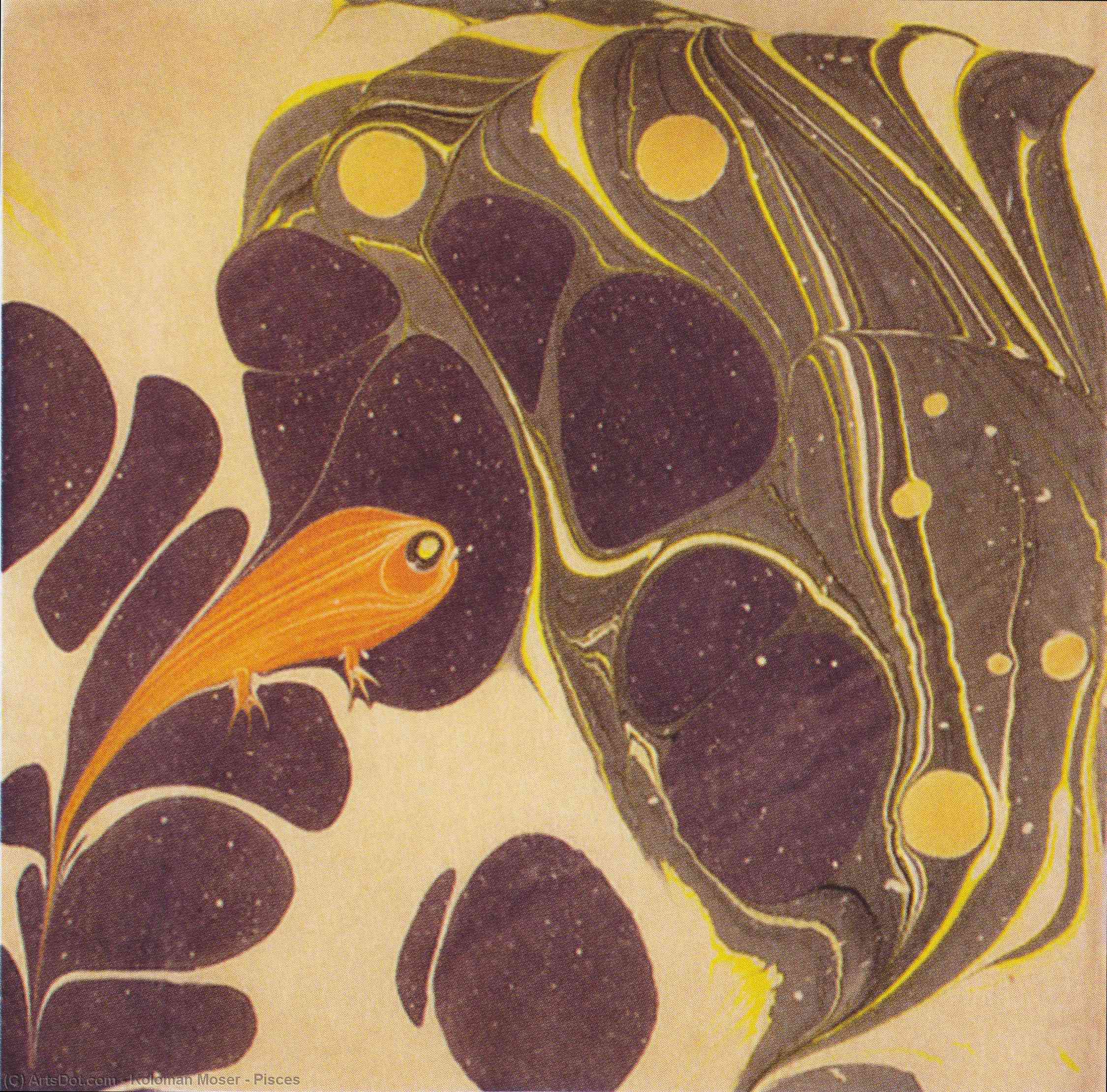
A mesmerizing Art Nouveau swirl of a golden fish emerges from deep purple depths in this 1904 masterpiece by Koloman Moser, offering a timeless way to bring Viennese Secession elegance into your private collection.
Biografie kunstenaar
Ontdek Koloman Moser (1868-1918), een sleutelfiguur van de Wiener Secession & Wiener Werkstätte. Bewonder zijn indrukwekkende grafische ontwerpen, architectuur en toegepaste kunst – van glas in lood tot meubels. Een pionier van de Oostenrijkse Art Nouveau.
 Lees meer
vanaf ·
Hoofdstuk 1
Hoe groot moet het zijn?
Schuif om de afmetingen te wijzigen; de afbeelding aan de linkerzijde toont de lijst in de werkelijke breedte. De oorspronkelijke verhoudingen blijven behouden.
Kies uit onze vooraf ingestelde maten die overeenkomen met de originele verhoudingen van het kunstwerk.

Voer de breedte en hoogte in die u nodig heeft, passend bij uw lijst of uw muur. Omdat dit handgeschilderd is, kan de kunstenaar bij een afmeting met een andere beeldverhouding iets meer rondom het schilderij schilderen of juist iets meer weglaten — u kiest zelf. Wij sturen u een digitaal mockup ter goedkeuring voordat het schilderwerk begint. De afbeelding die op deze pagina wordt getoond, is niet het uiteindelijke resultaat — alleen de mockup geeft dit weer.
Hoofdstuk 2
Hoe moet het worden geleverd?
Kies de randen van het canvas
Kies uw lijst

Wit €1

Vervagende randen €1

Doorlopende rand €1

P118B €10

P118H €10

P118W €10

P438Z €10

P508JH €12

P508YH €12

P805H €10

P805Z €10

P919BZ €10

P919G €10

P919XJ €10

P959ZH €10

P968JZ €12

W106C €8

W218G €10

W218JH €8

W218Y €10

W307PJ €10

W316G €10

W316PJ €8

W316Y €10

W398PJ €8

W4111J €10

W500HY €15

W500JH €15

W692G €12

W849H €8

W940BG €15

W953PJ €8

H24-GOLD €30

H24-SILVER €30

H36-GOLD €45

H36-SILVER €45
Ingelijst
Lijstrand: . Totale afmetingen inclusief lijst: .
Hoofdstuk 3
Wie schildert het, en moet er iets veranderen?
Na de bestelling zal het team van OriginalUniqueArt.com per e-mail contact opnemen met de klant voor instructies en een mockup-voorbeeld verstrekken
Wereldwijde levering () binnen 3 tot 4 weken in plaats van de standaard 5 weken. (9 november). Zonder concessies aan de kwaliteit.
Hoofdstuk 4
De laatste hand aan
Een naambordje, zoals in een museum?
Details van de gegraveerde bronzen plaat
This elegant plaque features the artist's name and the title of the artwork, finely engraved for a timeless presentation.
It is made from bronze with a refined, elegant finish. The text is precisely laser-engraved for a sharp and permanent result. Measuring 9x2 cm, the plaque is compact yet easy to read. It's built to be durable and scratch-resistant, offering a professional, museum-quality look. Mounting is simple thanks to the included adhesive backing.
Details transparante acrylplaat
The plaque includes essential engraved details such as the artist's name, the title of the artwork, the date it was created, the type of media used-like oil on canvas or watercolor-a brief description of the piece, and a QR code that links to the complete artwork information.
It is crafted from clear acrylic, offering a sleek, modern appearance. The text is UV-engraved in black to ensure strong visual contrast. With a size of 10x15 cm, it ensures optimal readability. It comes equipped with two metal hooks for secure wall mounting. The plaque is designed to be weather-resistant, making it suitable for various environments, and it includes interactive features that work seamlessly with smartphone scanning.
Details zwarte acrylplaat
This elegant plaque includes engraved information such as the artist's name, the title of the artwork, the date it was created, the type of media used (like oil on canvas or watercolor), a short description of the artwork, and a QR code for quick access to more information.
The plaque itself is made from refined black acrylic with a premium finish. The text is laser-engraved in white for high contrast and readability. Its size is 10x15 cm, designed to be easy to read. It comes with two metal hooks for professional mounting. The design is sleek and fits any interior style. It is also weather-resistant and durable, with built-in digital integration for mobile compatibility.
Een beschermende vernis?
Wanneer heeft u het nodig?
Hoofdstuk 5
Uw schilderij, zoals u het heeft besteld

Pisces
Druktechniek
Afmetingen reproductie
-

Geselecteerde topkunstenaars
Meer detail, verfijning en extra productietijd
-

Lijst voor reproductie
-
-
Voor kunstwerken of reproducties die aan één zijde groter zijn dan 105 cm (ongeveer 41 inch), wordt de lijst als een losse set verzonden. Deze methode garandeert een veilige levering en voorkomt schade tijdens het transport.
Professionele montage vereist - dit is geen doe-het-zelfproduct.
De set moet worden gemonteerd en het canvas moet worden gespannen door een ervaren professionele lijstenmaker, met gebruik van houtlijm (niet inbegrepen), een doekspanter en klemmen om de sponningen recht te houden terwijl de lijm droogt. Onjuiste montage of een ongelijkmatige spanning op het canvas kan het kunstwerk permanent beschadigen en wordt niet gedekt door onze garantie.
 Voor kunstwerken of reproducties die aan één zijde groter zijn dan 105 cm (ongeveer 41 inch), wordt de lijst als een losse set verzonden. Deze methode garandeert een veilige levering en voorkomt schade tijdens het transport.
Alle massief houten onderdelen zijn inbegrepen, nauwkeurig op maat gesneden voor montage.
Te monteren met de meegeleverde schroeven, plus houtlijm voor de hoekverbindingen, die niet wordt meegeleverd en door uw lijstenmaker moet worden aangeschaft.
Professioneel gereedschap is vereist en niet inbegrepen: een spanner voor canvas en klemmen om de latten recht te houden terwijl de lijm droogt.
Belangrijk:
De hoekverbindingen vereisen houtlijm, de latten moeten met lijmklemmen worden vastgehouden tot de lijm volledig is opgedroogd, en het spannen van het canvas op het samengestelde frame vereist een doekspanter. Geen van deze artikelen is inbegrepen in de set. Wij adviseren u om een ervaren professionele lijstenmaker te raadplegen voordat u deze maat bestelt.

Naamplaatje
-
-

Beschermende vernislaag
Glanzende vernis (versterkt de kleuren en biedt bescherming tegen licht en vocht)
-

Mijn kunstwerk aanpassen
Voorbeelden van aanpassingen: vervang het gezicht door een eigen foto; voeg een huisdier toe (bijv. vervang de kat door een hond); verwerk een verborgen boodschap in de achtergrond; wijzig het landschap of andere elementen op de achtergrond.
-

Spoedlevering
Wereldwijde levering () binnen 3 tot 4 weken in plaats van de standaard 5 weken. (9 november). Geen concessies aan de kwaliteit.
-
Spoedlevering
Wereldwijde levering naar binnen 5 weken. (16 november).
Inbegrepen
Eindtotaal
€ 268
De optie voor glas is alleen beschikbaar bij een formaat kleiner dan 110 cm.
Inbegrepen bij elke bestelling
- Gratis wereldwijde expressverzending
- Hoogwaardig linnen canvas
- Volledige verzendverzekering
- Garantie op terugbetaling van invoerrechten
- Garantie op exacte kleurweergave
- Retourbeleid van 100 dagen (alleen bij defecten)
- 100% Geld-terug-garantie
- Korting bij meerdere afnames


 Voorvertoning
 Verstuur
 Delen
Delen
 Details bekijken
 Gids
Gids

 Download
 Vergelijkbare items
 Röntgenonderzoek
 Diavoorstelling
 Vraag & antwoord
 Statistieken
In cijfers
- 1904het jaar waarin het werd geschilderd
- 29lijsten om uit te kiezen
- standaardmaten, in hun eigen verhoudingen
- 5weken om te schilderen en te leveren
Over het origineel

- 17.0 x 17.0 cm


Koloman Moser
1868 - 1918, Oostenrijk
Snelle feiten over Koloman Moser
- Artistic Movement Or Style: Secessieschool
- Artists Or Movements Influenced By This Artist: ['Art Nouveau']
- Artists Who Influenced This Artist: ['Wiener Werkstätte']
- Date Of Birth: 30 mrt 1868
- Date Of Death: 18 okt 1918
- Full Name: Koloman Moser
- Nationality: Oostenrijks
- Notable Artworks:
- Decoratie façade
- Danser
- Drie kermend vrouwen
- Place Of Birth: Wenen, Oostenrijk-Hongarije
Biografie kunstenaar
Early Life and Artistic Foundations
Koloman Moser, a name inextricably linked to the vibrant spirit of Vienna’s artistic landscape at the turn of the 20th century, was born on March 30, 1868, in the heart of Vienna, Austria-Hungary – a region brimming with cultural ferment. His origins were deeply rooted in a family connected to the prestigious Wiener Akademie, an institution that nurtured young artists and instilled within him a profound appreciation for classical aesthetics. However, it wasn’t solely through formal training that Moser's artistic sensibilities blossomed; his upbringing also exposed him to the world of craftsmanship, particularly through the workshops associated with the Theresianum, a renowned academy dedicated to various artisanal skills. This unique blend of academic rigor and practical experience proved instrumental in shaping his diverse talents – he was equally adept at painting, graphic design, architecture, and the creation of exquisite applied arts. The influence of this early environment fostered an innate eye for detail, a deep understanding of materials, and a nascent desire to infuse beauty into every facet of life.A Pioneer of the Vienna Secession
Moser’s artistic trajectory took a decisive turn in 1897 when he became one of the founding members of the Vienna Secession – a movement that irrevocably altered the course of Viennese art. Dissatisfied with the conservative confines of the established art world, a group of forward-thinking artists, including Gustav Klimt, Josef Hoffmann, and others, sought to establish their own independent platform for artistic expression. The Secession’s manifesto, boldly rejecting academic traditions, declared its intention to “break away from the old foundations” and forge a new path rooted in innovation and aesthetic freedom. Moser quickly emerged as a key figure within this revolutionary collective, contributing significantly to the Secession's influential journal, *Ver Sacrum*, with his distinctive graphic designs – characterized by their geometric precision, elegant typography, and a subtle yet powerful sense of modernity. His involvement signaled not just an artistic shift but also a commitment to challenging established norms and embracing a more dynamic approach to visual communication.The Wiener Werkstätte: A Synthesis of Art and Craft
Building upon the foundations laid by the Secession, Moser played a pivotal role in the establishment of the Wiener Werkstätte (Vienna Workshop) in 1903 – a collaborative endeavor that epitomized the movement’s core philosophy of “Gesamtkunstwerk” or total work of art. Alongside Josef Hoffmann and Fritz Wärndorfer, Moser envisioned a space where artists and craftsmen could unite to create aesthetically pleasing household goods, integrating design, production, and functionality into a harmonious whole. The Wiener Werkstätte championed the idea that every element of an object – from its initial concept to its final execution – should be carefully considered and executed with artistic intention. Moser’s contributions to this remarkable workshop were vast and varied, encompassing furniture design, ceramics, textiles, metalwork, and even fashion, demonstrating his versatility as a designer and his commitment to elevating the status of applied arts. The collaborative spirit fostered within the Werkstätte allowed for experimentation, innovation, and a profound appreciation for the beauty of everyday objects.Architectural Innovations and Decorative Masterpieces
Beyond his contributions to graphic design and applied arts, Moser’s talents extended significantly into the realm of architecture. His most celebrated architectural achievement is undoubtedly the apse mosaic and stained-glass windows he designed for the Kirche am Steinhof (Church at the Steinhof) in Vienna – a project completed in 1904. This monumental undertaking showcased his ability to seamlessly blend artistic vision with functional design, creating a space that was both visually stunning and spiritually evocative. The intricate mosaic panels, depicting scenes from the life of Christ, combined with the vibrant stained-glass windows, transformed the church into a masterpiece of Art Nouveau architecture – a testament to Moser’s innovative spirit and his profound understanding of light, color, and form. His work on this project solidified his reputation as a leading architect and designer, demonstrating his ability to create works that transcended mere functionality and embraced artistic expression.Legacy and Enduring Influence
Koloman Moser's life was tragically cut short in October 1918, succumbing to cancer at the age of 50. Despite his untimely death, his legacy continues to resonate throughout the world of art and design. His pioneering spirit, innovative designs, and unwavering commitment to artistic excellence have left an indelible mark on Vienna’s cultural heritage. Furthermore, Moser's influence extends far beyond Austria, shaping the development of Art Nouveau and inspiring generations of artists and designers. A poignant reminder of his enduring impact is found on the Austrian 100 Euro Steinhof Church commemorative coin (2005), a symbolic recognition of his profound contribution to Viennese art and design. Moser’s work continues to be studied, admired, and celebrated as a testament to the power of artistic vision and the transformative potential of integrating beauty into everyday life.Gerelateerde artikelen

The Vienna Secession: A Golden Revolution of Modernism and the Legacy of Gustav Klimt
Explore the profound impact of the Vienna Secession movement. Discover how visionaries like Gustav Klimt revolutionized modern art through symbolism, gold leaf, and the concept of Gesamtkunstwerk in this expert-led historical guide.

The Vienna Secession: A Rebellion of Form & Spirit in Fin-de-Siècle Art
Discover the revolutionary Vienna Secession art movement! Explore Klimt, Olbrich & more. Learn about its history, characteristics & lasting influence on modern art. High-quality reproductions available.
Art Nouveau Meesterwerken: Top 10 die de Beweging Definieerden | OriginalUniqueArt.nl
Ontdek de top 10 Art Nouveau meesterwerken van o.a. Mucha & Klimt! Leer over symbolisme, Jugendstil en iconische decoratieve kunst. Vind museumkwaliteit reproducties & wooninspiratie op OriginalUniqueArt.com.

The Vienna Secession: A Golden Revolution of Symbolism and Modernity
Explore the profound impact of the Vienna Secession. Discover how Gustav Klimt and the masters of Viennese Modernism revolutionized art through symbolism, gold-leafed beauty, and the concept of Gesamtkunstwerk. A deep dive into a golden era of aesthetic rebellion.
