Baroque
St. Peter (José de Ribera)
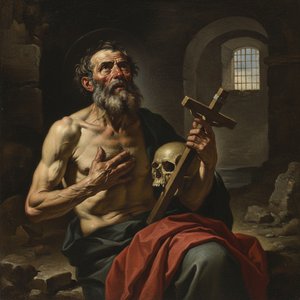
José de Ribera (1591–1652) maakte St. Peter. Het behoort tot de Baroque-stroming. Het is gemaakt van Oil On Canvas. Het is te vinden in Museo del Prado in Madrid, Spanje.
- Oil On Canvas
- Museo del Prado, Madrid

 Voorvertoning

 Met de hand geschilderd olieverfwerk
 Verstuur
 Delen
 Informatieblad


 Download
 Vergelijkbare items
 Röntgenonderzoek
 Diavoorstelling
 Vraag & antwoord

 Statistieken
St. Peter, in het kort
- Titel
- St. Peter
- Kunstenaar
- José de Ribera (1591–1652)
- Geboren in [jaar]
- Xàtiva, Spanje
- Medium
- Oil On Canvas
- Te zien in
- Museo del Prado, Madrid, Spanje
- Beweging
- Baroque
- Periode
- Early Modern
- Onderwerp
- man, beard, book, keys, cloak, brown
Wat stelt St. Peter voor?
The Portrait of St. Peter by Jusepe de Ribera
In this oil painting on canvas, Jusepe de Ribera presents us with a portrait of St. Peter. The subject, a central figure among the apostles of Jesus and recognized as the first Pope, is rendered with a profound sense of presence. Ribera focuses on the man himself, capturing the weight of his role and the character of his lived experience. There is a quiet intensity in the way the figure is presented, inviting a closer look at the weathered details of his countenance.
The work is a significant example of the Baroque style. Through this approach, the artist emphasizes the spiritual and human dimensions of the apostle. The depiction avoids idealization, opting instead for a directness that feels immediate. By focusing on the specific attributes of the saint, Ribera allows the subject to command the space, presenting a figure that is both a religious icon and a man of flesh and bone.
Composition and Visual Elements of the Portrait
The composition is built upon a stable pyramidal structure, with the head of St. Peter forming the apex of the form. He is presented from the waist up, his body turned slightly toward the viewer's left. In his right hand, he holds a book and a set of keys, objects that anchor the figure within the frame. This arrangement directs the eye upward toward his weathered features, creating a sense of quiet, grounded presence.
A strong light source enters from the left, illuminating his face and upper body while casting the rest of the figure into deep shadow. This light creates a sharp contrast against a background that is nearly black, pushing the subject forward into the viewer's space. The color palette is restrained, dominated by warm earth tones—ochre, brown, and gold—which emphasize the textures of his skin and the heavy folds of his clothing.
Technique and Artistic Style of the Work
The work is defined by a profound use of tenebrism, where the subject emerges from a nearly black background into a sharp, focused light. This dramatic chiaroscuro creates a sense of volume, pulling the figure forward and emphasizing the physical presence of the man. Such a heavy interplay of light and shadow reflects the influence of Caravaggio, grounding the religious subject in a palpable, earthly reality. The light source, positioned to the left, carves out the contours of the face and the weathered texture of the skin, casting deep shadows that heighten the emotional weight of the portrait.
Ribera’s approach to the medium is tactile and deliberate. He employs a technique of layering paint to build up depth, allowing the viewer to sense the physical weight of the drapery and the coarse nature of the beard. Visible brushstrokes are not hidden; instead, they contribute to the overall effect, lending a sense of immediacy to the rendering of the fabric and the aged features. Strong, defined lines delineate the eyes, nose, and mouth, providing a structural clarity that balances the more fluid, organic shapes of the figure. The result is a composition that feels both intensely personal and physically substantial.
Other Works by Jusepe de Ribera
The artist's exploration of this particular subject matter is reflected in several other significant pieces within our collection and major institutions. We hold St. Simeon 1 in our catalog, a work that speaks to the same profound human experience found in this portrait. Another notable piece in our collection is The Repentance of Saint Peter, which is currently housed in the Museum of Fine Arts, Lyon.
Beyond our own holdings, Ribera's preoccupation with the themes of remorse and spiritual weight is evident in other historical examples. The work known as Penitent St. Peter, dated about 1630, is held at the Kunsthistorisches Museum in Vienna. This piece shares a similar intensity in its depiction of the apostle's character. Additionally, The Tears of Saint Peter, which dates to 1612, is part of the collection at the Metropolitan Museum of Art in New York. These works collectively illustrate the artist's ability to capture the complexities of faith and the physical reality of the human condition through his characteristic use of light and shadow.
In welk museum bevindt St. Peter zich?
Museo del Prado
Madrid, Spanje
De geschiedenis van Museo del Prado De oorsprong van het Museo del Prado is onlosmakelijk verbonden met de Koninklijke Collectie van Spanje en vindt zijn wortels in de 18e eeuw. Wat begon als een visionair concept voor een natuurhistorisch kabinet onder Ferdinand VII, evolueerde uiteindelijk naar een gewijd heiligdom voor schilderkunst en beeldhouwkunst. Deze transformatie veranderde een wetenschappelijk streven in een schatkamer voor de meest betekenisvolle juwelen van de Spaanse Kroon.


Hoogwaardige afbeeldingen van St. Peter
Publiek domein: de kunstenaar is overleden in 1652.
José de Ribera, St. Peter, Museo del Prado. Publiek domein
De kleuren zijn door een digitale expert afgestemd op het origineel en het bestand is zorgvuldig geretoucheerd, trouw aan de penseelstreken van de kunstenaar.
Koop het bestand in hoge resolutieVragen over St. Peter, beantwoord
Waar is "St. Peter" door José de Ribera tegenwoordig te zien?
Het originele "St. Peter" door José de Ribera wordt bewaard in Museo del Prado, Madrid, Spanje. Een reproductie maakt het mogelijk om het werk thuis tentoon te stellen.
Met welke techniek is "St. Peter" gemaakt?
"St. Peter" is uitgevoerd in Oil On Canvas.
Wat wordt er afgebeeld in "St. Peter" door José de Ribera?
De thema's die aanwezig zijn in "St. Peter" door José de Ribera omvatten man, beard, book, keys, cloak, brown, gold, skin. Samen vatten zij de onderwerpen van het kunstwerk samen.
Behoort "St. Peter" door José de Ribera tot het publiek domein?
De auteursrechtelijke status van "St. Peter" door José de Ribera: het werk is bevindt zich in het publiek domein - de auteursrechten zijn verlopen. Dit bepaalt of reproducties van de afbeelding vrijelijk mogen worden gemaakt.
Wie heeft "St. Peter" gemaakt?
"St. Peter" is gemaakt door José de Ribera. De informatie op deze pagina beschrijft het originele werk van José de Ribera.
Bij welke kunststroming behoort "St. Peter" door José de Ribera?
"St. Peter" door José de Ribera behoort tot de Baroque-stroming. Deze stroming biedt de stilistische context van het werk.
Uit welke fase van de carrière van José de Ribera is "St. Peter"?
Binnen de carrière van José de Ribera valt "St. Peter" in de Mature Period. Deze fase helpt om het werk te vergelijken met andere werken van de kunstenaar.
Wat is de reden voor de auteursrechtelijke status van "St. Peter" door José de Ribera?
De auteursrechtstatus van "St. Peter" - bevindt zich in het publiek domein - de auteursrechten zijn verlopen - is gebaseerd op het overlijden van de kunstenaar in 1652.
Is "St. Peter" gebleven in het geboorteland van de kunstenaar?
Ja - het kunstwerk wordt bewaard in het land van herkomst van de kunstenaar. "St. Peter" bevindt zich in Spanje, terwijl José de Ribera werd geboren in Spanje.
Over de kunstenaar, José de Ribera

1591–1652, Spanje
José de Ribera
A Life Forged in Shadow and Light Jusepe de Ribera, bekend onder de bijnaam Lo Spagnoletto – “de Kleine Spaansman” – was een kolossale figuur van het Barokke tijdperk, een kunstenaar wiens doeken pulseren met dramatische intensiteit en onverbloemelijke realisme. Geboren in Xàtiva, Spanje, in 1591, liep zijn reis verder dan zijn Valencaanse oorsprong en vestigde hem uiteindelijk als een van de meest significante schilders van het 17e eeuwse Napels, een stad die toen onder Spaanse heerschappij lag. Ribera’s leven was niet slechts een kroniek van artistieke ontwikkeling; het was een verhaal geweven met lijden, ambitie en een onwrikbare toewijding aan het portretteren van de menselijke conditie in al haar rauwe complexiteit. Hoewel vroege biografische details nog steeds gehuld zijn in enig mysterie, weten we dat hij rond 1607 naar Italië kwam en aanvankelijk in Rome ging wonen, voordat hij zich in 1616 vestigde in Napels – een stad die zowel zijn artistieke thuis als de broeiplaats voor zijn unieke stijl zou worden.
Ook van José de Ribera
 Magdalena Ventura met haar man en zoon1631
 De Clubvoet
 St. Onuphrius1637
 The Duel of Women (The Duel of Isabella de Carazzi and Diambra de Pettinella)1636
Essays over St. Peter
 Mastering the Shadows: The Dramatic Power of Chiaroscuro and Tenebrism in Baroque Fine ArtExplore the profound drama of chiaroscuro and tenebrism. Discover how masters like Caravaggio used light and shadow to sculpt emotion and v…
 Masterpieces of Light: The Top 25 Artworks by Duccio di BuoninsegnaJourney through the divine elegance of Duccio di Buoninsegna. Explore 25 iconic Sienese masterpieces, from the Maestà to the Rucellai Madon…
 Jusepe de Ribera: Dramatic Realism & Spiritual Intensity in the Spanish Golden AgeExplore the powerful Baroque paintings of Jusepe de Ribera, master of tenebrism and dramatic realism. Discover his spiritual intensity, inf…