Voorvertoning
 Verstuur
 Delen
Delen
 Details bekijken
 Gids
Gids

 Download
 Vergelijkbare items
 Röntgenonderzoek
 Diavoorstelling
 Vraag & antwoord
 Statistieken
St. Francis of Assisi

- 103.0 x 77.0 cm


 Lees meer
Giclée / Kunstafdrukken
Giclée- of canvasafdruk van museumkwaliteit met een snelle productie en flexibele afwerkingsmogelijkheden. ( Bestel handgeschilderde reproductie Schakel over naar digitale afbeeldingen)




P118B €10

P118H €10

P118W €10

P438Z €10

P508JH €12

P508YH €12

P805H €10

P805Z €10

P919BZ €10

P919G €10

P919XJ €10

P959ZH €10

P968JZ €12

W106C €8

W218G €10

W218JH €8

W218Y €10

W307PJ €10

W316G €10

W316PJ €8

W316Y €10

W398PJ €8

W4111J €10

W500HY €15

W500JH €15

W692G €12

W849H €8

W940BG €15

W953PJ €8




Kies uit onze vooraf ingestelde maten die overeenkomen met de originele verhoudingen van het kunstwerk.

Voer de gewenste breedte en hoogte in, passend bij uw lijst of muur. Een afdruk kan alleen worden ingekort en nooit groter worden gemaakt dan het origineel; een formaat met andere verhoudingen zal daarom een deel van de afbeelding verliezen. Wij sturen u een digitaal mockup ter goedkeuring voordat we tot drukwerk overgaan. De afbeelding op deze pagina toont niet de werkelijke uitsnede — dit is alleen te zien op het mockup.
Wereldwijde levering () binnen 2 weken in plaats van de standaard 4/5 weken. (7 november)

Gratis wereldwijde expressverzending

Hoogwaardig linnen canvas

Volledige verzendverzekering

Garantie op terugbetaling van invoerrechten

Garantie op exacte kleurweergave

Retourbeleid van 100 dagen (alleen bij defecten)

100% Geld-terug-garantie

Korting bij meerdere afnames
 De optie voor glas is alleen beschikbaar bij een formaat kleiner dan 110 cm.

St. Francis of Assisi
Giclée / Kunstafdrukken
Afmetingen reproductie
-


Eindtotaal
€ 72
A Masterpiece of Shadow and Soul
In the quiet, profound depths of Jusepe de Ribera’s 1643 masterpiece, St. Francis of Assisi, viewers are invited into a space where the boundaries between the earthly and the divine begin to dissolve. This painting is not merely a portrait of a saint; it is an immersive experience in tenebrism, a technique that defines the dramatic intensity of the Baroque era. As the eye meets the canvas, one is immediately struck by the stark, theatrical contrast between light and shadow. Ribera, often called Lo Spagnoletto, masterfully employs this chiaroscuro to pull the figure of St. Francis out of an oppressive, velvety darkness, casting him in a singular, spiritual spotlight that demands contemplation.
The subject itself—the beloved patron saint of animals and the humble founder of the Franciscan order—is rendered with an unflinching realism that is characteristic of Ribera’s Neapolitan style. Clad in the simple, coarse brown habit of his order, St. Francis appears not as a distant icon, but as a man deeply rooted in the physical reality of human existence. His weathered face, framed by a contemplative gaze and a rugged beard, tells a story of asceticism and devotion. There is a palpable sense of gravity in his posture, a stillness that suggests a soul caught in a moment of profound internal dialogue with the Creator.
Symbolism and the Memento Mori
Beyond the striking visual technique lies a rich tapestry of symbolic meaning that resonates with the spiritual traditions of the 17th century. Most hauntingly, St. Francis holds aloft a skull, a potent memento mori—a reminder of death. This element serves as a powerful meditation on the fleeting nature of life and the inevability of mortality. In the hands of Ribera, this symbol is not meant to inspire fear, but rather to prompt a reflection on the permanence of the soul versus the transience of the flesh. The skull acts as a bridge between the physical world we inhabit and the eternal realm toward which the saint directs his devotion.
The composition is intentionally tight, focusing the viewer's attention entirely on the interaction between the saint and his symbolic object. By eschewing a detailed background, Ribera removes all worldly distractions, forcing an intimate encounter with the subject. This isolation amplifies the emotional weight of the scene, making the painting an ideal centerpiece for those seeking art that evokes introspection, peace, and a sense of historical depth. For the collector or interior designer, this piece offers more than just aesthetic beauty; it provides a focal point of intellectual and spiritual gravity.
An Enduring Legacy for the Modern Collector
To possess a reproduction of this caliber is to bring a fragment of the Palazzo Pitti into one's own sanctuary. The painting’s ability to command a room through its dramatic tonal shifts makes it an extraordinary choice for sophisticated interiors, particularly those that favor classical, moody, or academic aesthetics. Whether placed in a library, a study, or a grand hallway, the work of Jusepe de Ribera continues to captivate because it speaks to the universal human experience of searching for meaning amidst the shadows.
For art lovers and decorators alike, St. Francis of Assisi represents the pinnacle of Baroque emotion. It is a testament to an era where light was used as a tool of revelation and shadow was used to define the very essence of being. Owning such a piece allows for a daily engagement with the profound themes of humility, simplicity, and the enduring power of faith, rendered through one of the most skilled hands in the history of Spanish and Italian art.
Veelgestelde vragen
Zijn de kleuren van "St. Francis of Assisi" door Jusepe de Ribera verzadigd of gedempt?
Het kleurenpalet van "St. Francis of Assisi" heeft een verzadiging van Muted.
Welke emotie straalt "St. Francis of Assisi" door Jusepe de Ribera uit?
"St. Francis of Assisi" door Jusepe de Ribera straalt een Reflective emotionele toon uit.
Hoe kan ik een print van "St. Francis of Assisi" door Jusepe de Ribera verkrijgen?
Om een print van "St. Francis of Assisi" door Jusepe de Ribera te bestellen, kunt u terecht op de Fine Art Print pagina: een fine art print op katoenen canvas of archiefwaardig canvaspapier.
Biografie kunstenaar
A Life Forged in Shadow and Light
Jusepe de Ribera, bekend onder de bijnaam Lo Spagnoletto – “de Kleine Spaansman” – was een kolossale figuur van het Barokke tijdperk, een kunstenaar wiens doeken pulseren met dramatische intensiteit en onverbloemelijke realisme. Geboren in Xàtiva, Spanje, in 1591, liep zijn reis verder dan zijn Valencaanse oorsprong en vestigde hem uiteindelijk als een van de meest significante schilders van het 17e eeuwse Napels, een stad die toen onder Spaanse heerschappij lag. Ribera’s leven was niet slechts een kroniek van artistieke ontwikkeling; het was een verhaal geweven met lijden, ambitie en een onwrikbare toewijding aan het portretteren van de menselijke conditie in al haar rauwe complexiteit. Hoewel vroege biografische details nog steeds gehuld zijn in enig mysterie, weten we dat hij rond 1607 naar Italië kwam en aanvankelijk in Rome ging wonen, voordat hij zich in 1616 vestigde in Napels – een stad die zowel zijn artistieke thuis als de broeiplaats voor zijn unieke stijl zou worden. Zijn huwelijk met Caterina Azzolino, dochter van een lokale schilder, verstevigde verder zijn banden met de Neapolitanse kunstwereld, waardoor hij kon floreren binnen de levendige, maar vaak turbulente sfeer ervan.The Embrace of Tenebrism and Realist Vision
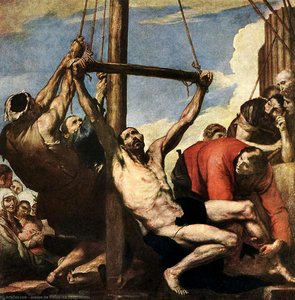
Ribera’s artistieke vorming werd diepgaand gevormd door de heersende stromingen in de Italiaanse schilderkunst. De invloed van Caravaggio is onmiskenbaar; Ribera absorbeerde de revolutionaire manier van Caravaggio om tenebrisme – dat dramatische spel van licht en schaduw – te gebruiken om scènes te creëren die geladen zijn met emotionele kracht. Echter, hij kopieerde het niet simpelweg. Hij synthetiseerde deze techniek met elementen die hij had opgedaan bij andere meesters zoals Guido Reni, waarbij hij een klassieke gevoeligheid integreerde in zijn composities terwijl hij tegelijkertijd de visceraal impact van Caravaggio’s realisme behield. Deze fusie resulteerde in een stijl uniek aan hemzelf: gekenmerkt door scherpe contrasten, intens gefocuste figuren en een bijna brutale eerlijkheid bij het portretteren van menselijk lijden en spirituele extase. Zijn vroege werken, zoals de Marteling van Sint-Bartholomeus, illustreren deze benadering – een aangrijpend beeld van pijn dat met onverbloemelijke details is weergegeven. Hij aarzelde niet om de fysieke realiteit van martelingen vast te leggen, de getormenteerde lichamen, de gespannen spieren, de textuur van huid en bot. Deze toewijding aan realisme strekte zich uit tot religieuze onderwerpen; zijn portretten van bedelaars en gewone mensen, vaak afgebeeld als filosofen of heiligen, waren baanbrekend voor hun tijd, waarbij ze de gemarginaliseerden een niveau van waardigheid en belangrijkheid gaven dat zelden in kunst te zien was.A Career Across Genres and Evolving Styles
Ribera’s artistieke productie was opmerkelijk divers. Hoewel hij vooral bekend staat om zijn religieuze schilderijen – scènes van marteling, afbeeldingen van heiligen en dramatische Bijbelverhalen – excelleerde hij ook in portretschilderkunst, stillevenskunst en zelfs landschapsschilderkunst. Zijn Saint Jerome and the Angel toont bijvoorbeeld een zachtere, contemplatievere kant van zijn artistieke expressie, terwijl hij tegelijkertijd de kenmerkende dramatische verlichting behield die zijn werk karakteriseert. Doorheen zijn carrière onderging Ribera’s stijl subtiele maar significante evoluties. Zijn vroegere werken worden gekenmerkt door een bijna strenge realisme en een scherpe tenebrismis. Naarmate hij zich steviger vestigde in Napels, werden zijn palet rijker, zijn composities complexer en werd zijn verlichting iets zachter. Echter, de kernelementen van zijn Barokke esthetiek – de emotionele intensiteit, de dramatische narratieven en de onwrikbare toewijding aan het portretteren van de menselijke ervaring met eerlijkheid – bleven constant. Hij was een meester ambachtsman, in staat om texturen met verbazingwekkende precisie weer te geven, van het ruwe laken van een bedelaarsmantel tot de gladde huid van een jonge heilige.Influences and Artistic Connections
Ribera’s artistic development was shaped by a complex interplay of influences. Beyond Caravaggio, he drew inspiration from the classical painters of the Renaissance, particularly Raphael and Giulio Romano, evident in his carefully balanced compositions and idealized figures. He also admired the works of Flemish masters like Rubens and Van Dyck, incorporating their dynamic brushwork and dramatic lighting into his own style. The Spanish school of painting, represented by Velázquez, also exerted a significant influence on Ribera’s approach to realism and portraiture. Notably, Ribera's work shares similarities with that of Bartolomé Esteban Murillo, another prominent Neapolitan painter known for his sentimental religious scenes. The connection between these artists lies in their shared interest in depicting human emotion and spirituality through realistic imagery.Legacy and Lasting Influence
Jusepe de Ribera’s impact op de kunstwereld strekte zich uit verder dan zijn Napolitanse werkplaats. Hij werd een sleutelfiguur in de Spaanse Barokke schilderkunst, naast meesters als Velázquez, Zurbarán en Murillo. Zijn innovatieve gebruik van tenebrisme en zijn onverbloemelijke realisme beïnvloedden generaties kunstenaars in heel Europa. Zijn werk resonerde met hen die wilden afbreken met de geïdealiseerde vormen van de Renaissancekunst en een meer visceraal, emotioneel geladen stijl omarmen. Zelfs latere kunstenaars haalden inspiratie uit zijn dramatische composities en krachtige afbeeldingen van de menselijke ervaring. Vandaag de dag worden Ribera’s schilderijen tentoongesteld in prestigieuze musea over de hele wereld – het Museo del Prado in Madrid, de National Gallery of Art in Washington D.C., en talloze instellingen in Europa – waardoor zijn nalatenschap ervoor zorgt dat hij voortaan inspireert en aanspoort tot contemplatie eeuwen na zijn dood in 1652. Hij staat als een getuigenis van de kracht van kunst om moeilijke waarheden te confronteren, de diepten van de menselijke emotie te verkennen en het blijvende spirituele vermogen te verlichten.
Jusepe de Ribera
1591 - 1652 , Spanje
Belangrijkste feiten
- Artistic Movement Or Style: Barok
- Artists Or Movements Influenced By This Artist:
- José de Ribera
- European meesters
- Artists Who Influenced This Artist:
- Caravaggio
- Guido Reni
- Date Of Birth: 1591
- Date Of Death: 1652
- Full Name: Jusepe de Ribera
- Nationality: Spaans
- Notable Artworks:
- Martirio San Bartolomé
- Santo Jerónimo
- Sileno ebrio
- Place Of Birth: Xativa, Spanje
Gerelateerde artikelen
Jusepe de Ribera: Dramatic Realism & Spiritual Intensity in the Spanish Golden Age
Explore the powerful Baroque paintings of Jusepe de Ribera, master of tenebrism and dramatic realism. Discover his spiritual intensity, influence on Spanish art, and considerations for collectors. Expert insights at OriginalUniqueArt.

Drama and Light: A Definitive Guide to the Italian Baroque Masterpieces and the Revolution of Chiaroscuro
Explore the dramatic world of Italian Baroque art. Discover how masters like Caravaggio used chiaroscuro and tenebrism to revolutionize painting through light, shadow, and profound realism. A definitive guide for history lovers and art collectors.

Francis Bacon's Top 25 Meesterwerken: Intensiteit & Emotie voor uw Interieur | OriginalUniqueArt
Ontdek de 25 meest iconische schilderijen van Francis Bacon, meester van emotie & abstract expressionisme. Leer over zijn leven, stijl en donkere kleuren. Museumkwaliteit reproducties op OriginalUniqueArt.com – voor een unieke kunstcollectie in uw interieur! Exploreer de collectie online.
The Dramatic Flourish: Exploring Themes of Power, Faith & Emotion in Baroque Artworks
Explore the dramatic world of Baroque art! Discover masters like Zurbarán & the powerful influence of religious zeal on painting techniques. Expert insights for collectors and enthusiasts.

Top 10 Barok Meesterwerken: Kunstgeschiedenis voor uw Interieur | OriginalUniqueArt.nl
Ontdek de 10 meest iconische Barok meesterwerken van Caravaggio, Rembrandt & Rubens! Duik in de geschiedenis en passie achter deze klassieke schilderijen. Vind museumkwaliteit reproducties voor uw interieur op OriginalUniqueArt.com.