Bekijk op ware grootte
 Verstuur
 Delen
Delen
 Details bekijken
 Gids voor studentenkunstwerken

 Download
 Vergelijkbare items
 Röntgenonderzoek
 Diavoorstelling
 Statistieken
Drunken Silenus


 Lees meer
Handgemaakte olieverfreproductie
Met de hand geschilderd in olieverf op canvas in uw gewenste maat en lijst, op bestelling gemaakt door onze kunstenaars. ( Schakel over naar print Schakel over naar digitale afbeeldingen)




P118B €10

P118H €10

P118W €10

P438Z €10

P508JH €12

P508YH €12

P805H €10

P805Z €10

P919BZ €10

P919G €10

P919XJ €10

P959ZH €10

P968JZ €12

W106C €8

W218G €10

W218JH €8

W218Y €10

W307PJ €10

W316G €10

W316PJ €8

W316Y €10

W398PJ €8

W4111J €10

W500HY €15

W500JH €15

W692G €12

W849H €8

W940BG €15

W953PJ €8




Kies uit onze vooraf ingestelde maten die overeenkomen met de originele verhoudingen van het kunstwerk.

Voer de breedte en de hoogte in die u nodig heeft, passend bij uw lijst of uw muur. Dit is handgeschilderd, dus bij een afmeting met een andere vormverhouding kan de kunstenaar iets meer rondom het schilderij schilderen of juist iets meer weglaten — u kiest zelf. Wij sturen u een digitaal mockup ter goedkeuring voordat het schilderwerk begint. De afbeelding die op deze pagina wordt getoond, is niet het uiteindelijke resultaat — alleen de mockup geeft dit weer.
Na de bestelling zal het team van OriginalUniqueArt.com per e-mail contact opnemen met de klant voor instructies en een mockup-voorbeeld sturen.
Wereldwijde levering () binnen 3 tot 4 weken in plaats van de standaard 5 weken. (23 oktober). Zonder concessies aan de kwaliteit.

Gratis wereldwijde expressverzending

Hoogwaardig linnen canvas

Volledige verzendverzekering

Garantie op terugbetaling van invoerrechten

Garantie op exacte kleurweergave

Retourbeleid van 100 dagen (alleen bij defecten)

100% Geld-terug-garantie

Korting bij meerdere afnames
 De optie voor glas is alleen beschikbaar bij een formaat kleiner dan 110 cm.

Drunken Silenus
Reproductiemethode
Formaat reproductie
-


Totaalprijs
€ 264
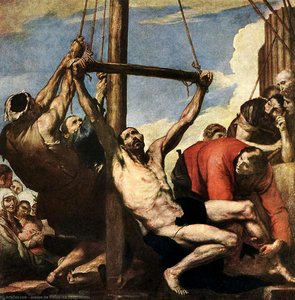
The Shadowed Revelry of Jusepe de Ribera’s *Drunken Silenus*
Jusepe de Ribera's 1626 painting, *Drunken Silenus*, isn’t merely a depiction of a drunken reveler; it’s a visceral plunge into the heart of the Baroque era – a world saturated with drama, religious fervor, and a profound fascination with human vulnerability. Housed within the Museo di Capodimonte in Naples, this monumental canvas immediately commands attention with its stark contrasts of light and shadow, a signature technique known as tenebrism that Ribera honed to breathtaking effect. The scene unfolds against a dark, almost claustrophobic background, drawing the viewer’s eye relentlessly towards Silenus himself – a figure sprawled upon a simple cloth, his body rendered with an unflinching realism that borders on brutality. He's not idealized; he’s a man consumed by intoxication, his features distorted by wine-induced delirium, yet there’s a strange magnetism in his slumped posture and vacant gaze.
Ribera masterfully employs color to heighten the drama. Deep reds and browns dominate the palette, punctuated by flashes of gold and silver – the glint of the cup offered by a satyr, the shimmering wreath crowning Silenus’s head. This interplay of light and dark isn't simply aesthetic; it serves to emphasize the figure’s vulnerability and isolation within the chaotic energy of the surrounding group. The composition itself is deliberately unbalanced, mirroring the disequilibrium of Silenus’s state. The figures around him – a panoply of satyrs, maenads, and drunken revelers – are rendered with equally intense detail, each contributing to the painting's overall sense of unrestrained abandon.
Mythological Roots and Baroque Symbolism
Silenus himself is a figure steeped in Greek mythology. He’s not simply a drunkard; he’s Dionysus’s tutor, a companion who embodies the god’s wildness, his connection to nature, and his association with intoxication and ecstasy. Ribera cleverly adapts this mythological archetype for a Baroque audience, imbuing it with layers of symbolic meaning. The snake coiled at the bottom right, a recurring motif in Ribera's work, represents wisdom – a paradoxical element within the context of drunken revelry. The turtle to the right symbolizes laziness and sloth, further reinforcing the painting’s exploration of human weakness and indulgence.
Pan, the god of shepherds and wild nature, is depicted crowning Silenus with vines, a gesture that simultaneously celebrates his status as a divine figure and subtly mocks his drunken state. The shell he holds – a symbol announcing his death – adds another layer of morbid humor to the scene. The inclusion of these classical symbols within a secular setting speaks to the Baroque era’s fascination with blending religious and mythological themes, creating works that were both deeply spiritual and intensely worldly.
Technique and the Power of Tenebrism
Ribera's mastery of technique is evident in every brushstroke. He employs a highly detailed, almost photographic realism, meticulously rendering the textures of skin, fabric, and foliage. However, it’s his use of tenebrism – the dramatic contrast between light and dark – that truly elevates *Drunken Silenus* to a masterpiece. Ribera doesn't simply paint; he sculpts with light, creating an illusion of depth and volume that draws the viewer into the scene. The strong chiaroscuro not only emphasizes the figures but also evokes a sense of drama and urgency.
The etching version of this painting, now held in the British Museum, demonstrates Ribera’s ability to translate his dramatic style to printmaking. The stark contrasts of light and shadow are even more pronounced in the etching, creating a powerful and immediate impact. The simplified forms and heightened detail further emphasize the emotional intensity of the scene.
A Window into Naples: Context and Legacy
Created in Naples during the Spanish rule of the city, *Drunken Silenus* is more than just a mythological painting; it’s a reflection of the social and cultural landscape of 17th-century Italy. Ribera's work often explored themes of poverty, suffering, and mortality – subjects that resonated deeply with the realities of life in Naples. The inscription on the painting itself—"Hic est Silenus, qui in Nipo diebat"—("Here is Silenus who lived in Naples")—is a deliberate act of claiming artistic ownership over the city, solidifying his position as one of its most significant cultural figures. *Drunken Silenus* remains a powerful testament to Ribera’s genius and a captivating window into the dramatic world of the Baroque.
Vragen & Antwoorden
Welke stemming en emotie komen samen in "Drunken Silenus"?
"Drunken Silenus" door Jusepe de Ribera roept een Melancholic gevoel op binnen een algeheel Dramatic stemmigheid.
Welk kleurenpalet wordt gebruikt in "Drunken Silenus"?
De kleuren van "Drunken Silenus" vormen een Earthy palet. Deze classificatie beschrijft de dominante kleurfamilies.
Is "Drunken Silenus" door Jusepe de Ribera een bekend kunstwerk?
"Drunken Silenus" wordt geclassificeerd als Iconic.
Biografie van de kunstenaar
A Life Forged in Shadow and Light
Jusepe de Ribera, bekend onder de bijnaam Lo Spagnoletto – “de Kleine Spaansman” – was een kolossale figuur van het Barokke tijdperk, een kunstenaar wiens doeken pulseren met dramatische intensiteit en onverbloemelijke realisme. Geboren in Xàtiva, Spanje, in 1591, liep zijn reis verder dan zijn Valencaanse oorsprong en vestigde hem uiteindelijk als een van de meest significante schilders van het 17e eeuwse Napels, een stad die toen onder Spaanse heerschappij lag. Ribera’s leven was niet slechts een kroniek van artistieke ontwikkeling; het was een verhaal geweven met lijden, ambitie en een onwrikbare toewijding aan het portretteren van de menselijke conditie in al haar rauwe complexiteit. Hoewel vroege biografische details nog steeds gehuld zijn in enig mysterie, weten we dat hij rond 1607 naar Italië kwam en aanvankelijk in Rome ging wonen, voordat hij zich in 1616 vestigde in Napels – een stad die zowel zijn artistieke thuis als de broeiplaats voor zijn unieke stijl zou worden. Zijn huwelijk met Caterina Azzolino, dochter van een lokale schilder, verstevigde verder zijn banden met de Neapolitanse kunstwereld, waardoor hij kon floreren binnen de levendige, maar vaak turbulente sfeer ervan.The Embrace of Tenebrism and Realist Vision
Ribera’s artistieke vorming werd diepgaand gevormd door de heersende stromingen in de Italiaanse schilderkunst. De invloed van Caravaggio is onmiskenbaar; Ribera absorbeerde de revolutionaire manier van Caravaggio om tenebrisme – dat dramatische spel van licht en schaduw – te gebruiken om scènes te creëren die geladen zijn met emotionele kracht. Echter, hij kopieerde het niet simpelweg. Hij synthetiseerde deze techniek met elementen die hij had opgedaan bij andere meesters zoals Guido Reni, waarbij hij een klassieke gevoeligheid integreerde in zijn composities terwijl hij tegelijkertijd de visceraal impact van Caravaggio’s realisme behield. Deze fusie resulteerde in een stijl uniek aan hemzelf: gekenmerkt door scherpe contrasten, intens gefocuste figuren en een bijna brutale eerlijkheid bij het portretteren van menselijk lijden en spirituele extase. Zijn vroege werken, zoals de Marteling van Sint-Bartholomeus, illustreren deze benadering – een aangrijpend beeld van pijn dat met onverbloemelijke details is weergegeven. Hij aarzelde niet om de fysieke realiteit van martelingen vast te leggen, de getormenteerde lichamen, de gespannen spieren, de textuur van huid en bot. Deze toewijding aan realisme strekte zich uit tot religieuze onderwerpen; zijn portretten van bedelaars en gewone mensen, vaak afgebeeld als filosofen of heiligen, waren baanbrekend voor hun tijd, waarbij ze de gemarginaliseerden een niveau van waardigheid en belangrijkheid gaven dat zelden in kunst te zien was.A Career Across Genres and Evolving Styles
Ribera’s artistieke productie was opmerkelijk divers. Hoewel hij vooral bekend staat om zijn religieuze schilderijen – scènes van marteling, afbeeldingen van heiligen en dramatische Bijbelverhalen – excelleerde hij ook in portretschilderkunst, stillevenskunst en zelfs landschapsschilderkunst. Zijn Saint Jerome and the Angel toont bijvoorbeeld een zachtere, contemplatievere kant van zijn artistieke expressie, terwijl hij tegelijkertijd de kenmerkende dramatische verlichting behield die zijn werk karakteriseert. Doorheen zijn carrière onderging Ribera’s stijl subtiele maar significante evoluties. Zijn vroegere werken worden gekenmerkt door een bijna strenge realisme en een scherpe tenebrismis. Naarmate hij zich steviger vestigde in Napels, werden zijn palet rijker, zijn composities complexer en werd zijn verlichting iets zachter. Echter, de kernelementen van zijn Barokke esthetiek – de emotionele intensiteit, de dramatische narratieven en de onwrikbare toewijding aan het portretteren van de menselijke ervaring met eerlijkheid – bleven constant. Hij was een meester ambachtsman, in staat om texturen met verbazingwekkende precisie weer te geven, van het ruwe laken van een bedelaarsmantel tot de gladde huid van een jonge heilige.Influences and Artistic Connections
Ribera’s artistic development was shaped by a complex interplay of influences. Beyond Caravaggio, he drew inspiration from the classical painters of the Renaissance, particularly Raphael and Giulio Romano, evident in his carefully balanced compositions and idealized figures. He also admired the works of Flemish masters like Rubens and Van Dyck, incorporating their dynamic brushwork and dramatic lighting into his own style. The Spanish school of painting, represented by Velázquez, also exerted a significant influence on Ribera’s approach to realism and portraiture. Notably, Ribera's work shares similarities with that of Bartolomé Esteban Murillo, another prominent Neapolitan painter known for his sentimental religious scenes. The connection between these artists lies in their shared interest in depicting human emotion and spirituality through realistic imagery.Legacy and Lasting Influence
Jusepe de Ribera’s impact op de kunstwereld strekte zich uit verder dan zijn Napolitanse werkplaats. Hij werd een sleutelfiguur in de Spaanse Barokke schilderkunst, naast meesters als Velázquez, Zurbarán en Murillo. Zijn innovatieve gebruik van tenebrisme en zijn onverbloemelijke realisme beïnvloedden generaties kunstenaars in heel Europa. Zijn werk resonerde met hen die wilden afbreken met de geïdealiseerde vormen van de Renaissancekunst en een meer visceraal, emotioneel geladen stijl omarmen. Zelfs latere kunstenaars haalden inspiratie uit zijn dramatische composities en krachtige afbeeldingen van de menselijke ervaring. Vandaag de dag worden Ribera’s schilderijen tentoongesteld in prestigieuze musea over de hele wereld – het Museo del Prado in Madrid, de National Gallery of Art in Washington D.C., en talloze instellingen in Europa – waardoor zijn nalatenschap ervoor zorgt dat hij voortaan inspireert en aanspoort tot contemplatie eeuwen na zijn dood in 1652. Hij staat als een getuigenis van de kracht van kunst om moeilijke waarheden te confronteren, de diepten van de menselijke emotie te verkennen en het blijvende spirituele vermogen te verlichten.
Jusepe de Ribera
1591 - 1652 , Spanje
Snelle feiten
- Artistic Movement Or Style: Barok
- Artists Or Movements Influenced By This Artist:
- José de Ribera
- European meesters
- Artists Who Influenced This Artist:
- Caravaggio
- Guido Reni
- Date Of Birth: 1591
- Date Of Death: 1652
- Full Name: Jusepe de Ribera
- Nationality: Spaans
- Notable Artworks:
- Martirio San Bartolomé
- Santo Jerónimo
- Sileno ebrio
- Place Of Birth: Xativa, Spanje
Gerelateerde artikelen
Drama and Light: A Definitive Guide to the Power and Emotion of Baroque Art
Explore the dramatic power of Baroque art through an expert guide to light, shadow, and emotion. Discover how the Counter-Reformation shaped 17th-century masterpieces and learn about the profound techniques used by the Old Masters to inspire awe.

Barokke Pracht: Kunst die Grootsheid in Huis Brengt
Ontdek de barokke pracht! Leer over de geschiedenis, kenmerken en toepassingen van deze weelderige kunststijl in uw interieur. Laat u inspireren door meesters en breng grootsheid in huis.

Theatricality & Triumph: Baroque Drama in Painting & Sculpture
Explore the dramatic world of Baroque art! Discover its history, defining characteristics, & lasting influence on painting & sculpture. Expert insights into Caravaggio, Zurbarán, and Bernini – plus high-quality reproductions at OriginalUniqueArt.

Barok Ontrafeld: De Kracht van Licht, Drama en Emotie in de 17e-eeuwse Kunst
Ontdek de dramatiek en techniek van de Barok door experts. Duik in de wereld van licht en emotie.

Baroque Classicism: The Grandeur of Order and Drama in 17th-Century Art History
Explore the profound elegance of Baroque Classicism. Discover how 17th-century masters synthesized dramatic emotion with classical order through the lens of the Counter-Reformation and the works of legends like Carlo Maratta and Andrea Sacchi.