
 Voorvertoning
 Verstuur
 Delen
Delen
 Details bekijken
 Gids
Gids

 Download
 Vergelijkbare items
 Röntgenonderzoek
 Diavoorstelling
 Q&A
Q&A Statistieken
Casa Amatller


 Lees meer
Giclée / Kunstafdrukken
Giclée- of canvasafdruk van museumkwaliteit met een snelle productie en flexibele afwerkingsmogelijkheden. ( Bestel handgeschilderde reproductie Schakel over naar digitale afbeeldingen)




P118B €10

P118H €10

P118W €10

P438Z €10

P508JH €12

P508YH €12

P805H €10

P805Z €10

P919BZ €10

P919G €10

P919XJ €10

P959ZH €10

P968JZ €12

W106C €8

W218G €10

W218JH €8

W218Y €10

W307PJ €10

W316G €10

W316PJ €8

W316Y €10

W398PJ €8

W4111J €10

W500HY €15

W500JH €15

W692G €12

W849H €8

W940BG €15

W953PJ €8




Kies uit onze vooraf ingestelde maten die overeenkomen met de originele verhoudingen van het kunstwerk.

Voer de gewenste breedte en hoogte in, passend bij uw lijst of muur. Een afdruk kan alleen worden ingekort en nooit groter worden gemaakt dan het origineel; een formaat met andere verhoudingen zal daarom een deel van de afbeelding verliezen. Wij sturen u een digitaal mockup ter goedkeuring voordat we tot drukwerk overgaan. De afbeelding op deze pagina toont niet de werkelijke uitsnede — dit is alleen te zien op het mockup.
Wereldwijde levering () binnen 2 weken in plaats van de standaard 4/5 weken. (1 november)

Gratis wereldwijde expressverzending

Hoogwaardig linnen canvas

Volledige verzendverzekering

Garantie op terugbetaling van invoerrechten

Garantie op exacte kleurweergave

Retourbeleid van 100 dagen (alleen bij defecten)

100% Geld-terug-garantie

Korting bij meerdere afnames
 De optie voor glas is alleen beschikbaar bij een formaat kleiner dan 110 cm.

Casa Amatller
Giclée / Kunstafdrukken
Afmetingen reproductie
-


Eindtotaal
€ 72
Een Symfonie van Steen en Licht: Casa Amatller
Casa Amatller, gelegen in het hart van Barcelona’s Illa de la Discòrdia – een blok gebouwd met drie baanbrekende architecturale werken van Antoni Gaudí en Josep Puig i Cadafalch – is meer dan alleen een prachtige bouwsel; het is een tastbare uitdrukking van het Catalan Modernisme en een bewijs van de ongeëvenaarde visie van twee kunstenaars die hun tijd voorbijschreden. Gebouwd tussen 1898 en 1900 door Josep Puig i Cadafalch, opdrachtgever van chocolatier Antoni Amatller, staat deze woning symboolisch voor een nieuwe manier van denken over architectuur – een combinatie van natuurlijke vormen en geometrische precisie die Gaudí’s stijl zou definiëren.- Architecturale Stijl: Puig i Cadafalch verkende de grenzen van het Modernisme, waarbij hij zich liet inspireren door zowel de grandeur van het Byzantijnse erfgoed als de eenvoudige schoonheid van de Katalane Gothiek. Een directe verwijzing naar deze historische tradities is zichtbaar in de bouwstijl zelf: een imposante vierkante kern omgeven door drie ronde galerijen, die een gevoel van balans en harmonie oproepen.
- Techniek: De constructeurs gebruikten hoogwaardige keramische tegels – een materiaal dat Puig i Cadafalch zorgvuldig koos voor zijn unieke textuur en kleurpalet. Deze tegels vormen niet alleen het oppervlak van de woning, maar ook een essentieel onderdeel van het architecturale ontwerp, waarbij hun geometrische patronen perfect aansluiten bij de algemene compositie.
- Historische Context: De bouw vond plaats tijdens een periode van enorme culturele en economische transformatie in Catalonië – een tijd waarin het Modernisme floreerde als reactie op de stagnatie van de Beaux-Arts stijl en een nieuwe energie naar binnen drukte. Casa Amatller vertegenwoordigt daarmee een belangrijke mijlpaal in de geschiedenis van Barcelona’s kunstenaarsgemeenschap.
Veelgestelde vragen
Hoe kan ik kunstwerken ontdekken die lijken op "Casa Amatller" door Josep Puig i Cadafalch?
Ontdek vergelijkbare werken voor "Casa Amatller" op de Vergelijkbare werken-pagina van dit kunstwerk.
Hoe harmonieus is het kleurgebruik in "Casa Amatller" door Josep Puig i Cadafalch?
De kleurharmonie van "Casa Amatller" wordt beschreven als Harmonieus palet.
Waar kan ik de afbeelding van "Casa Amatller" door Josep Puig i Cadafalch downloaden?
"Casa Amatller" door Josep Puig i Cadafalch kan worden gedownload via de Downloaden-pagina van het kunstwerk, als een digitale afbeelding in hoge resolutie om te downloaden.
Biografie kunstenaar
Josep Puig i Cadafalch: Life and Legacy
Early Life and Education
- Born in Mataró, Spain on October 17, 1867, Josep Puig i Cadafalch was a pivotal figure in the Catalan Modernista movement.
- He received his initial architectural training at the Provincial School of Architecture in Barcelona, demonstrating an early aptitude for design and innovation.
- His education extended beyond technical skills; he possessed a strong interest in history, law, and politics, which would profoundly influence his work throughout his life.
Architectural Development and Influences
- Puig i Cadafalch’s architectural style was deeply rooted in the Modernisme movement, characterized by organic forms, intricate ornamentation, and a revival of Catalan Gothic traditions.
- He drew inspiration from diverse sources including medieval architecture, particularly Gothic and Arabic styles, as well as contemporary movements like Art Nouveau.
- His early works demonstrate a blend of historical references with innovative structural solutions, setting him apart from his contemporaries.
Major Architectural Achievements
- Casa Martí (Els Quatre Gats): Perhaps his most iconic creation, Casa Martí served as a meeting place for artists, writers, and intellectuals, becoming the epicenter of Catalan Modernism.
- Casa Amatller: Located next to Antoni Gaudí’s Casa Batlló on Passeig de Gràcia, Casa Amatller is a stunning example of Puig i Cadafalch's mastery of ornamentation and detail. It showcases his unique blend of Gothic and Modernista elements.
- Other notable works include the Casa Terrades (Casa de les Punxes), the Palau del Baró de Quadras, and various renovations of historical buildings.
Political Career and Cultural Advocacy
- Puig i Cadafalch was not only a celebrated architect but also an active politician deeply committed to Catalan identity and autonomy.
- He served as a Barcelona City Councillor (1901-1903), a member of the Spanish Parliament (1907-1910), and the second President of the Commonwealth of Catalonia (1917-1924).
- From 1942 until his death, he presided over the Institut d'Estudis Catalans, dedicating himself to preserving and promoting Catalan language, culture, and history.
Historical Significance and Legacy
- Puig i Cadafalch played a crucial role in shaping Barcelona’s architectural landscape during its golden age of Modernisme.
- His buildings are not merely structures but cultural landmarks that embody the spirit of Catalan identity and artistic innovation.
- He was a tireless advocate for Catalan culture, actively documenting historical sites and promoting linguistic preservation.
- His work continues to inspire architects and designers today, solidifying his place as one of Catalonia’s most important figures.
Later Life and Death
- Puig i Cadafalch continued his scholarly pursuits and cultural advocacy until his death in Barcelona on December 21, 1956.
- His contributions to architecture, politics, and Catalan culture left an indelible mark on the region’s history and identity.
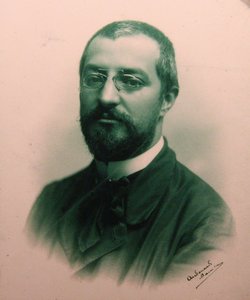
Josep Puig i Cadafalch
1867 - 1956 , Spain
Belangrijkste feiten
- Birth Date: 1867-10-17
- Death Date: 1956-12-21
- Influenced: None, 'influenced by': None, 'movement': 'Modernisme (Catalan Modernism)', 'name': 'Josep Puig i Cadafalch', 'nationality': 'Spanish', 'notable works':
- Birth Place: Mataró, Spain
- Date Of Birth: 1867
- Date Of Death: 1956
- Place Of Birth: Mataró, Spain
- Els Quatre Gats: Casa Amatller
Gerelateerde artikelen

Modernist Art for Commercial Interiors: A Strategic Guide to Transforming Hospitality Spaces with Bold, Scalable Style
Optimize hospitality design with professional Modernist art procurement. APS provides high-volume, hand-painted oil reproductions in scalable sizes for hotels and corporate projects. Benefit from reliable global shipping, bulk ordering, and custom sizing to meet large-scale project demands.
Josep Mompou Dencausse: Exploring Intimacy & Catalan Identity Through Minimalist Expression
Explore the captivating world of Josep Mompou Dencausse, a master of Post-Impressionism whose intimate paintings reflect Catalan identity and minimalist beauty. Discover his life, style & legacy.
Joaquim Mir: A Catalan Visionary – Exploring Symbolism, Landscape & Modernist Aesthetic
Explore the captivating world of Joaquim Mir, a pivotal Catalan Modernisme painter. Discover his vibrant landscapes, symbolic depth & lasting influence on Spanish art history. Learn more at OriginalUniqueArt.

Josep Cusachs i: Exploring Catalan Modernism Through Social Commentary & Artistic Innovation
Explore the captivating world of Josep Cusachs i, a key figure in Catalan Modernism. Discover his realist paintings, social commentary, and influence on 19th-century Spanish art. Hand-painted reproductions available at OriginalUniqueArt.

Charles Sheeler Jr.: Precisionism, Industrial Aesthetics & the American Modernist Vision
Explore the groundbreaking work of Charles Sheeler Jr., a pivotal figure in American Precisionism. Discover his iconic industrial landscapes, photographic studies & lasting influence on modernist art. Expert insights for collectors.
