
 Voorvertoning
 Verstuur
 Delen
Delen
 Details bekijken
 Gids
Gids

 Download
 Vergelijkbare items
 Röntgenonderzoek
 Diavoorstelling
 Statistieken
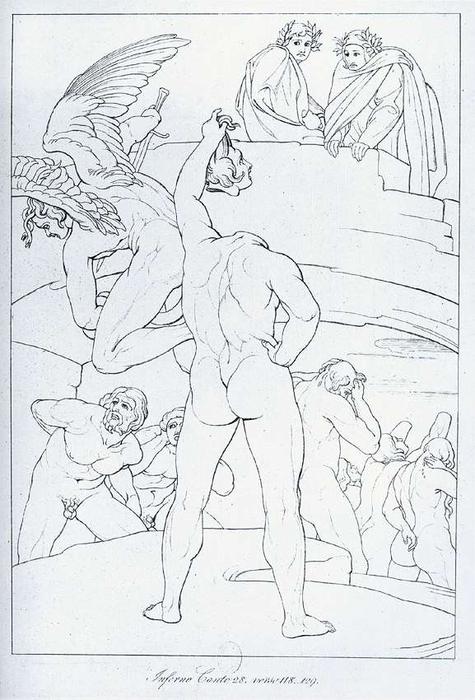
Inferno
 Engraving
- WallArt
- Neoclassical Style
 1793
1793- 19th Century
 160.0 x 270.0 cm
 Bibliothèque nationale de France
 Lees meer
Ontvang een bestand dat klaar is voor drukwerk en de kwaliteit van het online voorbeeld ver overstijgt. Elke digitale afbeelding die wij verkopen, is afkomstig van een high-resolution master uit onze database — meestal tussen de 5.000 en 15.000 pixels breed — zodat u met vertrouwen groot kunt afdrukken, nauwkeurig kunt bijsnijden of fijne details kunt reproduceren.
Geen enkel bestand verlaat ons atelier onbewerkt. Een digitaal expert controleert de kleuren aan de hand van het originele schilderij en corrigeert deze indien nodig, om vervolgens de helderheid en details te verbeteren met professionele retoucheertechnieken — waarbij de penseelstreek en stijl van de kunstenaar altijd strikt worden gerespecteerd. Het resultaat is een afbeelding die oogt als het schilderij zelf, en niet als een gescande foto met een filter.
U keurt goed voordat het proces wordt afgerond: onze expert stuurt de afbeelding binnen 72 uur per e-mail naar u toe ter beoordeling. Niet tevreden? Vraag om verbeteringen of correcties, of vraag een terugbetaling aan als de kwaliteit niet voldoet.
Dit is de kwaliteit waarop uitgevers, designstudio's, galeries en drukkerijen vertrouwen.
Digitale afbeeldingen
Download een bestand met hoge resolutie voor persoonlijke weergave, afdrukken en creatieve projecten. ( Schakel over naar print Bestel handgeschilderde reproductie)
Inbegrepen bij elke bestelling van een digitale afbeelding
Professionele digitale levering, gegarandeerd
Wanneer u kiest voor OriginalUniqueArt.com, ontvangt u niet alleen een afbeelding – u krijgt een professioneel verbeterd digitaal kunstwerk, met precisie vervaardigd en voorzien van een tevredenheidsgarantie. Dit is alles wat automatisch bij uw bestelling is inbegrepen:

Snelle levering per e-mail
Uw hoogwaardige digitale afbeeldingsbestand wordt binnen 72 uur na bestelling naar u gemaild – klaar voor direct gebruik.

AI-verbeterd digitaal bestand
Uw kunstwerk wordt professioneel geoptimaliseerd met behulp van geavanceerde AI-tools en handmatige bewerkingen, waardoor maximale details, helderheid en kleurnauwkeurigheid worden gegarandeerd.

Gratis levenslange herlevering van digitale bestanden
Je bestand per ongeluk verwijderd of kwijtgeraakt? Geen zorgen – we sturen het u op elk gewenst moment gratis opnieuw toe.

Geen invoerkosten – nooit
Geniet direct van uw kunstwerk zonder invoerrechten, belastingen of verzendkosten – digitale downloads zijn altijd belastingvrij.

Garantie op kleurgetrouwheid
Met behulp van professionele hulpmiddelen en kleurbeheer zorgen wij ervoor dat uw digitale afbeelding de originele kleuren zo nauwkeurig mogelijk weergeeft.

100 dagen tevredenheidsgarantie
Mocht u niet tevreden zijn met uw digitale afbeelding, dan passen wij deze aan of storten wij 100% terug binnen 100 dagen – zonder vragen te stellen.

100% Geld-terug-garantie
Niet tevreden? Ontvang een volledige terugbetaling binnen 100 dagen na ontvangst van uw digitale bestand – zonder vragen te stellen.

Korting bij grote bestellingen
Koop 3 afbeeldingen, bespaar 10% - Koop 5, bespaar 15% - Koop 10+, bespaar 20%. Ideaal voor creatieve projecten, galerieën en bureaus.
A Descent Into Darkness: Exploring John Flaxman’s Inferno
John Flaxman's engraving of Dante Alighieri’s *Inferno*, completed in 1793, stands as a monumental achievement of neoclassical illustration—a testament to both artistic skill and intellectual fervor. More than just a depiction of Dante’s harrowing journey through Hell, it embodies the spirit of Enlightenment thought, grappling with themes of morality, judgment, and divine retribution within a meticulously crafted visual language. Flaxman's work transcends mere representation; it strives to convey the profound psychological drama inherent in Dante’s poetic vision.- Composition & Perspective: Flaxman employs a complex pyramidal arrangement, guiding the viewer’s eye upwards towards a radiant angelic figure—a beacon of hope amidst the pervasive gloom. The flattened perspective characteristic of engraving techniques reinforces the sense of timelessness and universality, emphasizing the enduring relevance of Dante's narrative.
- Line Technique & Texture: Flaxman’s mastery lies in his masterful use of line engraving. Delicate lines delineate musculature and facial expressions with astonishing precision, capturing the agony etched upon the tormented souls depicted. Simultaneously, bolder lines define architectural elements and create a palpable textural illusion—the rough surface of Hell contrasted against the smooth contours of angelic forms.
- Color Palette & Lighting: The absence of color is deliberate; Flaxman eschews pigment to focus on tonal variation—a technique favored by neoclassical artists who sought clarity and restraint. Dramatic lighting casts long shadows, intensifying the emotional impact of the scene and highlighting the psychological torment experienced by the figures.
Symbolism & Narrative Depth
The winged creature dominating the upper portion of the engraving serves as a potent symbol—representing divine grace attempting to penetrate the impenetrable darkness of Hell. Its outstretched wings suggest aspiration, redemption, and the promise of salvation for those who persevere through suffering. The anguished expressions on the faces of Dante’s companions convey the visceral horror of their predicament, mirroring the psychological exploration central to Dante's poem. Flaxman doesn’t merely illustrate Dante; he embodies its philosophical core—a confrontation with inescapable moral responsibility.Historical Context & Influence
Flaxman’s engraving emerged during a period of significant artistic and intellectual upheaval in Britain, coinciding with the rise of Neoclassicism as a reaction against Rococo excess. Inspired by classical sculpture and literature, Flaxman sought to recapture the grandeur and moral seriousness of antiquity—values championed by thinkers like Rousseau and Voltaire. His work profoundly impacted subsequent generations of illustrators and artists, establishing a precedent for conveying complex narratives through stylized visual representations. Flaxman’s *Inferno* remains an iconic image of Enlightenment idealism—a timeless depiction of human suffering illuminated by divine compassion.Conclusion: An Enduring Legacy
John Flaxman's *Inferno* endures not merely as a beautiful engraving but as a powerful distillation of Dante’s poetic genius and the intellectual currents of its time. Its meticulous craftsmanship, symbolic richness, and emotive impact continue to inspire admiration and provoke contemplation—a testament to Flaxman’s enduring contribution to British art history and his ability to transform literature into unforgettable visual experience.Veelgestelde vragen
Wie heeft "Inferno" gemaakt?
"Inferno" is gemaakt door John Flaxman. De informatie op deze pagina beschrijft het originele werk van John Flaxman.
Welke emotionele toon gaat gepaard met de Neoclassical Style-stijl van "Inferno"?
De Dramatic emotie van "Inferno" gaat samen met de Neoclassical Style stijl.
Zijn de kleuren van "Inferno" door John Flaxman verzadigd of gedempt?
Het kleurenpalet van "Inferno" heeft een verzadiging van Muted.
Kunstenaarsbiografie
A Life Etched in Stone and Line
John Flaxman, born in York in 1755, emerged as a pivotal figure bridging the gap between the waning Rococo era and the ascendant Neoclassical movement in Britain. His story is one of remarkable artistic evolution, fueled by both innate talent and diligent study. From humble beginnings assisting his father, a moulder of plaster casts, young John absorbed an early appreciation for form and texture. This practical grounding, coupled with a voracious appetite for classical literature – pursued largely through self-education – laid the foundation for a career that would redefine British sculpture and illustration. His childhood was marked by illness and loss; his mother’s death when he was nine years old profoundly shaped his introspective nature. Yet, even in these early years, his artistic promise shone brightly, winning him accolades from the Society of Arts at just twelve years old. This initial success propelled him into the orbit of London's burgeoning art scene, where friendships with William Blake and Thomas Stothard would prove formative, fostering a lifelong exchange of ideas and creative energy.Wedgwood and the Classical Ideal
Flaxman’s artistic trajectory took a significant turn with his employment by Josiah Wedgwood in 1775. This association wasn't merely a source of income; it was an immersive apprenticeship in translating classical motifs into commercially viable art forms. Modeling reliefs for Wedgwood’s renowned jasperware and basaltware demanded precision, economy of line, and a deep understanding of antique design. The influence of d’Hancarville’s engravings of Greek vases proved particularly potent, shaping Flaxman's aesthetic sensibility towards streamlined elegance and narrative clarity. Designs like the *Apotheosis of Homer* and the *Dancing Hours* weren’t simply decorative elements; they were distillations of classical mythology and allegory, rendered with a newfound emphasis on linear grace. This period honed his skills in relief sculpture, a medium he would masterfully employ throughout his career, particularly in his funerary monuments. It was during this time that Flaxman began to cultivate the style for which he became celebrated – a delicate balance between classical purity and emotional resonance.Roman Reveries and Illustrative Triumph
A transformative journey to Rome in 1787 marked a turning point in Flaxman’s artistic development. Funded partly by Wedgwood, this extended sojourn allowed him to immerse himself directly in the heart of antiquity. He studied not only classical sculpture but also medieval and Renaissance art, broadening his understanding of artistic traditions. More importantly, it was in Rome that he began producing the book illustrations that would secure his lasting fame. Commissions followed for editions of Homer’s *Iliad* and *Odyssey*, Dante’s *Divine Comedy*, and Aeschylus' tragedies. These weren’t mere accompaniments to the text; they were independent works of art, characterized by their stark simplicity, dynamic compositions, and masterful use of line. The illustrations, engraved by figures like Tommaso Piroli, resonated deeply with European audiences, earning Flaxman widespread acclaim – Goethe famously hailed him as “the idol of all dilettanti.” His designs for Dante’s *Divine Comedy*, in particular, proved profoundly influential, inspiring artists such as Goya and Ingres and serving as a crucial resource for art students throughout the 19th century.Monuments to Memory and Lasting Legacy
Upon his return to England, Flaxman established himself as a leading sculptor of funerary monuments. He approached these commissions with a unique sensitivity, eschewing ostentation in favor of restrained elegance and heartfelt emotion. His memorials – found in churches across England, including those dedicated to Thomas Chatterton, Mrs. Morley, and the Rev. Thomas Ball – are characterized by their simplicity, pathos, and rhythmic design. The monument to George Stevens, now housed in the Fitzwilliam Museum, exemplifies his ability to convey profound grief and enduring remembrance through subtle yet powerful forms. While he achieved recognition as a professor of sculpture at the Royal Academy in 1810, it is perhaps his illustrations that cemented his place in art history. John Flaxman’s work represents a synthesis of classical ideals, technical mastery, and emotional depth. He left an indelible mark on British art, influencing generations of artists with his elegant style and unwavering commitment to the power of line. His legacy continues to inspire, reminding us of the enduring beauty and profound meaning that can be found in both stone and ink. He remains a testament to the transformative power of artistic vision.
John Flaxman
1755 - 1826 , United States of America
Belangrijkste feiten
- Full Name: John Flaxman
- Nationality: British
- Date Of Birth: 1755
- Date Of Death: 1826
- Place Of Birth: York, United States of America
- Notable Artworks:
- Saint Michael Overcoming Satan
- The Fight for Body of Patroclus
- Apotheosis of Homer
- Dante's Divine Comedy
- Artistic Movement Or Style: Neoclassicism
- Artists Who Influenced This Artist:
- George Romney
- William Blake
- Artists Or Movements Influenced By This Artist:
- Goya
- Ingres