Schakel over naar print
 Lees meer







































 Voor kunstwerken of reproducties die aan één zijde groter zijn dan 105 cm (ongeveer 41 inch), wordt de lijst als een losse set verzonden. Deze methode garandeert een veilige levering en voorkomt schade tijdens het transport.


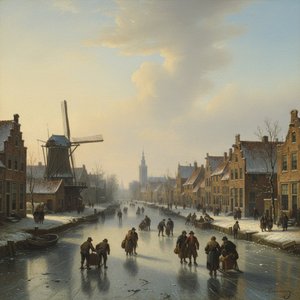
A Symphony of Light and Sky: The Essence of Windmill near Delft
In the quiet, sun-drenched landscapes of the Netherlands, certain moments possess a timeless quality that transcends the mere passage of years. Johan Barthold Jongkind’s 1857 masterpiece, Windmill near Delft, captures such a moment with unparalleled grace. This is not simply a landscape painting; it is a profound meditation on the ephemeral nature of light and the enduring spirit of the Dutch countryside. As the eye wanders across the canvas, one is immediately struck by the brilliant azure sky, where fluffy white clouds drift lazently, casting soft shadows upon the earth below. The composition is anchored by a solitary windmill, positioned with a deliberate, off-center elegance that guides the viewer’s gaze through a tranquil scene of rural life.
The painting serves as a vital bridge between the structured traditions of Dutch Romanticism and the burgeoning revolution of Impressionism. While the subject matter—a quintessential Dutch vista featuring a winding canal and figures engaged in daily rhythms—honors the heritage of masters like Vermeer, Jongkind’s technique whispers of a new era. He moves away from the rigid, meticulous outlines of his predecessors, opting instead for a loose, expressive brushwork that prioritizes atmosphere over anatomical precision. This approach allows the light to appear almost tactile, as if the viewer could feel the warmth of the sun filtering through an overcast afternoon. For the discerning collector or interior designer, this piece offers a sense of movement and vitality, making it a breathtaking focal point for any space seeking a touch of classical serenity paired with modern energy.
Technique and the Impressionistic Dawn
To study Windmill near Delft is to witness the early tremors of the Impressionist movement. Jongkind, a close contemporary and friend to Claude Monet and Eugène Boudin, utilized a palette that was both vibrant and harmoniously muted. His technique involves a sophisticated layering of oil paints to build depth and luminosity, creating a surface where colors bleed into one another with soft, feathered edges. The canal in the foreground acts as a mirror, reflecting the expansive heavens above and pulling the viewer deeper into the perspective of the landscape. This use of horizontal lines emphasizes the vastness of the Dutch horizon, instilling a sense of peace and boundless space.
The emotional resonance of the work lies in its ability to evoke nostalgia without descending into sentimentality. The scattered figures—women tending to flowers by the water’s edge and a man navigating a small boat—are not mere decorations; they are symbols of the quiet, industrious pulse of community life. There is a rhythmic quality to the composition, where the geometric strength of the windmill meets the organic, flowing shapes of the foliage and water. For those looking to adorn a home or gallery, this reproduction offers more than just aesthetic beauty; it provides an invitation to slow down and appreciate the fleeting, beautiful textures of the natural world.
Veelgestelde vragen
Met welke techniek is "Windmill near Delft" gemaakt?
Johan Barthold Jongkind gebruikte de Oil On Canvas-techniek voor "Windmill near Delft". De techniek bepaalt de materiële aard van het originele werk.
Zijn de kleuren van "Windmill near Delft" krachtig of juist zacht?
"Windmill near Delft" door Johan Barthold Jongkind heeft een Balanced kleurintensiteit.
In welke oriëntatie staat "Windmill near Delft" door Johan Barthold Jongkind?
"Windmill near Delft" door Johan Barthold Jongkind is een Portrait compositie. Het is raadzaam de verhoudingen te controleren voordat u een afmeting voor de print kiest.
 Voorvertoning
 Verstuur
 Delen
Delen
 Details bekijken
 Gids
Gids

 Download
 Vergelijkbare items
 Röntgenonderzoek
 Diavoorstelling
 Vraag & antwoord
 Statistieken