

 Bekijk op ware grootte
 Verstuur
 Delen
Delen
 Details bekijken
 Gids voor studentenkunstwerken

 Download
 Vergelijkbare items
 Röntgenonderzoek
 Diavoorstelling
 Statistieken
De gelukkige dag
 Olieverf op canvas
- Wanddecoratie
- Impressionisme
 1892
1892 83.0 x 116.0 cm
 Galleria d'Arte Moderna di Udine
 Lees meer
Handgemaakte olieverfreproductie
Met de hand geschilderd in olieverf op canvas in uw gewenste maat en lijst, op bestelling gemaakt door onze kunstenaars. ( Schakel over naar print Schakel over naar digitale afbeeldingen)




P118B $10

P118H $10

P118W $10

P438Z $10

P508JH $12

P508YH $12

P805H $10

P805Z $10

P919BZ $10

P919G $10

P919XJ $10

P959ZH $10

P968JZ $12

W106C $8

W218G $10

W218JH $8

W218Y $10

W307PJ $10

W316G $10

W316PJ $8

W316Y $10

W398PJ $8

W4111J $10

W500HY $15

W500JH $15

W692G $12

W849H $8

W940BG $15

W953PJ $8




Kies uit onze vooraf ingestelde maten die overeenkomen met de originele verhoudingen van het kunstwerk.

U kunt uw eigen afmetingen invoeren om in een specifieke lijst of ruimte te passen. Als de door u gekozen maat niet overeenkomt met de verhoudingen van het originele beeld, zullen we het kunstwerk bijsnijden of het schilderij uitbreiden met extra handgeschilderde elementen. Een digitale mockup wordt ter goedkeuring naar u verzonden voordat de productie begint.
Houd er rekening mee dat de preview op het scherm niet de werkelijke uitsnede of uitbreiding weergeeft. Alleen de mockup toont de uiteindelijke compositie nauwkeurig.
Hoewel aangepaste afmetingen mogelijk zijn, raden we aan een maat uit de vooraf gedefinieerde lijst te selecteren om de originele verhoudingen te behouden.
Na de bestelling zal het team van OriginalUniqueArt.com per e-mail contact opnemen met de klant voor instructies en een mockup-voorbeeld sturen.
Wereldwijde levering () binnen 3 tot 4 weken in plaats van de standaard 5 weken. (25 september). Zonder concessies aan de kwaliteit.

Gratis wereldwijde expressverzending

Hoogwaardig linnen canvas

Volledige verzendverzekering

Garantie op terugbetaling van invoerrechten

Garantie op exacte kleurweergave

Retourbeleid van 100 dagen (alleen bij defecten)

100% Geld-terug-garantie

Korting bij meerdere afnames
 De optie voor glas is alleen beschikbaar bij een formaat kleiner dan 110 cm.

De gelukkige dag
Reproductiemethode
Formaat reproductie
-


Totaalprijs
$ 300
Een viering van licht en kameraadschap: een verkenning van Joaquín Sorolla’s “The Happy Day”
Joaquín Sorolla y Bastida (1863 – 1923), een Valencianse schilder wiens doeken schitteren met de gouden tinten van mediterrane zomers, blijft een van de meest geliefde artistieke figuren van Spanje. Zijn oeuvre wordt gekenmerkt door een onwankelbare toewijding aan het vastleggen van vluchtige momenten van vreugde en verbondenheid—een filosofie die haar puurste expressie vindt in “The Happy Day”, voltooid in 1892.
- Onderwerp: Het schilderij toont een groep van negen individuen die betrokken zijn bij gezamenlijke reparatiewerkzaamheden aan een boot in een werkplaats. Deze ogenschijnlijk alledaagse activiteit krijgt een diepere betekenis door Sorolla’s meesterlijke weergave van menselijke interactie en gedeelde ervaring.
- Stijl: De stijl van Sorolla is stevig geworteld in het impressionisme, maar hij overstijgt de loutere reproductie van visuele sensaties. In plaats daarvan streeft hij naar een emotionele resonantie—een tastbaar gevoel van warmte, optimisme en gemeenschapszin.
De techniek van Sorolla is opmerkelijk vanwege zijn vermogen om licht met ongeëvenaarde nauwkeurigheid weer te geven. Hij maakt gebruik van losse penseelstreken die over elkaar heen zijn aangebracht om een lumineus oppervlak te creëren dat het gefilterde zonlicht door de bladeren nabootst. De kunstenaar observeert minutieus hoe licht kleur transformeert, waarbij hij subtiele variaties in toon en tint vastlegt die bijdragen aan de algehele atmosfeer van het schilderij.
- Techniek: Sorolla gebruikte olieverf op canvas, die hij met snelle, expressieve streken aanbracht—een kenmerk van de impressionistische praktijk. Hij mengde kleuren op behendige wijze om een fluweelachtige textuur te bereiken en een illusie van diepte te creëren, waardoor de kijker wordt meegezogen in de levendige omgeving van de scène.
- Kleurenpalet: Het dominante kleurenpalet van het schilderij bestaat uit warme gelen, oranjes en roden—kleuren die associaties oproepen met zonneschijn, warmte en vitaliteit. Deze tinten worden afgezet tegen koelere groenen en blauwen om een harmonieus evenwicht te creëren en het gevoel van sereniteit te versterken.
“The Happy Day” bevindt zich in de Galleria d’Arte Moderna di Udine in Udine, Italië, waar het het publiek blijft boeien met zijn tijdloze schoonheid. Naast de esthetische verdiensten spreekt het schilderij tot bredere thema's van menselijke verbondenheid en de transformerende kracht van gezamenlijke inspanning. Sorolla's intentie was niet enkel om een scène in een werkplaats af te beelden; hij zocht naar de essentie van geluk te vangen—een moment bevroren in de tijd, uitstralend van warmte en uitnodigend tot contemplatie.
Historische context:
Geschilderd tijdens de Belle Époque, weerspiegelt “The Happy Day” het optimisme en de dynamiek van die tijd. Het werk van Sorolla sluit aan bij een bredere artistieke beweging die het realisme ondersteunde naast expressieve kleur—een bewuste breuk met academische conventies die minutieuze details boven emotionele impact stelden.
Symboliek:
De boot zelf dient als een krachtig symbool—het vertegenwoordigt niet alleen praktische arbeid, maar ook aspiratie, vooruitgang en het streven naar collectieve doelen. De figuren eromheen belichamen kameraadschap en samenwerking—waarden die door het hele oeuvre van Sorolla worden gevierd.
Uiteindelijk overstijgt “The Happy Day” zijn formele elementen om een blijvende boodschap over te brengen: dat ware vreugde schuilt in het omarmen van de eenvoudige genoegens van het leven en het koesteren van betekenisvolle verbindingen met anderen. Het blijft een getuigenis van Sorolla’s artistieke genie—een meesterwerk van het impressionisme dat blijft inspireren tot bewondering en verwondering.
Biografie van de kunstenaar
A Life Bathed in Light: The World of Joaquín Sorolla
Joaquín Sorolla y Bastida, a name inextricably linked to the radiant light and vibrant energy of Spain, was far more than simply a painter; he served as a chronicler of his nation’s very soul. Born in Valencia in 1863, Sorolla's early life unfolded under a shadow of profound loss. Orphaned at the tender age of two following a devastating cholera epidemic that claimed both his parents, young Joaquín and his younger sister were entrusted to the care of their maternal aunt and uncle – an experience that likely instilled within him a deep-seated appreciation for the ephemeral beauty of existence—a sentiment that would profoundly shape his artistic vision. Despite these early hardships, the spark of artistic talent ignited within him, quickly becoming apparent through his initial instruction in Valencia, where his aptitude was recognized, leading to studies under established artists such as Cayetano Capuz and José Benlliure, culminating in a coveted four-year grant to pursue his passion in Rome. It was amidst the classical grandeur of Italy that Sorolla began to forge his distinctive artistic path, absorbing influences while simultaneously developing a style uniquely his own—a synthesis of tradition and innovation.From Historical Narratives to Sun-Drenched Realism
Sorolla’s early works were largely defined by the prevailing academic trends of the time – sweeping historical and mythological scenes rendered with meticulous detail. However, a transformative shift occurred upon his return to Spain, as he began to truly observe the world around him. He found himself utterly captivated by the everyday lives of his countrymen, particularly those inhabiting the sun-drenched coastline of Valencia. The intense Mediterranean sunlight, the shimmering sea, and the palpable energy of the people became the primary subjects that fueled his artistic endeavors. This transition wasn’t immediate; Sorolla continued to explore social realism with poignant works such as *Sad Inheritance* (1899), a deeply moving depiction of children afflicted by polio bathing in the sea—a painting that garnered significant acclaim, yet simultaneously revealed a compassionate and empathetic side to his artistic sensibilities. *Sad Inheritance*, exhibited at the Universal Exhibition in Paris, brought him widespread recognition and firmly established his position as a leading figure within the Spanish art scene. Yet, it was his increasingly focused exploration of light and color, deeply influenced by Impressionism—though never fully embracing its tenets—that would ultimately define his legacy. He wasn’t merely *depicting* light; he sought to *capture* its very essence—the way it danced on water, illuminated skin, and transformed ordinary moments into scenes brimming with extraordinary beauty.Master of Luminism: A Unique Artistic Voice
Sorolla's technique became instantly recognizable – a bold and dynamic display of brushwork characterized by loose, energetic strokes that conveyed movement and atmosphere. He favored working *en plein air* whenever possible, directly confronting the challenges of capturing fleeting light conditions. This dedication to painting outdoors resulted in canvases brimming with life and immediacy. His beach scenes—perhaps his most iconic works—are not simply picturesque representations of leisure; they are meticulously crafted studies in luminosity, reflections, and the joyful interaction between people and their environment. Paintings such as *Children on the Seashore* and *Sewing the Sail* exemplify this mastery – figures bathed in golden light, rendered with a remarkable sense of spontaneity and vitality. He wasn’t interested in achieving photographic precision; rather, he sought to convey the *impression* of reality—prioritizing atmosphere and emotion over strict adherence to detail. This approach earned him comparisons to Impressionists like Monet and Renoir, yet Sorolla's work possessed a distinctly Spanish character—a warmth, intensity, and emotional depth that set it apart.Key Achievements & Recognition
- 1892: Received the gold medal at the National Exhibition in Madrid for *Another Marguerite*.
- 1894: Gained recognition for *The Return from Fishing: Hauling the Boat*, which was acquired by the Musée du Luxembourg.
- 1899: Awarded a Grand Prix and an honorary medal at the Universal Exhibition in Paris for *Sad Inheritance*.
- 1900-1923: Enjoyed extensive exhibitions throughout Europe and the United States, solidifying his international reputation.
- 1912-1928: Commissioned to create *Vision of Spain* for the Hispanic Society of America (completed posthumously).
- Present Day: His works are proudly displayed in major museums worldwide, including the Museo Sorolla in Madrid.
Legacy and Enduring Influence
By the early 20th century, Joaquín Sorolla had firmly established himself as an internationally renowned artist. He exhibited extensively throughout Europe and the United States, receiving numerous accolades and prestigious commissions. His most ambitious undertaking—*Vision of Spain*, a series of fourteen monumental murals commissioned by the Hispanic Society of America—stands as a testament to his artistic vision and technical skill. Though he suffered a debilitating stroke in 1920 that curtailed his painting activity, Sorolla’s influence continued to grow after his death in 1923. His work inspired generations of artists, not only within Spain but across the globe. Today, his paintings continue to resonate with audiences, reminding us of the power of art to illuminate our world and capture the fleeting beauty of life—a legacy firmly rooted in the radiant light and vibrant spirit of Spain.
Joaquín Sorolla
1863 - 1923 , Spanje
Snelle feiten
- Artistic Movement Or Style: Impressionisme, Luminisme
- Artists Or Movements Influenced By This Artist: ['Sorolla']
- Artists Who Influenced This Artist:
- Pradilla
- Bastien-Lepage
- Menzel
- Date Of Birth: 27 feb 1863
- Date Of Death: 10 aug 1923
- Full Name: Joaquín Sorolla y Bastida
- Nationality: Spaans
- Notable Artworks:
- Another Marguerite
- Return van Vissen
- Sad Inheritance
- Place Of Birth: Valencia, Spanje
Gerelateerde artikelen
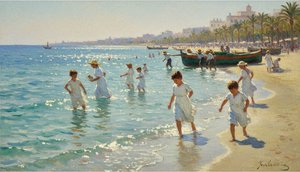
Joaquín Sorolla: Capturing Spanish Light & Life – A Legacy of Impressionism
Explore the luminous world of Joaquín Sorolla, Spanish master of Impressionism. Discover his life, techniques & legacy – a guide for art collectors and enthusiasts. Invest in timeless beauty.

Manuel Benedito Vives: A Study of Light, Color & Emotional Resonance in Contemporary Spanish Painting
Explore the captivating world of Manuel Benedito Vives, a celebrated Spanish painter influenced by Sorolla. Discover his masterful portraits, luminous landscapes & enduring legacy – a favorite of the Spanish Royal Family. Art collectors will appreciate this in-depth study.

Top 10 Boot Kunstwerken: Meesterwerken & Decoratie Inspiratie | OriginalUniqueArt
Ontdek 10 iconische boot kunstwerken! Van Monet's impressionisme tot Courbet's realisme. Leer over de geschiedenis, techniek & betekenis van deze meesterwerken. Vind museumkwaliteit reproducties en decoratie inspiratie op OriginalUniqueArt.com.
Evocations of Open Air: A Comprehensive Exploration of Outdoor Scenes in Art History
Explore the rich history of outdoor painting! Discover Impressionism, en plein air techniques & renowned landscape artists. Learn about light, color & enduring artistic legacies with OriginalUniqueArt.

Top 10 Impressionistische Meesterwerken: Kleur, Licht & Emotie voor uw Interieur
Ontdek de top 10 impressionistische meesterwerken van Monet, Renoir & meer! Duik in kleur, licht en emotie met deze iconische schilderijen. Vind museumkwaliteit kunst reproducties voor uw interieur op OriginalUniqueArt.com.


