Voorvertoning
 Verstuur
 Delen
Delen
 Details bekijken

 Download
 Vergelijkbare items
 Röntgenonderzoek
 Diavoorstelling
Untitled
 Acrylic On Canvas
- WallArt
- Surrealism
 1931
1931- Modern
 19.0 x 27.0 cm
 Lees meer
Giclée / Kunstafdrukken
Giclée- of canvasafdruk van museumkwaliteit met een snelle productie en flexibele afwerkingsmogelijkheden. ( Bestel handgeschilderde reproductie Koop afbeelding)




P118B $10

P118H $10

P118W $10

P438Z $10

P508JH $12

P508YH $12

P805H $10

P805Z $10

P919BZ $10

P919G $10

P919XJ $10

P959ZH $10

P968JZ $12

W106C $8

W218G $10

W218JH $8

W218Y $10

W307PJ $10

W316G $10

W316PJ $8

W316Y $10

W398PJ $8

W4111J $10

W500HY $15

W500JH $15

W692G $12

W849H $8

W940BG $15

W953PJ $8




Kies uit onze vooraf ingestelde maten die overeenkomen met de originele verhoudingen van het kunstwerk.

U kunt uw eigen afmetingen opgeven om in een specifieke lijst of ruimte te passen. Als de door u gekozen maat niet overeenkomt met de proporties van het originele kunstwerk, zullen wij de afbeelding bijsnijden of uitbreiden met een gespiegelde of effen rand. Een digitaal mockup wordt ter goedkeuring naar u verzonden voordat de productie begint.
Houd er rekening mee dat de preview op het scherm de werkelijke bijsneding of uitbreiding niet weergeeft. Alleen de mockup toont de uiteindelijke compositie nauwkeurig.
Hoewel aangepaste maten beschikbaar zijn, raden wij aan een afmeting uit de vooraf bepaalde lijst te kiezen om de originele proporties te behouden.
Wereldwijde levering () binnen 2 weken in plaats van de standaard 4/5 weken. (7 september)

Gratis wereldwijde expressverzending

Hoogwaardig linnen canvas

Volledige verzendverzekering

Garantie op terugbetaling van invoerrechten

Garantie op exacte kleurweergave

Retourbeleid van 100 dagen (alleen bij defecten)

100% Geld-terug-garantie

Korting bij meerdere afnames
 De optie voor glas is alleen beschikbaar bij een formaat kleiner dan 110 cm.

Untitled
Giclée / Kunstafdrukken
Afmetingen reproductie
-


Eindtotaal
$ 81
A Window into Miró’s Inner World: Exploring an Untitled Composition from 1931
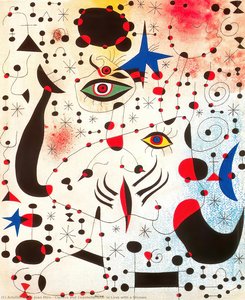
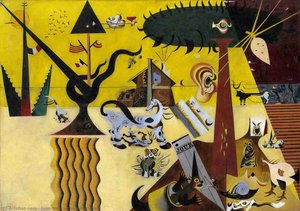
This captivating work by Joan Miró, created in 1931, offers a compelling glimpse into the artist's unique visual language and psychological landscape. Measuring just 19 x 27 cm, its intimate scale belies the expansive world contained within. Painted on wood, this piece is part of a pivotal series produced following a period of personal crisis – a nervous breakdown – for Miró. This context is crucial to understanding the raw emotionality and dreamlike quality that permeate the composition. The artwork’s previous ownership by Surrealist poet Georges Hugnet, author of a seminal work on Miró himself, further anchors it within an important intellectual circle.Decoding the Visual Language: Style & Technique
The painting is a masterful example of Miró's evolving style, blending elements of Cubism and Surrealism into something distinctly his own. Biomorphic shapes, rounded and organic, dominate the canvas, suggesting figures or forms emerging from an unconscious realm. These aren’t representations in the traditional sense; rather, they are *evocations* – fragments of memory, emotion, or perhaps pure invention. The artist employs a fluid line and a warm palette of yellows and oranges, creating a dynamic yet harmonious interplay between form and color. While appearing spontaneous, the work reveals careful consideration of composition, with overlapping shapes and subtle variations in saturation used to suggest depth and movement within a deliberately flattened space. Brushwork is visible, adding texture and reinforcing the sense of immediacy.Symbolism & Psychological Resonance
Interpreting Miró’s symbolism is often an exercise in embracing ambiguity. The abstracted forms resist definitive readings, inviting viewers to project their own associations and emotions onto the work. Some scholars suggest these shapes represent fragmented human figures or psychological states – anxieties, desires, or subconscious impulses brought to the surface. The dreamlike quality isn’t accidental; Miró aimed to bypass rational thought and tap into the realm of the irrational, mirroring the principles championed by the Surrealist movement. The lack of a clear narrative encourages contemplation and allows for a deeply personal connection with the artwork. It's a visual poem rather than a literal depiction.Historical Context & Lasting Influence
Created in 1931, this piece reflects a period of significant artistic experimentation. The Surrealist movement was gaining momentum, challenging conventional notions of representation and exploring the power of the unconscious mind. Miró’s work, alongside that of artists like Dalí and Magritte, helped to define this revolutionary aesthetic. His influence extends far beyond painting; his distinctive visual vocabulary has resonated with designers, sculptors, and contemporary artists for generations. This *Untitled* composition is not merely a historical artifact but a testament to the enduring power of abstract art to evoke emotion, stimulate imagination, and offer a window into the complexities of the human psyche.Biografie van de kunstenaar
A Catalan Visionary: The Life and Art of Joan Miró
Joan Miró i Ferrà, born in Barcelona in 1893, stands as one of the most significant figures in 20th-century art. His journey was not merely a progression through styles but an exploration of inner worlds, translating dreams, memories, and Catalan identity onto canvas with a uniquely poetic visual language. From humble beginnings marked by illness and initial parental reservations about his artistic pursuits, Miró persevered, driven by an innate need to express the intangible—the emotions, sensations, and subconscious currents that lie beneath the surface of reality. His early life was steeped in the traditions of Barcelona, a city brimming with architectural marvels thanks to Antoni Gaudí, whose organic forms would subtly influence Miró’s later abstractions. The goldsmithing profession of his father instilled an appreciation for meticulous craftsmanship, while the rugged Catalan landscape became a recurring motif and source of inspiration throughout his career.Early Influences and the Path to Surrealism
Miró's formal artistic training began at La Llotja in Barcelona, where he honed his skills in traditional techniques. However, it was exposure to the avant-garde movements sweeping through Paris that truly ignited his creative evolution. The vibrant colors of Fauvism and the fragmented forms of Cubism resonated deeply, prompting him to move to Paris in 1920. This period proved pivotal as he encountered artists like Pablo Picasso and began experimenting with increasingly abstract compositions. Yet, Miró didn’t simply adopt these styles; he synthesized them, forging a path toward his own distinctive aesthetic. He sought to distill forms to their essence, stripping away representational details in favor of symbolic shapes and evocative colors. This exploration led him to the Surrealist group in 1924, aligning him with artists such as Max Ernst and Salvador Dalí. While embracing the Surrealist interest in the subconscious, Miró maintained a unique sensibility—his work was less about shocking imagery or Freudian symbolism than it was about creating a world of playful forms and poetic suggestion.The Language of Symbols: Key Works and Artistic Innovations
Throughout the 1920s and 30s, Miró developed his signature visual vocabulary—a universe populated by biomorphic shapes, floating forms, and vibrant colors. The Farm (1922), often considered a cornerstone of his oeuvre, exemplifies this transition. It’s not merely a depiction of rural life but an evocation of Catalan identity and a symbolic representation of the natural world. His collaborative spirit led to innovative techniques like *grattage*, pioneered with Max Ernst in 1926 for designs intended for Sergei Diaghilev's ballet, where textures were revealed by scraping paint across canvas. The Dutch Interiors (1928) series demonstrated his ability to reinterpret the Old Masters through a distinctly modern lens, transforming domestic scenes into dreamlike abstractions. Painting (1933), with its bold colors and simplified forms, encapsulates Miró’s exploration of the subconscious and his rejection of conventional artistic boundaries. Beyond painting, Miró fearlessly experimented with sculpture, ceramics, and printmaking, expanding his creative horizons and demonstrating a remarkable versatility.Legacy and Enduring Influence
Joan Miró's impact on 20th-century art is undeniable. He wasn’t simply a painter; he was a visionary who challenged the very definition of artistic expression. His work paved the way for abstract expressionism and continues to inspire artists across disciplines. He established two foundations—the Fundació Joan Miró in Barcelona (1975) and the Fundació Pilar i Joan Miró in Palma de Mallorca (1981)—ensuring that his legacy would endure, providing spaces for artistic exploration and education. Throughout his long career, he remained committed to pushing boundaries, questioning conventions, and exploring the depths of human imagination. Miró’s art is a testament to the power of abstraction, symbolism, and poetic expression—a vibrant celebration of life, dreams, and the enduring spirit of Catalan culture. His work continues to resonate with audiences worldwide, inviting us to enter a world where anything is possible and the boundaries between reality and fantasy blur into a captivating dance of color and form.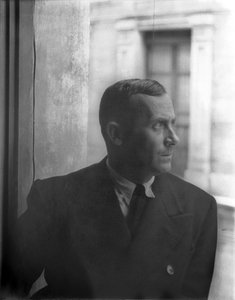
Joan Miró
1893 - 1983 , Spanje
Belangrijkste feiten
- Artistic Movement Or Style: Surrealisme, Abstract Art
- Artists Who Influenced This Artist:
- Pablo Picasso
- Sergei Diaghilev
- Date Of Birth: 20 april 1893
- Full Name: Joan Miró i Ferrà
- Nationality: Spanish
- Notable Artworks:
- The Farm
- Dutch Interiors
- Painting
- Place Of Birth: Barcelona, Spain
Gerelateerde artikelen
Joan Miró's Top 25 Meesterwerken: Kleurrijke Dromen voor Je Interieur | OriginalUniqueArt
Ontdek de top 25 kunstwerken van Joan Miró! Duik in zijn kleurrijke wereld vol surrealisme & abstractie. Leer over zijn techniek en vind museumkwaliteit reproducties voor jouw interieur op OriginalUniqueArt.com.
Top 10 Surrealistische Meesterwerken: Kunst die de Realiteit Uitdaagt | OriginalUniqueArt
Ontdek de 10 meest iconische surrealistische schilderijen van Dalí, Magritte & Miró. Duik in de droomwereld en onbewuste kunst met OriginalUniqueArt's collectie hoogwaardige reproducties. Vind jouw perfecte wandkunst! Explore the full collection online.

Top 10 Meesterwerken van de Geometrische Abstractie | OriginalUniqueArt.nl
Ontdek de 10 meest invloedrijke meesterwerken van de geometrische abstractie! Van Mondriaan tot Malevich, leer over kunstenaars, technieken & kleuren. Museumkwaliteit reproducties op OriginalUniqueArt.com – voor een unieke interieurstijl.

Top 10 Abstract Expressionisme Meesterwerken: Kunst voor uw Interieur | OriginalUniqueArt.com
Ontdek de 10 meest invloedrijke werken van Abstract Expressionisme! Leer over Jackson Pollock, Mark Rothko & meer. Museumkwaliteit kunst reproducties voor uw interieur. Bekijk de collectie op OriginalUniqueArt.com.
Top 10 Surrealistische Meesterwerken: Kunst die de Realiteit Uitdaagt | OriginalUniqueArt
Ontdek de 10 meest iconische surrealistische meesterwerken van Dalí, Magritte & Miró. Duik in hun droomwerelden en laat je inspireren door deze baanbrekende kunst. Museumkwaliteit reproducties op OriginalUniqueArt.com – Kunst voor elke wand!