Voorvertoning
 Verstuur
 Delen
Delen
 Details bekijken
 Gids
Gids

 Download
 Vergelijkbare items
 Röntgenonderzoek
 Diavoorstelling
 Statistieken
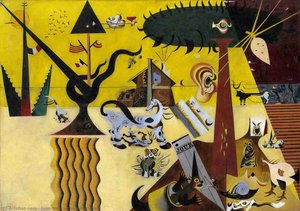
Harlekijn's Karnaval
 Olieverf op canvas
- Wanddecoratie
- Surrealist Expression
 1925
1925- Modern
 66.0 x 93.0 cm
 Buffalo AKG Art Museum
 Lees meer
De kunstwerken die op deze pagina worden weergegeven, zijn beschermd door de auteursrechtwetgeving, wat betekent dat het ons wettelijk niet is toegestaan om identieke reproducties te maken of te verkopen. Deze bescherming wordt gehandhaafd onder internationale overeenkomsten zoals de Conventie van Bern en door nationale wetgeving, waaronder de bepalingen van de Amerikaanse auteurswet - Titel 17. Alle rechten voorbehouden. Reproduceren of distribueren van afbeeldingen is niet toegestaan zonder uitdrukkelijke schriftelijke toestemming van WahooArt.com en de rechthebbenden.
Deze methode voldoet volledig aan de auteursrechtwetgeving, omdat het niet gaat om het kopiëren of dupliceren van het beschermde kunstwerk. In plaats daarvan is er sprake van een creatieve herinterpretatie — een nieuw schilderij dat door het origineel wordt geïnspireerd, maar er niet identiek aan is.
Giclée / Kunstafdrukken
Giclée- of canvasafdruk van museumkwaliteit met een snelle productie en flexibele afwerkingsmogelijkheden. ( Bestel handgeschilderde reproductie Schakel over naar digitale afbeeldingen)




P118B €10

P118H €10

P118W €10

P438Z €10

P508JH €12

P508YH €12

P805H €10

P805Z €10

P919BZ €10

P919G €10

P919XJ €10

P959ZH €10

P968JZ €12

W106C €8

W218G €10

W218JH €8

W218Y €10

W307PJ €10

W316G €10

W316PJ €8

W316Y €10

W398PJ €8

W4111J €10

W500HY €15

W500JH €15

W692G €12

W849H €8

W940BG €15

W953PJ €8




Kies uit onze vooraf ingestelde maten die overeenkomen met de originele verhoudingen van het kunstwerk.

Voer de gewenste breedte en hoogte in, passend bij uw lijst of muur. Een afdruk kan alleen worden ingekort en nooit groter worden gemaakt dan het origineel; een formaat met andere verhoudingen zal daarom een deel van de afbeelding verliezen. Wij sturen u een digitaal mockup ter goedkeuring voordat we tot drukwerk overgaan. De afbeelding op deze pagina toont niet de werkelijke uitsnede — dit is alleen te zien op het mockup.
Wereldwijde levering () binnen 2 weken in plaats van de standaard 4/5 weken. (26 oktober)

Gratis wereldwijde expressverzending

Hoogwaardig linnen canvas

Volledige verzendverzekering

Garantie op terugbetaling van invoerrechten

Garantie op exacte kleurweergave

Retourbeleid van 100 dagen (alleen bij defecten)

100% Geld-terug-garantie

Korting bij meerdere afnames
 De optie voor glas is alleen beschikbaar bij een formaat kleiner dan 110 cm.

Harlekijn's Karnaval
Giclée / Kunstafdrukken
Afmetingen reproductie
-


Eindtotaal
€ 71
Een surrealistisch meesterwerk van Joan Miró
Joan Miró's "Harlekijnskarnaval" (1925) is een levendige en complexe compositie die de essentie van het surrealisme perfect vangt. Dit fascinerende kunstwerk nodigt de kijker uit in een sprookjesachtige wereld waarin fantasie en realiteit met elkaar verweven zijn, wat het een volmaakte toevoeging maakt aan elke kunstcollectie of elk verfijnd interieur.
Speelse onderwerpen en compositie
Het schilderij bruist van de uiteenlopende objecten, figuren en abstracte elementen, wat een dynamische en speelse atmosfeer creëert. De compositie is dichtbevolkt met talloze elementen die over het canvas zijn verspreid; door de levendige kleuren en ongebruikelijke vormen wordt de blik van de toeschouwer voortdurend naar nieuwe gebieden getrokken. Deze organische en spontane ordening roept een gevoel van verwondering en nieuwsgierigheid op.
Rijk kleurenpalet en gedurfde penseelstreken
Het kleurenpalet is rijk en gevarieerd, met warme aardetinten zoals bruin en beige die contrasteren met heldere accenten van rood, blauw, geel en groen. Deze krachtige kleuren worden spaarzaam maar effectief ingezet om de aandacht te vestigen op specifieke elementen binnen de compositie. Het gebruik van lijnen, vormen en texturen voegt diepte en complexiteit toe, waarbij een mix van organische en geometrische vormen een gevoel van beweging en spontaniteit creëert.
Historische context en symboliek
Gemaakt tussen 1924 en 1925, is "Harlekijnskarnaval" een van Miró's bekendste werken en een schoolvoorbeeld van surrealistische kunst. De harlekijn, een bekend personage uit het Italiaanse komische theater, wordt afgebeeld met een ruitjeskostuum, een snor, een admiraalsmuts en een pijp. Het carnavals thema kan verwijzen naar Mardi Gras, de viering die plaatsvindt vlak voordat de vastentijd begint.
Het schilderij bevat talrijke fantastische en magische elementen, zoals zeemeerminnen, vissen buiten het water, dansende katten, vallende sterren, een gevleugeld wezen in een doos die op een dobbelsteen lijkt, zwevende muzieknoten en een zwevende hand. Elk object vertegenwoordigt mogelijk verschillende ideeën of emoties, waardoor de kijker wordt uitgenodigd om de scène te verkennen en te interpreteren.
Emotionele impact en artistieke techniek
"Harlekijnskarnaval" straalt een speelse en verbeeldingsrijke stemming uit, wat het tot een boeiend werk maakt dat vreugde en nieuwnieuwsgierigheid opwekt. Het gebruik van heldere kleuren tegen een gedempte achtergrond zorgt voor een opvallend contrast, wat de algehele impact van het kunstwerk versterkt.
Miró maakte gebruik van een combinatie van schildertechnieken en mogelijk collage-elementen, met verfijnde details en gedurfde penseelstreken. Gezien de rijkdom en diepte van de kleuren, bevatten de gebruikte materialen waarschijnlijk olieverf of acrylverf op canvas. Dit meesterwerk is een getuigenis van Miró's vermogen om zijn innerlijke leven uit te drukken via visionaire kunst.
Waarom kiezen voor deze reproductie?
Voor kunstliefhebbers, verzamelaars en interieurontwerpers die op zoek zijn naar een werk dat levendigheid en intrige aan elke ruimte toevoegt, is "Harlekijnskarnaval" een uitstekende keuze. De surrealistische stijl en de rijke symboliek maken het een gespreksstof bij uitstek, terwijl de speelse en verbeeldingsrijke sfeer een gevoel van vreugde en verwondering in elke kamer brengt.
Investeer in een hoogwaardige reproductie van dit iconische kunstwerk en breng de magie van Joan Miró naar uw huis of kantoor. Of u nu op zoek bent naar inspiratie voor creativiteit, een vleugje fantasie wilt toevoegen, of simpelweg de schoonheid van de surrealistische kunst wilt waarderen: "Harlekijnskarnaval" is een tijdloos meesterwerk dat nog jarenlang zal blijven boeien en verrassen.
Veelgestelde vragen
Waarvoor wordt het gebruik van "Harlekijn's Karnaval" door Joan Miró aanbevolen?
Een reproductie van "Harlekijn's Karnaval" door Joan Miró wordt aanbevolen voor Gespreksstof. Dit advies is gebaseerd op het onderwerp, de sfeer en de kleuren van het werk.
Hoe verzadigd is het kleurenpalet van "Harlekijn's Karnaval"?
De kleuren van "Harlekijn's Karnaval" door Joan Miró hebben een Duidelijke kleurverzadiging verzadiging. Verzadiging beschrijft hoe levendig of gedempt de kleuren zijn.
Wie heeft "Harlekijn's Karnaval" gemaakt?
De kunstenaar achter "Harlekijn's Karnaval" is Joan Miró. Het werk is gecatalogiseerd onder de naam van Joan Miró.
Biografie kunstenaar
A Catalan Visionary: The Life and Art of Joan Miró
Joan Miró i Ferrà, born in Barcelona in 1893, stands as one of the most significant figures in 20th-century art. His journey was not merely a progression through styles but an exploration of inner worlds, translating dreams, memories, and Catalan identity onto canvas with a uniquely poetic visual language. From humble beginnings marked by illness and initial parental reservations about his artistic pursuits, Miró persevered, driven by an innate need to express the intangible—the emotions, sensations, and subconscious currents that lie beneath the surface of reality. His early life was steeped in the traditions of Barcelona, a city brimming with architectural marvels thanks to Antoni Gaudí, whose organic forms would subtly influence Miró’s later abstractions. The goldsmithing profession of his father instilled an appreciation for meticulous craftsmanship, while the rugged Catalan landscape became a recurring motif and source of inspiration throughout his career.Early Influences and the Path to Surrealism
Miró's formal artistic training began at La Llotja in Barcelona, where he honed his skills in traditional techniques. However, it was exposure to the avant-garde movements sweeping through Paris that truly ignited his creative evolution. The vibrant colors of Fauvism and the fragmented forms of Cubism resonated deeply, prompting him to move to Paris in 1920. This period proved pivotal as he encountered artists like Pablo Picasso and began experimenting with increasingly abstract compositions. Yet, Miró didn’t simply adopt these styles; he synthesized them, forging a path toward his own distinctive aesthetic. He sought to distill forms to their essence, stripping away representational details in favor of symbolic shapes and evocative colors. This exploration led him to the Surrealist group in 1924, aligning him with artists such as Max Ernst and Salvador Dalí. While embracing the Surrealist interest in the subconscious, Miró maintained a unique sensibility—his work was less about shocking imagery or Freudian symbolism than it was about creating a world of playful forms and poetic suggestion.The Language of Symbols: Key Works and Artistic Innovations
Throughout the 1920s and 30s, Miró developed his signature visual vocabulary—a universe populated by biomorphic shapes, floating forms, and vibrant colors. The Farm (1922), often considered a cornerstone of his oeuvre, exemplifies this transition. It’s not merely a depiction of rural life but an evocation of Catalan identity and a symbolic representation of the natural world. His collaborative spirit led to innovative techniques like *grattage*, pioneered with Max Ernst in 1926 for designs intended for Sergei Diaghilev's ballet, where textures were revealed by scraping paint across canvas. The Dutch Interiors (1928) series demonstrated his ability to reinterpret the Old Masters through a distinctly modern lens, transforming domestic scenes into dreamlike abstractions. Painting (1933), with its bold colors and simplified forms, encapsulates Miró’s exploration of the subconscious and his rejection of conventional artistic boundaries. Beyond painting, Miró fearlessly experimented with sculpture, ceramics, and printmaking, expanding his creative horizons and demonstrating a remarkable versatility.Legacy and Enduring Influence
Joan Miró's impact on 20th-century art is undeniable. He wasn’t simply a painter; he was a visionary who challenged the very definition of artistic expression. His work paved the way for abstract expressionism and continues to inspire artists across disciplines. He established two foundations—the Fundació Joan Miró in Barcelona (1975) and the Fundació Pilar i Joan Miró in Palma de Mallorca (1981)—ensuring that his legacy would endure, providing spaces for artistic exploration and education. Throughout his long career, he remained committed to pushing boundaries, questioning conventions, and exploring the depths of human imagination. Miró’s art is a testament to the power of abstraction, symbolism, and poetic expression—a vibrant celebration of life, dreams, and the enduring spirit of Catalan culture. His work continues to resonate with audiences worldwide, inviting us to enter a world where anything is possible and the boundaries between reality and fantasy blur into a captivating dance of color and form.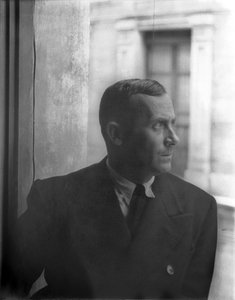
Joan Miró
1893 - 1983 , Spanje
Belangrijkste feiten
- Artistic Movement Or Style: Surrealisme, Abstract Art
- Artists Who Influenced This Artist:
- Pablo Picasso
- Sergei Diaghilev
- Date Of Birth: 20 april 1893
- Full Name: Joan Miró i Ferrà
- Nationality: Spanish
- Notable Artworks:
- The Farm
- Dutch Interiors
- Painting
- Place Of Birth: Barcelona, Spain
Gerelateerde artikelen

Top 10 Abstract Expressionisme Meesterwerken: Kunst voor uw Interieur | OriginalUniqueArt.com
Ontdek de 10 meest invloedrijke werken van Abstract Expressionisme! Leer over Jackson Pollock, Mark Rothko & meer. Museumkwaliteit kunst reproducties voor uw interieur. Bekijk de collectie op OriginalUniqueArt.com.

Top 10 Meesterwerken van de Geometrische Abstractie | OriginalUniqueArt.nl
Ontdek de 10 meest invloedrijke meesterwerken van de geometrische abstractie! Van Mondriaan tot Malevich, leer over kunstenaars, technieken & kleuren. Museumkwaliteit reproducties op OriginalUniqueArt.com – voor een unieke interieurstijl.
Top 10 Surrealistische Meesterwerken: Kunst die de Realiteit Uitdaagt | OriginalUniqueArt
Ontdek de 10 meest iconische surrealistische meesterwerken van Dalí, Magritte & Miró. Duik in hun droomwerelden en laat je inspireren door deze baanbrekende kunst. Museumkwaliteit reproducties op OriginalUniqueArt.com – Kunst voor elke wand!
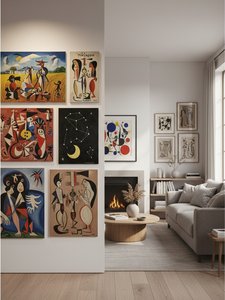
Joan Miró's Top 25 Meesterwerken: Kleurrijke Dromen voor Je Interieur | OriginalUniqueArt
Ontdek de top 25 kunstwerken van Joan Miró! Duik in zijn kleurrijke wereld vol surrealisme & abstractie. Leer over zijn techniek en vind museumkwaliteit reproducties voor jouw interieur op OriginalUniqueArt.com.
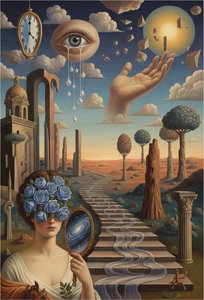
Top 10 Surrealistische Meesterwerken: Kunst die de Realiteit Uitdaagt | OriginalUniqueArt
Ontdek de 10 meest iconische surrealistische schilderijen van Dalí, Magritte & Miró. Duik in de droomwereld en onbewuste kunst met OriginalUniqueArt's collectie hoogwaardige reproducties. Vind jouw perfecte wandkunst! Explore the full collection online.