Pop Art · 1999
MONKEY (Red-Orange) (Jeff Koons, 1999)
Jeff Koons (1955) maakte MONKEY (Red-Orange). Het dateert uit 1999. Het behoort tot de Pop Art-stroming.
- 1999

 Voorvertoning

 Met de hand geschilderd olieverfwerk
 Verstuur
 Delen
 Informatieblad


 Download
 Vergelijkbare items
 Röntgenonderzoek
 Diavoorstelling
 Vraag & antwoord

 Statistieken
MONKEY (Red-Orange), in het kort
- Titel
- MONKEY (Red-Orange)
- Kunstenaar
- Jeff Koons (1955)
- Geboren in [jaar]
- York, Verenigde Staten
- Datum
- 1999
- Beweging
- Pop Art
- Onderwerp
- monkey, reflection, sculpture, pop art, vibrant, animal
Wat stelt MONKEY (Red-Orange) voor?
MONKEY (Red-Orange) by Jeff Koons: A Vibrant Exploration of Pop Culture
- Artist: Jeff Koons
- Year: 1999
- Medium: Stainless Steel with Mirror Finish
- Dimensions: 175.30 x 150.30 x 3.00 cm (approximate)
Subject and Style: A Playful Reflection of Consumerism
“MONKEY (Red-Orange)” is a striking sculpture by Jeff Koons, instantly recognizable for its vibrant color and playful form. The artwork depicts a stylized monkey head, simplified to an almost cartoonish degree. This simplification aligns with Koons’ signature style – Neo-Pop Art – which draws heavily from popular culture imagery and mass production techniques. The choice of a monkey, often associated with playfulness, mimicry, and even consumerism in contemporary society, adds layers of meaning to the piece.
Technique and Materials: Mirror-Polished Precision
Koons is renowned for his meticulous fabrication process. “MONKEY (Red-Orange)” exemplifies this approach. The sculpture is crafted from stainless steel and finished with a highly polished mirror surface. This technique isn't merely aesthetic; it’s integral to the artwork’s concept. The reflective quality of the material transforms the sculpture into more than just an object; it becomes a dynamic element that interacts with its surroundings and, crucially, reflects the viewer themselves. The process involves a team of assistants working under Koons’ direction, ensuring a level of precision and uniformity rarely seen in traditional art forms.
Historical Context and Symbolism: Kitsch, Commerce, and Self-Reflection
Emerging from the 1980s Neo-Pop movement, Koons' work directly engages with the rise of consumer culture and the blurring lines between high art and popular entertainment. “MONKEY (Red-Orange)” can be interpreted as a commentary on our relationship with objects, particularly those associated with childhood innocence and playful enjoyment. The use of bright, artificial colors further reinforces this connection to mass-produced goods and commercial imagery. The reflective surface encourages self-reflection – literally and figuratively – prompting viewers to consider their own role in the cycle of consumption and representation.
Emotional Impact: Joyful Energy and Provocative Inquiry
Despite its potential for critical analysis, “MONKEY (Red-Orange)” evokes a sense of joyful energy. The vibrant red-orange hue is inherently stimulating, while the simplified form possesses an undeniable charm. However, this seemingly lighthearted aesthetic is deliberately provocative. Koons challenges viewers to question their assumptions about art and beauty, forcing them to confront the complexities of consumerism and self-perception within a visually arresting and engaging artwork.
Hoogwaardige afbeeldingen van MONKEY (Red-Orange)

Protected by copyright: these files are for personal reference, not a licence to republish.
Jeff Koons, MONKEY (Red-Orange) (1999).
Vragen over MONKEY (Red-Orange), beantwoord
In welk jaar werd "MONKEY (Red-Orange)" door Jeff Koons gemaakt?
"MONKEY (Red-Orange)" door Jeff Koons werd gecreëerd in 1999.
Wat stelt "MONKEY (Red-Orange)" voor?
"MONKEY (Red-Orange)" door Jeff Koons toont: monkey, reflection, sculpture, pop art, vibrant, animal, mirrored, playful.
Is "MONKEY (Red-Orange)" vrij van auteursrecht?
Wat betreft het auteursrecht valt "MONKEY (Red-Orange)" onder nog steeds auteursrechtelijk beschermd.
Wie heeft "MONKEY (Red-Orange)" gemaakt?
"MONKEY (Red-Orange)" wordt toegeschreven aan Jeff Koons.
Tot welke stijl behoort "MONKEY (Red-Orange)"?
"MONKEY (Red-Orange)" is een werk uit de Pop Art. De stroming geeft de artistieke traditie aan waartoe het werk behoort.
In welke periode van de carrière van Jeff Koons valt "MONKEY (Red-Orange)"?
"MONKEY (Red-Orange)" behoort tot de Mature Period in de carrière van Jeff Koons. Deze classificatie plaatst het werk in de context van de ontwikkeling van de kunstenaar.
Op welke leeftijd maakte Jeff Koons "MONKEY (Red-Orange)"?
Jeff Koons maakte "MONKEY (Red-Orange)" op 44-jarige leeftijd. De kunstenaar werd geboren in 1955 en het werk dateert uit 1999.
Wat deelt "MONKEY (Red-Orange)" met het overige oeuvre van Jeff Koons?
Binnen het oeuvre van Jeff Koons past "MONKEY (Red-Orange)" binnen de Pop Art-stijl, samen met de thema's van pop art aesthetics, consumer culture inspiration, exploration of kitsch, represents koons' signature style, continues exploration of pop culture, part of 'easyfun' series, playfulness and innocence, consumerism critique.
Hoe verhoudt het onderwerp van "MONKEY (Red-Orange)" zich tot de gebruikelijke thema's van Jeff Koons?
De terugkerende thema's van Jeff Koons omvatten pop art aesthetics, consumer culture inspiration, exploration of kitsch, represents koons' signature style, continues exploration of pop culture, part of 'easyfun' series, playfulness and innocence, consumerism critique; "MONKEY (Red-Orange)" richt zich op monkey, reflection, sculpture, pop art, vibrant, animal, mirrored, playful.
Over de kunstenaar, Jeff Koons

1955, Verenigde Staten
Jeff Koons
A Reflection of Our Times: The World of Jeff Koons Jeff Koons, geboren in York, Pennsylvania, in 1955, is een kunstenaar wiens werk de grenzen van wat we beschouwen als kunst uitdaagt. Zijn oeuvre, doordrenkt van invloeden uit de katholieke opvoeding en de Amerikaanse cultuur, presenteert een fascinerende mix van onschuld, spiritualiteit en vaak schijnbaar kitscherige iconografie. Koons’ vroege opleiding aan het School of the Art Institute of Chicago en later aan het Maryland Institute College of Art legden de basis voor zijn artistieke exploraties, maar de begeleiding van Ed Paschke was cruciaal om zijn passie voor Pop Art-technieken en -filosofie te ontketenen. Deze invloed zou een kenmerkend element worden van zijn evoluerende stijl.
Ook van Jeff Koons
 Tulips2004
 Wild Boy and Puppy1988
 Hanging Heart (Red/Gold)2006
 Serpents1988
Essays over MONKEY (Red-Orange)
 Timeless Modernity: The Top 25 Masterpiece Works by Jacques VilledieuExperience the magic of Jacques Villedieu's top 25 artworks. Explore a stunning fusion of modern life and classical mastery through premium…
 Postmodernity, Kitsch, and the New Logic of Neo-Pop ArtMaster the evolution of Neo-Pop from Jeff Koons to Murakami. Explore the intersection of kitsch and high art now.
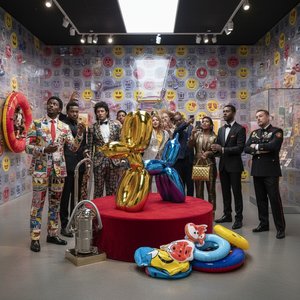 Jeff Koons: Irony, Kitsch & the Commodification of Contemporary ArtExplore the complex world of Jeff Koons with OriginalUniqueArt. Discover the irony, kitsch, and market forces behind his iconic sculptures.…