Schakel over naar print
 Lees meer







































 Voor kunstwerken of reproducties die aan één zijde groter zijn dan 105 cm (ongeveer 41 inch), wordt de lijst als een losse set verzonden. Deze methode garandeert een veilige levering en voorkomt schade tijdens het transport.


A Vision of Rococo Serenity
In the soft, luminous glow of Jean-Honoré Fragonard’s “Rest on the Flight into Egypt,” we are invited into a world where the boundaries between the divine and the earthly dissolve into a dreamlike haze. Created around 1774, this masterpiece serves as a breathtaking window into the heart of the Rococo era—a period defined by its pursuit of grace, elegance, and an almost ethereal lightness of being. The painting captures a moment of profound stillness amidst a journey of great significance; it is a scene that breathes with the quiet intimacy of a family finding sanctuary. As the eye wanders through the lush, verdant surroundings, one feels the gentle pulse of a world where even the most sacred narratives are draped in the velvet textures of aristocratic leisure and romantic idealism.
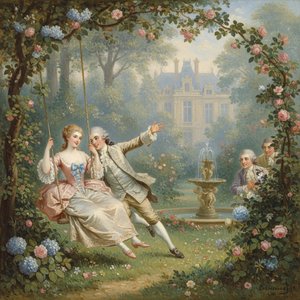
The composition is a masterclass in balanced harmony, guiding the viewer through a narrative that is as much about emotion as it is about biblical history. At the center of this pastoral sanctuary, the Holy Family reclines upon opulent cushions, their forms bathed in a soft, diffused light that seems to emanate from within the landscape itself. The presence of a young boy, playfully interacting with a bird amidst the flowering shrubs, injects a sense of innocent vitality into the scene, reminding us of the fleeting beauty of youth and nature. This interplay between the monumental weight of the flight into Egypt and the delicate, momentary joy of a child creates a poignant tension, transforming a religious subject into a universal celebration of peace and familial tenderness.
The Mastery of Light and Brushwork
To behold a Fragonard is to witness the dance of the brush in its most liberated form. The artist’s technique is characterized by an extraordinary fluidity, where every stroke feels spontaneous yet remains meticulously placed to achieve a sense of atmospheric depth. He employs the hallmark of the Rococo style—loose, expressive brushwork—to create an effect that is almost impressionistic in its ability to capture light and movement. There is a palpable texture to the foliage and the heavy drapery, achieved through a sophisticated layering of pastel hues. Pale pinks, soft blues, and luminous greens blend seamlessly, creating a palette that feels both airy and rich, perfect for evoking the sensory delights of a summer afternoon.
For the discerning collector or interior designer, this painting offers more than mere decoration; it provides an emotional anchor for a space. The subtle interplay of light and shadow within the garden pavilion creates a sense of three-dimensional intimacy that can transform a room into a sanctuary of calm. Whether placed in a grand salon or a quiet study, the artwork’s ability to evoke nostalgia and tranquility makes it a timeless choice. It is a piece that invites long periods of contemplation, rewarding the viewer with new details—the shimmer of a leaf, the softness of a cheek, or the delicate flutter of a bird—each time they encounter its enchanting, sun-drenched world.
Veelgestelde vragen
Tot welke periode in de carrière van Jean-Honoré Fragonard behoort "Rest on the Flight"?
Binnen de carrière van Jean-Honoré Fragonard valt "Rest on the Flight" in de Mature Period. Deze fase helpt om het werk te vergelijken met andere werken van de kunstenaar.
Hoeveel mensen bekijken "Rest on the Flight"?
Statistieken over "Rest on the Flight" door Jean-Honoré Fragonard zijn te vinden op de Statistieken-pagina van het kunstwerk: maandelijkse weergaven van het kunstwerk, weergaven van de werken van de kunstenaar en een uitsplitsing naar land en taal van recente bezoekers.
Zijn de kleuren van "Rest on the Flight" levendig of gedempt?
"Rest on the Flight" door Jean-Honoré Fragonard is vastgelegd met een Muted verzadiging en een Monochromatic intensiteit.
 Voorvertoning
 Verstuur
 Delen
Delen
 Details bekijken
 Gids
Gids

 Download
 Vergelijkbare items
 Röntgenonderzoek
 Diavoorstelling
 Q&A
Q&A Statistieken