Symbolist Expressionism · 1895
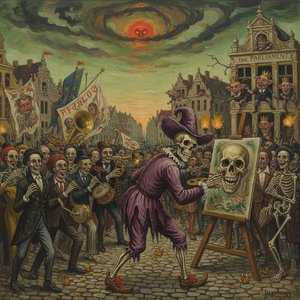
The Skeleton Painter (James Ensor, 1895)
James Ensor (1860–1949) maakte The Skeleton Painter. Het dateert uit 1895. Het behoort tot de Symbolist Expressionism-stroming. Het is gemaakt van Acrylic On Canvas. Het is te vinden in Koninklijk Museum voor Schone Kunsten Antwerpen in Antwerpen, België.
- 1895
- Acrylic On Canvas
- Koninklijk Museum voor Schone Kunsten Antwerpen

 Voorvertoning

 Met de hand geschilderd olieverfwerk
 Verstuur
 Delen
 Informatieblad


 Download
 Vergelijkbare items
 Röntgenonderzoek
 Diavoorstelling
 Vraag & antwoord

 Statistieken
The Skeleton Painter, in het kort
- Titel
- The Skeleton Painter
- Kunstenaar
- James Ensor (1860–1949)
- Geboren in [jaar]
- Oostende, België
- Datum
- 1895
- Medium
- Acrylic On Canvas
- Te zien in
- Koninklijk Museum voor Schone Kunsten Antwerpen, Antwerpen, België
- Beweging
- Symbolist Expressionism
- Onderwerp
- skeleton, artist, death, masks, paintings, room
Wat stelt The Skeleton Painter voor?
A Dance with Mortality: James Ensor’s “The Skeleton Painter”
James Ensor's "The Skeleton Painter," completed in 1895, is not merely a painting; it’s an unsettling plunge into the subconscious, a meticulously crafted tableau of morbidity and artistic obsession. The image, rendered with a distinctive and increasingly personal style, immediately confronts the viewer with a scene both bizarre and profoundly familiar – a room overflowing with art, dominated by a central figure: a skeleton diligently wielding a paintbrush. This isn’t a morbid spectacle intended to shock for shock's sake; rather, it’s a complex meditation on life, death, creativity, and the inescapable nature of artistic endeavor. Ensor, born in Ostend, Belgium, in 1860, cultivated an intensely individual vision, one deeply rooted in his upbringing amidst the vibrant chaos of a seaside resort town and fueled by a fascination with masks, disguise, and the theatricality of human experience.
The Artist’s Studio – A Realm of Shadows
The setting itself is crucial to understanding the painting's power. The room is crammed with canvases, each bearing witness to Ensor’s restless hand. A dining table, laden with objects—a clock, a partially consumed meal—suggests an interrupted life, a space where sustenance and creation intertwine. The presence of other skeletons, scattered amongst the chairs and leaning against walls, reinforces the pervasive theme of mortality. These aren't simply decorative elements; they are active participants in the scene, almost as if they’re observing or even contributing to the artist’s work. The inclusion of a cat, curled up near the left edge, adds an element of domesticity and perhaps a subtle critique – a creature of instinct and survival nestled within this world of intellectual pursuit.
Symbolism and Technique: A Palette of Unease
Ensor’s technique is immediately recognizable. He employed a thick, impasto application of paint, building up layers of color to create a tactile surface that seems almost sculptural. The palette is deliberately muted – browns, greys, ochres, and deep blues dominate—contributing to the painting's somber mood. The skeletal figure itself is rendered with remarkable detail, highlighting the fragility of bone while simultaneously conveying a sense of focused determination. Notice how Ensor uses strong diagonals – particularly in the arrangement of the chairs and paintings – to create a feeling of unease and instability. The use of color is not about beauty; it’s about evoking emotion, creating a visual atmosphere of melancholy and contemplation. His style evolved significantly throughout his career, moving away from academic influences towards a highly expressive, often unsettling, approach that anticipated the Symbolist movement.
Ensor's Exploration of Artistic Identity
"The Skeleton Painter" can be interpreted as an exploration of Ensor’s own artistic identity and his relationship to mortality. The skeleton artist represents not just death but also the inevitable end of creative endeavor, the fading of inspiration with time. It speaks to the paradox of the artist – someone who often seems detached from the everyday realities of life, yet is ultimately defined by their engagement with them. Ensor’s own struggles with artistic recognition and his rejection of traditional academic training likely fueled this preoccupation with themes of isolation and the ephemeral nature of existence. The painting isn't a celebration of art; it’s a questioning of its purpose and its ultimate significance in the face of oblivion. It invites us to consider what drives an artist to create, knowing that their work, like their own physical form, will eventually succumb to time.
OriginalUniqueArt offers exquisite, hand-painted reproductions of James Ensor’s “The Skeleton Painter,” allowing you to bring this haunting masterpiece into your home or office. Each reproduction is created with the same meticulous attention to detail and expressive technique as the original, capturing the painting's unique atmosphere and emotional depth. Explore our collection today and experience the unsettling beauty of Ensor’s vision.
In welk museum bevindt The Skeleton Painter zich?
Koninklijk Museum voor Schone Kunsten Antwerpen
Antwerpen, België
Oorsprong en geschiedenis van het museum Het Koninklijk Museum voor Schone Kunsten werd opgericht in 1810, maar de wortels van deze instelling reiken veel dieper in het verleden. De fundamenten van het museum zijn geworteld in de rijke nalatenschap van het Antwerps Sint-Lucasgilde, een invloedrijk instituut dat actief was van de late 14e eeuw tot 1773. De collectie van het museum vond haar oorsprong in de kunstwerken die door dit gilde werden beheerd, waardoor een directe en onverbrekelijke band ontstond tussen het handelsverleden van de stad en haar artistieke bloei.


Hoogwaardige afbeeldingen van The Skeleton Painter

Publiek domein: de kunstenaar is overleden in 1949.
Andere formaten, uitsneden en citatie →James Ensor, The Skeleton Painter (1895), Koninklijk Museum voor Schone Kunsten Antwerpen. Publiek domein
Vragen over The Skeleton Painter, beantwoord
Waar kan ik het originele werk "The Skeleton Painter" door James Ensor bewonderen?
Het originele werk "The Skeleton Painter" is te bewonderen in Koninklijk Museum voor Schone Kunsten Antwerpen, Antwerpen, België.
In welk jaar werd "The Skeleton Painter" door James Ensor gemaakt?
"The Skeleton Painter" dateert uit 1895. Deze datum plaatst het werk binnen de carrière van James Ensor en het betreffende tijdperk.
Met welk medium is "The Skeleton Painter" door James Ensor uitgevoerd?
Het medium van "The Skeleton Painter" door James Ensor is Acrylic On Canvas. Reproducties zijn bedoeld om de uitstraling van deze techniek weer te geven.
Wat wordt er afgebeeld in "The Skeleton Painter" door James Ensor?
De thema's die aanwezig zijn in "The Skeleton Painter" door James Ensor omvatten skeleton, artist, death, masks, paintings, room, cat, decay. Samen vatten zij de onderwerpen van het kunstwerk samen.
Is "The Skeleton Painter" vrij van auteursrecht?
Wat betreft het auteursrecht valt "The Skeleton Painter" onder bevindt zich in het publiek domein - de auteursrechten zijn verlopen.
Aan welke kunstenaar wordt "The Skeleton Painter" toegeschreven?
"The Skeleton Painter" wordt toegeschreven aan James Ensor.
Tot welke stijl behoort "The Skeleton Painter"?
"The Skeleton Painter" is een werk uit de Symbolist Expressionism. De stroming geeft de artistieke traditie aan waartoe het werk behoort.
Tot welke periode in de carrière van James Ensor behoort "The Skeleton Painter"?
"The Skeleton Painter" behoort tot de Late Period in de carrière van James Ensor. Deze classificatie plaatst het werk in de context van de ontwikkeling van de kunstenaar.
Op welke leeftijd maakte James Ensor "The Skeleton Painter"?
Toen "The Skeleton Painter" werd gemaakt in 1895, was James Ensor - geboren in 1860 - 35 jaar oud.
Over de kunstenaar, James Ensor

1860–1949, België
James Ensor
Vroege Leven, Familie en Artistieke Vorming James Ensor werd geboren op 13 april 1860 in Oostende, België. Zijn identiteit werd gevormd door een unieke culturele kruisbestuiving: zijn vader, James Frederic Ensor, was in Brussel geboren uit Engelse ouders, terwijl zijn moeder, Maria Catherina Haegheman, Belgisch was. Deze dubbele afkomst vormde de basis voor een perspectief dat zich vaak buiten de nauwe grenzen van de lokale traditie bevond. Tijdens zijn jeugd groeide de kunstenaar op tussen de muren van een souvenirwinkel die zijn ouders in Oostende runden.
Ook van James Ensor
 De Intrede van Christus in Brussel1888
 Portret met Maskers1899
 De Baden te Oostende
 Skeletten die zich opwarmen1889

Essays over The Skeleton Painter
 Beauty in Mortality: Capturing the Soul of the Skull through the Luminous Lens of Impressionist ArtExplore the profound beauty of mortality through Impressionism. Discover how masters like Monet and Renoir transformed the Memento Mori tra…
 De Psychologie van Speelse Beeldtaal: Een Verkenning van Humoristische en Fantasierijke Schilderijen als Katalysatoren voor Emotioneel Welzijn en Sociale VerbindingOntdek de psychologische kracht van humoristische & fantasierijke schilderijen. OriginalUniqueArt biedt museumkwaliteit reproducties en AI-…
 James Ensor's Grotesque Visions: Social Commentary & Artistic InnovationExplore the unsettling yet captivating world of James Ensor, a pioneer of Expressionism. Discover his satirical masterpieces, symbolic imag…