

 Bekijk op ware grootte
 Verstuur
 Delen
Delen
 Details bekijken
 Gids voor studentenkunstwerken

 Download
 Vergelijkbare items
 Röntgenonderzoek
 Diavoorstelling
 Statistieken
Tivoli, the Cascatelle
 Oil On Canvas
- WallArt
- Romanticism
 1827
1827- 19th Century
 77.0 x 60.0 cm
 Tate Britain
 Lees meer
Giclée / Kunstafdrukken
Giclée- of canvasafdruk van museumkwaliteit met een snelle productie en flexibele afwerkingsmogelijkheden. ( Koop handgeschilderd kunstwerk Schakel over naar digitale afbeeldingen)




P118B $10

P118H $10

P118W $10

P438Z $10

P508JH $12

P508YH $12

P805H $10

P805Z $10

P919BZ $10

P919G $10

P919XJ $10

P959ZH $10

P968JZ $12

W106C $8

W218G $10

W218JH $8

W218Y $10

W307PJ $10

W316G $10

W316PJ $8

W316Y $10

W398PJ $8

W4111J $10

W500HY $15

W500JH $15

W692G $12

W849H $8

W940BG $15

W953PJ $8




Kies uit onze vooraf ingestelde maten die overeenkomen met de originele verhoudingen van het kunstwerk.

U kunt uw eigen afmetingen opgeven om in een specifieke lijst of ruimte te passen. Als de door u gekozen maat niet overeenkomt met de proporties van het originele kunstwerk, zullen wij de afbeelding bijsnijden of uitbreiden met een gespiegelde of effen rand. Een digitaal mockup wordt ter goedkeuring naar u verzonden voordat de productie begint.
Houd er rekening mee dat de preview op het scherm de werkelijke bijsneding of uitbreiding niet weergeeft. Alleen de mockup toont de uiteindelijke compositie nauwkeurig.
Hoewel aangepaste maten beschikbaar zijn, raden wij aan een afmeting uit de vooraf bepaalde lijst te kiezen om de originele proporties te behouden.
Wereldwijde levering () binnen 2 weken in plaats van de standaard 4/5 weken. (26 september)

Gratis wereldwijde expressverzending

Hoogwaardig linnen canvas

Volledige verzendverzekering

Garantie op terugbetaling van invoerrechten

Garantie op exacte kleurweergave

Retourbeleid van 100 dagen (alleen bij defecten)

100% Geld-terug-garantie

Korting bij meerdere afnames
 De optie voor glas is alleen beschikbaar bij een formaat kleiner dan 110 cm.

Tivoli, the Cascatelle
Giclée / Kunstafdrukken
Formaat reproductie
-


Totaalprijs
$ 81
A Symphony of Light and Shadow: Turner’s “Tivoli, the Cascatelle”
Joseph Mallord William Turner's "Tivoli, the Cascatelle," painted around 1827-8, isn’t merely a depiction of a picturesque Italian landscape; it’s an immersive experience—a fleeting moment captured in oil and pigment that vibrates with emotion and a profound understanding of light. The scene unfolds within the dramatic gorge of Tivoli, nestled amongst the Sabine Hills just outside Rome, dominated by the cascading waters of the Aniene River and the ghostly silhouette of the ancient Temple of Maecenas perched precariously above. Turner, a master of atmospheric perspective and color manipulation, transports us not to a static vista, but to a dynamic, almost hallucinatory realm where reality blurs with memory and imagination. The painting’s power lies in its ability to evoke a sense of sublime awe—a feeling of being both insignificant before the grandeur of nature and utterly captivated by its beauty.The Romantic Vision: Light, Color, and Emotion
Turner was a pivotal figure in the Romantic movement, and “Tivoli” exemplifies this artistic philosophy perfectly. Unlike the Neoclassical emphasis on reason and order, Romanticism prioritized emotion, intuition, and the power of nature. Turner sought to capture not just what he *saw*, but what he *felt*—the overwhelming sense of wonder, mystery, and even a touch of melancholy that can be experienced when confronted with the sublime. His technique is characterized by loose, expressive brushstrokes – almost frantic in places – applied in rapid succession to build up layers of color. He eschewed precise detail, instead prioritizing the overall effect of light and atmosphere. The dominant blues and greens create a sense of depth and distance, while flashes of ochre and yellow illuminate the rocks and vegetation, suggesting a fleeting moment of sunlight breaking through the mist. The painting’s luminosity isn't achieved through meticulous blending; rather, it’s built up from countless tiny dabs of color, creating an almost shimmering effect that mimics the play of light on water.A Study in Atmospheric Perspective and Symbolism
Turner wasn’t simply recording a landscape; he was exploring its essence. The high horizon line emphasizes the verticality of the falls, drawing the eye upwards towards the dramatic cascade. The distant hills are rendered as hazy blue forms, utilizing atmospheric perspective to convey their immense scale and remoteness. This technique isn't just about creating visual depth; it also suggests a sense of timelessness—as if the scene exists outside of conventional space and time. The Temple of Maecenas itself holds symbolic weight. Its ruined state speaks to the transience of human endeavor against the backdrop of enduring nature, reinforcing the painting’s central theme of the sublime. Furthermore, the turbulent waters are often interpreted as representing the forces of nature—powerful, unpredictable, and ultimately beyond human control. The small figures in the foreground, seemingly dwarfed by the scale of the landscape, serve to underscore this point, reminding us of our own vulnerability within the vastness of the natural world.The Legacy of a Visionary: Reproduction and Interpretation
“Tivoli, the Cascatelle” remains one of Turner’s most celebrated works, admired for its innovative use of color and light, and its evocative portrayal of the sublime. Reproductions capture much of the original's magic, but it is important to note that no reproduction can fully replicate the experience of standing before the painting in person. The subtle shifts in tone, the almost palpable sense of movement, and the sheer intensity of Turner’s vision are all best appreciated within the context of the original canvas. Today, “Tivoli” continues to inspire artists and designers alike, serving as a testament to Turner's genius and his profound understanding of the relationship between humanity and nature. Its influence can be seen in countless works of art that strive to capture the fleeting beauty and overwhelming power of the natural world. A high-quality reproduction offers a beautiful way to bring this iconic image into your home or office, allowing you to enjoy its timeless appeal for years to come.Biografie van de kunstenaar
A Life Painted in Light: The World of J.M.W. Turner
Joseph Mallord William Turner, universally known as J.M.W. Turner, was far more than a painter; he was a visionary who fundamentally reshaped the landscape of art and laid the groundwork for modern abstraction. Born in Maiden Lane, Covent Garden, London, in 1775, his origins were modest – the son of a barber and wig maker. Yet, even from childhood, an extraordinary talent began to blossom within him. By the age of fourteen, he was enrolled at the Royal Academy, making his debut as an artist just a year later. This early promise wasn’t merely technical proficiency; it hinted at an innate understanding of light, color, and atmosphere – qualities that would become the defining characteristics of his remarkable career. To supplement his artistic education, Turner gained practical experience as an architectural draftsman, honing his perspective and compositional skills—abilities that proved invaluable in rendering both meticulously detailed topographical views and vast, emotionally resonant landscapes. Turner’s formative years were characterized by a relentless dedication to his craft, fueled by natural aptitude and an unwavering pursuit of artistic excellence.The Romantic Tempest: Style and Influences
Turner emerged during the height of the Romantic era, yet he didn't simply replicate its conventions. He absorbed influences from diverse sources – the luminous landscapes of Dutch masters like Claude Lorrain and Aelbert Cuyp, and the poetic approach to nature championed by artists such as Richard Wilson. However, Turner didn’t merely imitate; he synthesized these influences into something entirely new. His work is immediately recognizable for its expressive use of color, often employing bold contrasts and vibrant hues to convey emotion and atmosphere. He possessed a profound fascination with the power and drama of the natural world – turbulent seascapes, fiery sunsets, and swirling storms became recurring motifs in his paintings. Crucially, Turner wasn’t interested in simply depicting what he saw; he sought to capture the *feeling* of a place, the sublime awe inspired by nature's grandeur. This pursuit led him to experiment with increasingly loose brushwork, dissolving forms into washes of color and light—techniques that presaged the Impressionist movement decades later. The influence of John Ruskin is undeniable; from 1840, the critic championed Turner’s work, elevating landscape painting to a level of critical acclaim previously unheard of.A Prolific Legacy: The Scope of Turner's Output
The sheer volume of Turner’s artistic output is astonishing—a testament to his tireless exploration and experimentation. He created over 550 oil paintings, nearly 2,000 watercolors, and an astounding 30,000 works on paper. This prolificacy wasn’t simply a matter of quantity; it reflected his unwavering commitment to exploring diverse subjects, techniques, and styles. His paintings range from meticulously detailed topographical views of British landscapes—such as the dramatic coastal scenes of Cornwall—to dynamic historical scenes and evocative maritime paintings that capture the essence of the sea. He was equally adept at conveying the tranquility of a pastoral scene and the terrifying power of a raging storm. Consider, for example, “Fort Vimieux,” where swirling clouds and crashing waves create an atmosphere of intense drama and sublime beauty. Similarly, "Scene in the Campagna" showcases his ability to capture the warmth and serenity of the Italian countryside with delicate brushwork and luminous colors. Beyond painting, Turner was also a skilled printmaker, further disseminating his artistic vision through engravings and lithographs—making his work accessible to a wider audience.Eccentricity and Remembrance: The Man Behind the Masterpieces
Turner’s personal life was as complex and enigmatic as his art. He remained intensely private and reclusive, often shunning social gatherings and preferring the solitude of his studio or the open road. He fathered two daughters, Evelina and Georgiana, with Sarah Danby, the widow of a fellow artist, but maintained a distant relationship with them. His later years were marked by increasing eccentricity and declining health. Following the death of his father in 1829, he became increasingly morose and withdrawn, living in squalor and neglecting his appearance. He adopted the pseudonym “Mr. Booth” to avoid recognition and even rowed his boat into the Thames during a census to remain untraceable. Despite these eccentricities—or perhaps because of them—Turner remains one of Britain’s most beloved artists. His final years were spent in Chelsea, where he passed away on December 19, 1851, at the age of 76. In a fitting tribute to his enduring legacy, he is buried in St Paul's Cathedral, alongside other British luminaries—a testament to his profound impact on art and culture. His work continues to inspire artists and captivate audiences worldwide, ensuring that the light of J.M.W. Turner will continue to shine for generations to come.Major Achievements
Turner’s career spanned over half a century, during which he achieved remarkable success and critical acclaim. He was elected an Academician in 1802, solidifying his position as one of the leading artists of his time. His paintings were exhibited at the Royal Academy throughout his life, attracting large crowds and generating considerable discussion. His innovative use of color and light revolutionized landscape painting, influencing generations of artists to come. Key works such as "The Fighting Temeraire," depicting the decommissioning of a warship, and “Rain, Steam and Speed – The Great Western Railway,” are considered masterpieces of Romanticism and continue to be celebrated for their dramatic intensity and evocative power. Turner’s legacy extends beyond his individual paintings; he helped establish watercolor as a serious medium for landscape artists, paving the way for future developments in the art form.Historical Significance
J.M.W. Turner's work is not merely aesthetically pleasing; it holds significant historical importance. His paintings offer valuable insights into 19th-century Britain—its industrialization, its relationship with nature, and its evolving social consciousness. His depictions of the Thames River, for example, capture the changing landscape of London as it transformed from a primarily agricultural region to an urban center. Furthermore, his engagement with contemporary issues, such as the abolition of slavery (as evidenced in "Slave Ship"), reflects his progressive views and his commitment to social justice. Turner’s artistic innovations—particularly his use of color and light—anticipated developments in Impressionism and Abstract Art, demonstrating his profound influence on the course of modern art history. His work remains a powerful reminder of the enduring power of art to capture both beauty and truth.
J.M.W. Turner
1775 - 1851 , Verenigd Koninkrijk
Snelle feiten
- Artistic Movement Or Style: Romantiek
- Artists Or Movements Influenced By This Artist:
- Impressionisme
- Abstracte kunst
- Artists Who Influenced This Artist:
- Cozens
- Wilson
- Date Of Birth: 23 april 1775
- Date Of Death: 19 december 1851
- Full Name: Joseph Mallord William Turner
- Nationality: Britse kunstenaar
- Notable Artworks:
- Fort Vimieux
- Scene in the Campagna
- Place Of Birth: Londen, Verenigd Koninkrijk
Gerelateerde artikelen

Oil on Canvas: A Historical & Technical Exploration of a Timeless Artistic Medium
Explore the rich history & enduring techniques of oil painting on canvas. Discover the science behind its longevity, conservation practices, and contemporary relevance. Expert insights for art enthusiasts.
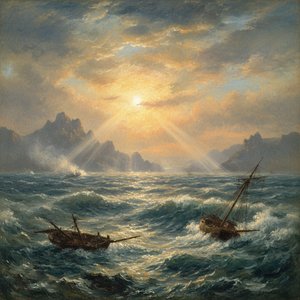
J.M.W. Turner: Light, Atmosphere & the Romantic Sublime
Explore the life & art of J.M.W. Turner, a master of Romantic landscape painting. Discover his innovative techniques, key works, and lasting influence on Impressionism. Find high-quality reproductions at OriginalUniqueArt.

The Enduring Power of Painting: A Historical & Contemporary Exploration of Form and Emotion
Explore the rich history & enduring techniques of oil painting with OriginalUniqueArt. Discover masterpieces, learn about art collecting, and find authentic handmade reproductions crafted by skilled artists.

De Blijvende Erfenis van Olieverf op Doek: Techniek, Geschiedenis en Hedendaagse Praktijk
Ontdek de rijke geschiedenis en technieken van olieverfschilderen. Van Renaissance meesterwerken tot moderne toepassingen, leer over pigmenten, glazuur en conservering.

The Enduring Legacy of Oil on Canvas: Technique, History & Aesthetic Impact
Explore the rich history & techniques of oil painting – from Renaissance masters to Impressionism. Discover pigments, layering methods, and why this timeless medium endures. Expert insights for artists & art enthusiasts.