Bekijk op ware grootte
 Verstuur
 Delen
Delen
 Details bekijken
 Gids voor studentenkunstwerken

 Download
 Vergelijkbare items
 Röntgenonderzoek
 Diavoorstelling
 Statistieken
The Rainbow.


 Lees meer
Giclée / Kunstafdrukken
Giclée- of canvasafdruk van museumkwaliteit met een snelle productie en flexibele afwerkingsmogelijkheden. ( Koop handgeschilderd kunstwerk Schakel over naar digitale afbeeldingen)




P118B €10

P118H €10

P118W €10

P438Z €10

P508JH €12

P508YH €12

P805H €10

P805Z €10

P919BZ €10

P919G €10

P919XJ €10

P959ZH €10

P968JZ €12

W106C €8

W218G €10

W218JH €8

W218Y €10

W307PJ €10

W316G €10

W316PJ €8

W316Y €10

W398PJ €8

W4111J €10

W500HY €15

W500JH €15

W692G €12

W849H €8

W940BG €15

W953PJ €8




Kies uit onze vooraf ingestelde maten die overeenkomen met de originele verhoudingen van het kunstwerk.

Voer de breedte en de hoogte in die u nodig heeft, passend bij uw lijst of uw muur. Een afdruk kan alleen worden ingekort, nooit groter worden gemaakt dan het origineel, waardoor een formaat met een andere verhouding een deel van de afbeelding verliest. Wij sturen u een digitaal mockup ter goedkeuring voordat we iets drukken. De afbeelding op deze pagina toont niet de werkelijke uitsnede — dit is alleen te zien op het mockup.
Wereldwijde levering () binnen 2 weken in plaats van de standaard 4/5 weken. (23 oktober)

Gratis wereldwijde expressverzending

Hoogwaardig linnen canvas

Volledige verzendverzekering

Garantie op terugbetaling van invoerrechten

Garantie op exacte kleurweergave

Retourbeleid van 100 dagen (alleen bij defecten)

100% Geld-terug-garantie

Korting bij meerdere afnames
 De optie voor glas is alleen beschikbaar bij een formaat kleiner dan 110 cm.

The Rainbow.
Giclée / Kunstafdrukken
Formaat reproductie
-


Totaalprijs
€ 71
A Symphony of Light and Hope
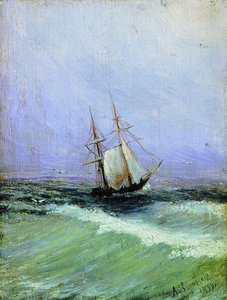
To gaze upon Ivan Konstantinovich Aivazovsky’s 1873 masterpiece, “The Rainbow,” is to witness a profound dialogue between the heavens and the sea. Aivazovsky, a titan of Romantic marine painting, possessed an almost supernatural ability to act as a conduit for the ocean’s soul. In this particular work, we find ourselves not merely observing a seascape, but participating in a moment of celestial alchemy. The painting captures that fleeting, ethereal instant where sunlight and rain converge to fracture white light into a breathtaking spectrum of color, casting a prismatic promise over the undulating waves. It is a scene that transcends mere maritime documentation, offering instead a meditative exploration of transition and the divine intersection of the earthly and the ethereal.
The composition is anchored by the delicate interplay of two vessels navigating the vast expanse. One small boat rests toward the left, while a larger vessel occupies much of the right-hand side, their presence providing a sense of scale against the infinite horizon. Within these boats, figures can be seen—some standing, some preparing for the journey ahead—adding a layer of human narrative to the elemental drama. There is a palpable sense of quiet anticipation; the atmosphere is at once serene and picturesque, capturing a moment of calm that feels both fragile and enduring.
The Mastery of Romantic Technique
Aivazovsky’s technical prowess is on full display through his sophisticated use of light and shadow. While many of his contemporaries, such as Turner, leaned into bold and vibrant palettes to depict maritime drama, Aivazovsky chose a more restrained, contemplative approach for “The Rainbow.” He employs a subdued tonal range—a delicate tapestry of muted blues, deep greens, and earthy ochres—to create an atmosphere of grandeur rather than mere spectacle. This deliberate restraint serves to heighten the emotional resonance of the work, drawing the viewer’s eye toward the subtle shifts in luminosity that define the water's surface.
The artist’s brushwork captures the very texture of the sea, from the translucent crest of a wave to the heavy, salt-laced weight of the deep. Through his mastery of light, he guides us through the turbulent seascape, emphasizing the vulnerability of the human element against the backdrop of nature's immense power. For the collector or interior designer, this technique offers a unique visual depth; the painting does not simply sit upon a wall but seems to breathe with an inner light, making it a captivating centerpiece for any sophisticated space.
Symbolism and Emotional Resonance
Beyond its aesthetic brilliance, “The Rainbow” carries deep symbolic weight. In the lexicon of art history, the rainbow has long served as a symbol of hope, a bridge between the turbulent storms of life and the promise of peace. By juxtaposing the potential for maritime struggle with the serene beauty of the atmospheric phenomenon, Aivivelysky creates a powerful metaphor for resilience. The painting speaks to the human spirit's ability to find beauty and light even amidst the unpredictable and often dangerous currents of existence.
For those seeking to bring a sense of tranquility and intellectual depth into their homes or galleries, this work offers an unparalleled emotional impact. It is a piece that invites long periods of contemplation, rewarding the viewer with new layers of meaning upon every encounter. Whether viewed as a triumph of 19th-century Romanticism or as a timeless emblem of hope, Aivazovsky’s vision remains as potent today as it was when the final brushstroke was applied in 1873.
Vragen & Antwoorden
Hoe harmonieus zijn de kleuren van "The Rainbow." door Ivan Aivazovsky?
De kleuren van "The Rainbow." door Ivan Aivazovsky vertonen een Unified Palette harmonie. Harmonie beschrijft de onderlinge relatie tussen de kleuren.
Waar staat "The Rainbow." binnen de terugkerende thema's van Ivan Aivazovsky?
"The Rainbow." verbeeldt seascape, rainbow, hope, sailors, stormysea, lightshadow, atmosphericpainting, terwijl de bekende thema's van Ivan Aivazovsky maritimetradition, romanticidealism, symbolicrepresentation, optimisticvision, iconicmasterpiece zijn. Een vergelijking tussen beide laat zien hoe het werk zich verhoudt tot de gebruikelijke onderwerpen van de kunstenaar.
Kan ik "The Rainbow." door Ivan Aivazovsky op mijn eigen muur bekijken voordat ik het koop?
De AR-voorvertoning-pagina van "The Rainbow." door Ivan Aivazovsky maakt gebruik van augmented reality om het kunstwerk op een compatibel apparaat in uw eigen ruimte te tonen.
Biografie van de kunstenaar
A Life Embraced by the Waves
Ivan Konstantinovich Aivazovsky, born Hovhannes Aivazian in 1817, was more than a painter of seascapes; he was a conduit to the ocean’s soul. His very existence seemed inextricably linked to the Black Sea—a vast, unpredictable expanse that would forever dominate his artistic vision and fuel an extraordinary career spanning nearly six decades. Born in the Crimean port city of Feodosia, Aivazovsky didn't merely observe the sea; he felt it – its raw energy, sublime beauty, and inherent danger becoming the very essence of his art. From a young age, this connection was nurtured, initially by local architect Jacob Koch who recognized the boy’s talent, then blossoming within the rigorous academic environment of the Imperial Academy of Arts in Saint Petersburg. Yet, formal training alone couldn't account for the depth of Aivazovsky’s understanding; it was the constant presence of salt-laced air and the cries of gulls that truly shaped his artistic sensibility. His Armenian heritage also played a significant role, as he was baptized at the St. Sargis Armenian Church in Feodosia and maintained strong cultural ties throughout his life, occasionally incorporating Armenian themes into his expansive body of work.The Early Years: Crimean Roots and Artistic Beginnings
Aivazovsky’s early years were deeply rooted in the rugged beauty of Crimea. His family, originally from Western Armenia, had settled in Feodosia, a bustling port city with a rich maritime history. This environment—the salty air, the vibrant harbor, and the constant presence of ships—provided an unparalleled source of inspiration for the young Aivazian. He began to draw and paint as a child, capturing the local landscapes and the working life of the sailors. Recognizing his exceptional talent, Jacob Koch, a prominent local architect, encouraged him to pursue his artistic ambitions. This early encouragement led to his enrollment in the Simferopol gymnasium No.1, followed by studies at the Imperial Academy of Arts in Saint Petersburg—a prestigious institution that provided him with formal training in classical painting techniques. However, Aivazovsky’s true education came from direct experience; he spent countless hours observing the sea, studying its moods and capturing its ever-changing light. This intimate connection to the ocean would become the defining characteristic of his artistic style.The Rise of a Marine Master: Italy and the Russian Navy
In 1840, Aivazovsky embarked on a transformative journey to Europe, beginning with Italy. The Italian landscape—with its dramatic coastlines, vibrant colors, and atmospheric light—proved to be an invaluable source of inspiration. He immersed himself in the works of artists like J.M.W. Turner and sought to emulate their ability to capture the power and beauty of nature. Returning to Russia, Aivazovsky’s talent quickly gained recognition, and he was appointed as the main painter of the Russian Navy in 1845. This appointment provided him with unprecedented access to naval life—ships, sailors, battles, and firsthand observations that profoundly influenced his work. He became intimately acquainted with maritime life, lending an authenticity to his depictions that resonated deeply with both military officials and art enthusiasts alike. The role afforded him the opportunity to document significant naval engagements, solidifying his reputation as a master of marine painting.A Style Defined by Drama and Light
Aivazovsky’s artistic style is instantly recognizable for its dramatic compositions, masterful use of color, and evocative portrayal of the sea. He was particularly adept at capturing the effects of light on water—the shimmering reflections, the swirling foam, and the ethereal glow of moonlight. His paintings are often characterized by a sense of movement and energy, as if the viewer is caught in the midst of a storm or witnessing a naval battle. Aivazovsky’s technique involved working *en plein air*, directly from nature, allowing him to capture fleeting light effects with remarkable precision. He employed thin layers of paint to create luminous textures and used atmospheric perspective to convey depth and distance. His most celebrated works—such as The Ninth Wave, Seascape with Full Moon, and A Ship in a Stormy Sea—are testaments to his technical skill and artistic vision. These paintings are not merely representations of the sea; they are emotional experiences that transport the viewer to the heart of the storm or onto the deck of a ship battling towering waves.Legacy and Enduring Influence
Ivan Konstantinovich Aivazovsky stands as one of the greatest masters of marine art in Russian history—a legacy cemented by his technical skill, emotional depth, and prolific output. His paintings are celebrated not only for their aesthetic beauty but also for their ability to evoke powerful emotions and capture the essence of the sea. He significantly contributed to the development of Russian landscape painting, influencing generations of artists with his innovative techniques and dramatic compositions. Aivazovsky’s work continues to resonate with audiences worldwide, exhibited in museums and galleries across the globe. His paintings are a testament to the enduring power of nature and the human spirit—a reminder of our vulnerability in the face of the elements and our capacity for resilience and hope. He wasn't simply a painter of seascapes; he was a poet of the ocean, translating its moods, mysteries, and majesty onto canvas with unparalleled skill and passion.
Ivan Aivazovsky
1817 - 1900 , Rusland
Snelle feiten
- Artistic Movement Or Style: Romantiek, Zeekunst
- Artists Or Movements Influenced By This Artist: ['Russische landschap schilderkunst']
- Artists Who Influenced This Artist: ['Turner']
- Date Of Birth: 1817
- Date Of Death: 1900
- Full Name: Ivan Konstantinovich Aivazovsky
- Nationality: Russisch-Armenisch
- Notable Artworks:
- De Negende Golf
- Schip in een Stormachtig Zee
- Landschap met Volle Maan
- Place Of Birth: Feodosia, Rusland
Gerelateerde artikelen

Masterpieces of the Sea: An Authoritative Guide to Iconic Maritime Artworks and the Eternal Horizon
Embark on a scholarly journey through the history of maritime art. Discover the evolution of seascapes from navigational records to Romantic masterpieces. Explore museum-quality, hand-painted oil reproductions of the world's most iconic marine artworks at OriginalUniqueArt.com.
Ivan Aivazovsky: Mastering Light & Emotion in 19th-Century Marine Painting
Explore the captivating world of Ivan Aivazovsky, a master of 19th-century marine painting. Discover his techniques, iconic artworks & lasting legacy in this expert guide.

Mastering the Tempest: The Sublime Power of Stormy Seas in Fine Art History
Explore the sublime beauty of stormy seas through the lens of art history. From Turner to Aivazovsky, discover how masterfully captured tempests evoke profound emotion and luxury in fine art collections and high-end interior design.
The Allure of the Horizon: A Comprehensive Exploration of Seascape Art Through History & Emotion
Explore the captivating world of seascape art! Discover its history, key artists & movements – from Dutch Masters to Impressionism. Expert insights for collectors and enthusiasts at OriginalUniqueArt.

10 Masterpieces Defined by Stunning Sea Green Tones
Immerse yourself in the serene beauty of sea green tones. Explore 10 iconic masterpieces, from Impressionist landscapes to coastal classics, and find inspiration for your decor with museum-quality reproductions. Discover all masterpieces on OriginalUniqueArt.com.