

 Bekijk op ware grootte
 Verstuur
 Delen
Delen
 Details bekijken
 Gids voor studentenkunstwerken

 Download
 Vergelijkbare items
 Röntgenonderzoek
 Diavoorstelling
 Statistieken
Housemaid with Pram


 Lees meer
Handgemaakte olieverfreproductie
Met de hand geschilderd in olieverf op canvas in uw gewenste maat en lijst, op bestelling gemaakt door onze kunstenaars. ( Schakel over naar print Schakel over naar digitale afbeeldingen)




P118B $10

P118H $10

P118W $10

P438Z $10

P508JH $12

P508YH $12

P805H $10

P805Z $10

P919BZ $10

P919G $10

P919XJ $10

P959ZH $10

P968JZ $12

W106C $8

W218G $10

W218JH $8

W218Y $10

W307PJ $10

W316G $10

W316PJ $8

W316Y $10

W398PJ $8

W4111J $10

W500HY $15

W500JH $15

W692G $12

W849H $8

W940BG $15

W953PJ $8




Kies uit onze vooraf ingestelde maten die overeenkomen met de originele verhoudingen van het kunstwerk.

U kunt uw eigen afmetingen invoeren om in een specifieke lijst of ruimte te passen. Als de door u gekozen maat niet overeenkomt met de verhoudingen van het originele beeld, zullen we het kunstwerk bijsnijden of het schilderij uitbreiden met extra handgeschilderde elementen. Een digitale mockup wordt ter goedkeuring naar u verzonden voordat de productie begint.
Houd er rekening mee dat de preview op het scherm niet de werkelijke uitsnede of uitbreiding weergeeft. Alleen de mockup toont de uiteindelijke compositie nauwkeurig.
Hoewel aangepaste afmetingen mogelijk zijn, raden we aan een maat uit de vooraf gedefinieerde lijst te selecteren om de originele verhoudingen te behouden.
Na de bestelling zal het team van OriginalUniqueArt.com per e-mail contact opnemen met de klant voor instructies en een mockup-voorbeeld sturen.
Wereldwijde levering () binnen 3 tot 4 weken in plaats van de standaard 5 weken. (25 september). Zonder concessies aan de kwaliteit.

Gratis wereldwijde expressverzending

Hoogwaardig linnen canvas

Volledige verzendverzekering

Garantie op terugbetaling van invoerrechten

Garantie op exacte kleurweergave

Retourbeleid van 100 dagen (alleen bij defecten)

100% Geld-terug-garantie

Korting bij meerdere afnames
 De optie voor glas is alleen beschikbaar bij een formaat kleiner dan 110 cm.

Housemaid with Pram
Reproductiemethode
Formaat reproductie
-


Totaalprijs
$ 300
A Moment Frozen in Time: Isaac Israëls’ “Housemaid with Pram”
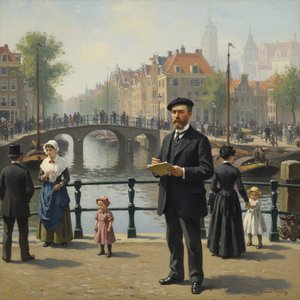
Isaac Lazarus Israëls' "Housemaid with Pram," painted in 1875, isn’t merely a snapshot of urban life; it’s a poignant meditation on the quiet dignity and understated beauty found within the everyday. This watercolor, now housed in the Rijksmuseum in Amsterdam, captures a fleeting moment along a bustling city street – a woman pushing a baby carriage, her face etched with a subtle blend of weariness and contentment. Israëls, a key figure in the Dutch Impressionist movement, masterfully utilizes loose brushstrokes and delicate washes to evoke not just a visual representation but an atmosphere, a feeling of the scene’s transient nature.
Israëls' artistic journey was deeply intertwined with his family history. The son of Jozef Israëls, a renowned Hague School painter known for his realistic depictions of working-class life, Isaac initially followed in his father’s footsteps, exploring similar themes of labor and social realism. However, he quickly developed his own distinct style, moving away from the stark formality of his father's work towards a more impressionistic approach – prioritizing capturing light, color, and mood over precise detail. This shift is powerfully evident in “Housemaid with Pram,” where the focus isn’t on the woman’s physical appearance but rather on her presence within the urban landscape.
The Language of Light and Color
Israëls' technique is characterized by a remarkable sensitivity to light. He employs broken color, layering translucent washes of pigment to create an ethereal quality, as if the scene is bathed in a soft, diffused glow. The muted palette – predominantly blues, greens, and browns – reflects the overcast Amsterdam sky, lending the painting a melancholic yet peaceful atmosphere. Notice how he uses highlights to draw attention to the woman’s face and the details of the pram, while simultaneously blurring the background figures into an indistinct mass. This selective focus directs the viewer's eye and emphasizes the central subject.
The composition itself is carefully constructed. The woman occupies a slightly off-center position, creating a sense of dynamism and inviting the viewer to step into the scene. The placement of the clock tower in the background provides a subtle temporal reference, anchoring the image within a specific moment in time. Israëls’ use of atmospheric perspective – making distant objects appear paler and less distinct – further enhances the illusion of depth and contributes to the painting's overall sense of realism.
Symbolism and Social Commentary
Beyond its aesthetic qualities, “Housemaid with Pram” carries a subtle layer of social commentary. The woman’s posture suggests both responsibility and exhaustion—a common reality for working-class women in 19th-century Amsterdam. The pram itself symbolizes motherhood and the cycle of life, while the bustling street represents the relentless pace of urban existence. Israëls doesn't offer a judgment or moralizing statement; instead, he presents a simple, honest portrayal of a woman’s daily life, inviting viewers to contemplate her experiences and consider the social conditions that shaped them.
The inclusion of other figures in the background – a man standing on the left and another further back on the right – adds to the painting's narrative complexity. They represent the broader context of urban society, highlighting the woman’s place within it. Their presence suggests a community, albeit one largely unseen by the central figure.
A Timeless Portrait of Human Experience
“Housemaid with Pram” is more than just a painting; it's a window into the past—a poignant and evocative depiction of everyday life in 19th-century Amsterdam. Israëls’ masterful use of light, color, and composition creates an image that resonates deeply with viewers today, reminding us of the shared human experiences of labor, motherhood, and the quiet beauty found within the ordinary moments of our lives. Reproductions of this work offer a chance to bring this evocative scene into any space, fostering contemplation and appreciation for Israëls’ enduring legacy.
Biografie van de kunstenaar
Vroege Leven en Artistieke Beginingen
Isaac Lazarus Israëls werd geboren in een familie die diep geworteld was in de Nederlandse kunstwereld. Hij was de zoon van Jozef Israëls, een vooraanstaande schilder verbonden aan de Haagse School, en Aleida Schaap. Deze artistieke erfenis stimuleerde bij Isaac al vroeg een waardering voor schilderkunst, die hij vanaf een jonge leeftijd liet zien met opmerkelijk talent. Tussen 1880 en 1882 studeerde hij aan de Koninklijke Academie van Kunst in Den Haag, waar hij kennismaakte met George Hendrik Breitner, wat een levenslange vriendschap vormde die zijn artistieke traject aanzienlijk beïnvloedde. Op slechts zestienjarige leeftijd bereikte Israëls vroegere erkenning toen hij “Bugle Practice” verkocht aan kunstenaar en verzamelaar Hendrik Willem Mesdag, zelfs voordat het werk volledig was voltooid. Portretten van zijn grootmoeder en een familievriendin, gemaakt in hetzelfde jaar, toonden al zijn aanzienlijke technische vaardigheid.De Amsterdamse Impressionist
Israëls werd een leidende figuur binnen de Amsterdamse impressionistische beweging. Gevleid door de filosofie van de Tachtigers – een groep schrijvers en kunstenaars die pleitte voor een stijl die inhoud en emotioneel geladen onderwerpen weerspiegelde via intense techniek – verschuifte hij zijn focus naar het vastleggen van de levendige scènes van alledaags leven in Amsterdam. Hij bracht vaak de zomers door met zijn vader in Scheveningen, waar hij kleurrijke kustlandschappen schilderde. Zijn werk weerspiegelde een verlangen om de bruisende straten, cafés en cabarets van Amsterdam te portretteren, weg van het meer traditionele onderwerp materiaal dat eerder door Nederlandse meesters was bewerkt.- Belangrijke werken: “Transport of Colonial Soldiers” (Kröller-Müller Museum), “The Coffee Sorters” (Museum Boijmans Van Beuningen), Portret van Mata Hari (Kröller-Müller Museum)
Reizen en Artistieke Ontwikkeling
In 1904 verhuisde Israëls naar Parijs, vestigde hij een atelier en omarmde de unieke motieven van de stad. Hij verdiepte zich verder in zijn interesse voor mode door te studeren aan de Paquin en Drecoll modehuizen. Het uitbreken van de Eerste Wereldoorlog leidde tot zijn terugkeer naar Nederland, waar hij voornamelijk portretten schilderde. Na de oorlog maakte hij uitgebreide reizen door Europa en Azië, waaronder twee jaar dat hij schetsen en schilderijen maakte in India en de Nederlandse Oostindische Compagnie. Deze ervaringen breidden zijn artistieke horizon uit, waardoor hij nieuwe onderwerpen en perspectieven ontdekte die zijn latere werk verrijkt.Erfgoed en Erkenning
Isaac Lazarus Israëls heeft een aanzienlijk oeuvre achtergelaten dat wordt gevierd om zijn levendige kleuren, losse penseelstreken en inzichtelijke portretten van alledaags leven. Zijn schilderijen worden nu in prestigieuze musea tentoongesteld, waaronder het Van Gogh Museum en het Mauritshuis. Hij bereikte internationale erkenning, met een Gouden Medaille op de Olympische Spelen van 1928 voor zijn schilderij “Red Rider”. Israëls’ nalatenschap ligt niet alleen in zijn artistieke prestaties, maar ook in zijn bijdrage aan de ontwikkeling van de Amsterdamse impressionisme, waardoor hij zich als een van de belangrijkste Nederlandse schilders van zijn tijd heeft gevestigd.
Isaac Lazarus Israëls
1865 - 1934 , Nederland
Snelle feiten
- Artistic Movement Or Style: Amsterdam Impressionisme
- Artists Or Movements Influenced By This Artist: ['Émile Zola']
- Artists Who Influenced This Artist:
- Jozef Israëls
- George Hendrik Breitner
- Date Of Birth: 3 februari 1865
- Full Name: Isaac Lazarus Israëls
- Nationality: Nederlands
- Notable Artworks:
- Transport van koloniale soldaten
- De koffiezetters
- Portret van Mata Hari
- Place Of Birth: Amsterdam, Nederland
Gerelateerde artikelen
Isaac Lazarus Israëls: A Chronicle of Dutch Life & the Evolution of Impressionistic Realism
Explore the captivating world of Isaac Lazarus Israëls (1865-1934), a leading Dutch Amsterdam Impressionist. Discover his city scenes, portraits & travels through Asia – a chronicle of Dutch life and artistic evolution.

Ephemeral Visions: Exploring the Artistic Legacy & Nuances of Watercolor Painting
Explore the captivating world of watercolor painting! Discover its rich history, essential techniques, influential artists & collecting tips from art experts. A comprehensive guide for enthusiasts.

Top 10 Legendarische Aquarellen die de Kunst voor Altijd Veranderden | OriginalUniqueArt
Ontdek de 10 legendarische aquarellen die kunstgeschiedenis schreven! Van Turner tot Monet, leer over techniek, emotie & impact. Vind museumkwaliteit reproducties en interieurinspiratie op OriginalUniqueArt.com.

Ephemeral Visions: Exploring the History & Emotional Resonance of Watercolor Painting
Explore the captivating history of watercolor painting, from ancient techniques to modern masters like Kandinsky & Blake. Discover essential artists, collecting tips & the emotional power of this luminous medium. Expert insights for art enthusiasts.

Ephemeral Visions: Exploring the Artistic Legacy & Contemporary Practice of Watercolor Painting
Explore the captivating world of watercolor painting! Discover its rich history, essential techniques, influential artists & collecting tips. A comprehensive guide for art enthusiasts from OriginalUniqueArt.