Voorvertoning
 Verstuur
 Delen
Delen
 Details bekijken
 Gids
Gids

 Download
 Vergelijkbare items
 Röntgenonderzoek
 Diavoorstelling
 Statistieken
Crispin and Scapin
 Ink On Paper
- WallArt
- Realism
 1858
1858- 19th Century
 61.0 x 82.0 cm
 Musée d'Orsay
 Lees meer
Giclée / Kunstafdrukken
Giclée- of canvasafdruk van museumkwaliteit met een snelle productie en flexibele afwerkingsmogelijkheden. ( Bestel handgeschilderde reproductie Schakel over naar digitale afbeeldingen)




P118B €10

P118H €10

P118W €10

P438Z €10

P508JH €12

P508YH €12

P805H €10

P805Z €10

P919BZ €10

P919G €10

P919XJ €10

P959ZH €10

P968JZ €12

W106C €8

W218G €10

W218JH €8

W218Y €10

W307PJ €10

W316G €10

W316PJ €8

W316Y €10

W398PJ €8

W4111J €10

W500HY €15

W500JH €15

W692G €12

W849H €8

W940BG €15

W953PJ €8




Kies uit onze vooraf ingestelde maten die overeenkomen met de originele verhoudingen van het kunstwerk.

Voer de gewenste breedte en hoogte in, passend bij uw lijst of muur. Een afdruk kan alleen worden ingekort en nooit groter worden gemaakt dan het origineel; een formaat met andere verhoudingen zal daarom een deel van de afbeelding verliezen. Wij sturen u een digitaal mockup ter goedkeuring voordat we tot drukwerk overgaan. De afbeelding op deze pagina toont niet de werkelijke uitsnede — dit is alleen te zien op het mockup.
Wereldwijde levering () binnen 2 weken in plaats van de standaard 4/5 weken. (28 oktober)

Gratis wereldwijde expressverzending

Hoogwaardig linnen canvas

Volledige verzendverzekering

Garantie op terugbetaling van invoerrechten

Garantie op exacte kleurweergave

Retourbeleid van 100 dagen (alleen bij defecten)

100% Geld-terug-garantie

Korting bij meerdere afnames
 De optie voor glas is alleen beschikbaar bij een formaat kleiner dan 110 cm.

Crispin and Scapin
Giclée / Kunstafdrukken
Afmetingen reproductie
-


Eindtotaal
€ 71
A Whispered Conspiracy: The Psychological Depth of Daumier’s Masterpiece
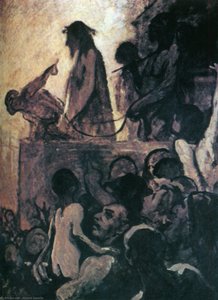
In the quiet, shadowed corners of 19th-century Parisian life, secrets were the currency of survival. Honoré Daumier’s “Crispin and Scapin,” completed in 1858, captures such a clandestine moment with an intensity that transcends the boundaries of mere illustration. At first glance, we witness two men locked in a private exchange; one leans in, his hand pressed against his mouth as if to stifle a scandalous truth, while the other listens with a focused, almost strained attention. This is not merely a depiction of characters from Shakespearean comedy, but a profound study of human vulnerability and the heavy weight of unspoken words. The composition draws the viewer into this intimate circle, making us feel like accidental eavesdroppers to a conversation that could alter the course of lives.
The emotional resonance of the piece lies in its ability to evoke a sense of palpable unease. Daumier masterfully utilizes the tension between the figures to mirror the broader anxieties of the era. There is a haunting quality to their proximity—a closeness born not of affection, but of necessity and shared risk. For the discerning collector or interior designer, this artwork offers more than just visual interest; it provides a focal point of intellectual and emotional gravity, perfect for spaces that demand a sense of history, mystery, and sophisticated storytelling.
The Art of the Line: Mastery in Monochrome
Technically, “Crispin and Scapin” is a triumph of expressive draughtsmanship. Eschewing the lush, distracting colors of the Romantic movement, Daumier relies on a disciplined monochrome palette to command attention. His use of black ink allows for a brilliant play of light and shadow, where every stroke serves a purpose. Through the meticulous application of hatching and cross-hatching, Daumier breathes life into the textures of the scene—from the heavy, tactile folds of the men's clothing to the rugged, distant silhouettes of the mountainous landscape. This technique creates a sculptural depth that makes the figures appear almost three-dimensional against their backdrop.
The artist’s hand is visible in every deliberate line, conveying a gritty realism that avoids the trap of idealization. There is no attempt to beautify his subjects; instead, he finds beauty in the truth of their expressions—the subtle creases around an eye, the tension in a jawline, and the way light catches the edge of a collar. This raw, unvarnished approach makes the reproduction of such a work incredibly impactful in a modern setting, offering a timeless elegance that complements both classical and contemporary decor.
Shadows of the Second Empire: History as Subtext
To understand the true power of this work, one must look through the lens of the political upheaval defining France in 1858. Following Louis Napoleon Bonaparte’s coup d’état, an atmosphere of suspicion and surveillance permeated Parisian society. Daumier, a renowned satirist and observer of social injustice, infused this scene with the spirit of that era. The clandestine nature of the conversation between Crispin and Scapin serves as a poignant metaphor for the political underground—the whispered debates and secret meetings held by those grappling with the limitations of autocratic rule.
The landscape itself, with its imposing mountains and isolated trees, reinforces this sense of solitude and the precariousness of truth. By placing these figures within such a vast, indifferent environment, Daumier highlights the fragility of human connection in the face of overwhelming political forces. Owning a piece that embodies such historical weight allows an art lover to possess a fragment of the very soul of 19th-century resistance and social commentary, making it a truly profound addition to any curated collection.
Veelgestelde vragen
Hoe is de kleurcompositie van "Crispin and Scapin" door Honoré Daumier opgebouwd?
De kleuranalyse van "Crispin and Scapin" door Honoré Daumier legt een Bold contrast en een Discordant Palette harmonie vast.
Wat is de luminantie van "Crispin and Scapin" door Honoré Daumier?
De vastgestelde luminantie voor "Crispin and Scapin" door Honoré Daumier is Gentle Luminance.
Is een download met hoge resolutie van "Crispin and Scapin" beschikbaar?
"Crispin and Scapin" is beschikbaar als een digitale afbeelding in hoge resolutie om te downloaden, direct te verkrijgen op de Digitale afbeelding pagina.
Biografie kunstenaar
Een Leven Geëtst in Satire: De Wereld van Honoré Daumier
Honoré-Victorin Daumier, geboren in Marseille in 1808, leefde een leven dat diep verweven was met de turbulente stromingen van het 19e-eeuwse Frankrijk. Zijn vroege jaren, gekenmerkt door de poëtische aspiraties van zijn vader en de daaropvolgende verhuizing naar Parijs in 1814, brachten hem in een stad die bruiste van artistieke energie. Hoewel aanvankelijk bestemd voor een loopbaan als jurist, leunde Daumier’s hart onwrikbaar naar de kunst. Hij begon zijn carrière als leerling onder Alexandre Lenoir, waar hij klassieke invloeden opnam naast een waardering voor het dramatische clair-obscur van Rubens, en verdiepte zich verder in zijn vaardigheden aan de Academie Suisse. Deze fundamentele training zou cruciaal blijken bij het vormen van zijn kenmerkende stijl – een krachtige mix van realisme en expressieve tekeningstechniek. Maar het was niet alleen de artistieke techniek die Daumier definieerde; het was een diepe gevoeligheid voor de sociale onrechtvaardigheden en politieke absurditeiten om hem heen.De Geslepen Pijl: Karikatuur en Sociale Bekritiek
Daumier’s carrière ontvouwde zich werkelijk in de nasleep van de Revolutie van 1830, een gebeurtenis die de loop van Franse geschiedenis onomkeerbaar veranderde en tegelijkertijd vruchtbare grond bood voor zijn opkomende satirische talent. Hij vestigde zich snel als een meester lithograaf, aanvankelijk door anoniem bij verschillende publicaties bij te dragen voordat hij bekendheid verwierf via zijn werk voor *Le Charivari*, een fel onafhankelijke stripblad dat was opgericht door Charles Philipon. Hier bloeide Daumier’s genie werkelijk uit. Zijn karikaturen waren niet simpelweg humoristische afbeeldingen; ze waren vernietigende aanklachten tegen de bourgeoisie, het juridische systeem en de politieke machthebbers. Hij sprak onverbloemelijk koning Louis-Philippe aan, waardoor hij zes maanden werd gearresteerd in 1832 voor een bijzonder scherp karikatuur. Deze ervaring, die zijn stem niet verstomde, maar juist versterkte, bevestigde zijn toewijding om hypocrisie te ontmaskeren en autoriteit uit te dagen door middel van kunst. Zijn lithografieën werden visuele manifesten, vastleggend de geest van verzet en een kritische commentaar op de maatschappelijke problemen van zijn tijd. De enorme hoeveelheid werk die hij tijdens deze periode produceerde is verbazingwekkend – duizenden lithografieën die zowel populair entertainment als krachtige politieke verklaringen vormden.Buiten Karikatuur: Schilderkunst en Beeldhouwwerk
Hoewel Daumier vooral bekend staat om zijn lithografieën, zou het een onrechtvaardige beperking zijn hem uitsluitend tot deze discipline te reduceren. Hij was ook een toegewijde schilder en beeldhouwer, hoewel erkenning voor dit werk pas later in zijn leven kwam. Zijn schilderijen, vaak beelden van alledaagse Parijse levens – de derde klaswagen, de wasserettes, de advocaten – zijn doordrenkt van een diep gevoel van realisme en empathie. Ze waren geen geïdealiseerde portretten, maar eerder onverbogen weergaven van lijden en strijd. Hij beheerst losse penseelstreken en dramatische belichting om emotie en sfeer over te brengen, wat foreshadowing was voor de technieken die later door de Impressionisten werden omarmd. Zijn beeldhouwwerk, grotendeels gemaakt in klei (veel stukken onbebroekt tijdens zijn leven), toont een vergelijkbare toewijding aan het vastleggen van de menselijke vorm met eerlijkheid en emotionele diepte. Deze beelden, ontdekt na zijn dood, bewijzen een opmerkelijke talent voor modellering en een vermogen om psychologische complexiteit over te brengen door middel van fysieke gebaren.Een Duurzaam Erfgoed: Invloed en Historische Betekenis
Honoré Daumier’s impact op de kunstgeschiedenis is onmiskenbaar. Hij verbond de romantiek met het realisme, waardoor toekomstige generaties kunstenaars een weg vrijmaakten om de wereld te portretteren zoals die werkelijk was – met al zijn imperfecties. Zijn onverbogen sociale commentaar beïnvloedde kunstenaars als Gustave Courbet en Édouard Manet, terwijl zijn innovatieve gebruik van lithografie het drukstechniek radicaal veranderde. Zijn werk resonneert nog steeds vandaag de dag, herinnert ons aan de kracht van kunst om autoriteit uit te dagen, onrechtvaardigheid bloot te leggen en getuige te zijn van de menselijke conditie. Het Musée d’Orsay in Parijs huisvest een aanzienlijke collectie van zijn schilderijen en beelden, waardoor bezoekers een blik krijgen op de wereld die hij zo levendig heeft weergegeven. Zijn lithografieën zijn wijdverspreid toegankelijk via collecties zoals die te vinden zijn op OriginalUniqueArt, waardoor zijn satirische genialiteit voortdurend nadenken en inspireren. Daumier was niet alleen een kunstenaar; hij was een chroniqueur van zijn tijd – een vispoët die zijn talent gebruikte om de stemmen van de minderbedeelde te verheffen en macht verantwoordelijk te houden. Zijn nalatenschap duurt voort als een getuigenis van de blijvende relevantie van kunst als kracht voor sociale verandering.Huidige Meta Beschrijving:
Discover Honoré Daumier (1808-1879), the French master of realism & satire. Explore his powerful lithographs, paintings & sculptures critiquing 19th-century society and influencing modern art.Huidige Meta Trefwoorden:
Honoré Daumier, Honore Daumier, French Realism, 19th Century Art, Political Satire, Lithography, Caricature, Parisian Life, Daumier Prints
Honoré Daumier
1808 - 1879 , Frankrijk
Belangrijkste feiten
- Artistic Movement Or Style: Realisme, Satire
- Artists Or Movements Influenced By This Artist:
- Impressionnisme
- Modern kunst
- Artists Who Influenced This Artist:
- Lenoir
- David
- Date Of Birth: 26 feb 1808
- Date Of Death: 10 feb 1879
- Full Name: Honoré-Victorin Daumier
- Nationality: Frans
- Notable Artworks:
- Rue Transnonain
- Les gens de justice
- Place Of Birth: Marseille, Frankrijk
Gerelateerde artikelen
Top 10 Legendarische Lithografieën die de Kunst voor Altijd Veranderden | OriginalUniqueArt.nl
Ontdek de 10 meest legendarische lithografieën die kunstgeschiedenis schreven! Van Toulouse-Lautrec tot Munch, duik in verhalen van iconische meesterwerken. Vind museumkwaliteit reproducties & interieurinspiratie op OriginalUniqueArt.com.

Monochrome Visions: Exploring the Aesthetic & Historical Significance of Black & White Photography
Explore the rich history & artistic power of black and white photography. From early techniques to iconic masters like Ansel Adams, discover why monochrome continues to captivate art lovers today. Expert insights for collectors.

Top 10 Witte Meesterwerken: Kunstgeschiedenis & Interieurinspiratie
Ontdek de top 10 witte meesterwerken uit de kunstgeschiedenis! Van Monet tot Mondriaan, bewonder abstracte vormen & serene kleuren. Vind museumkwaliteit reproducties en interieurinspiratie op OriginalUniqueArt.com.

Meesterwerken in Zwart: Top 10 Schilderijen Gedreven door Donkere Tinten | OriginalUniqueArt.nl
Ontdek de kracht van donker! Verlies jezelf in onze top 10 zwarte schilderijen, van Caravaggio tot Manet. Leer over meesterwerken, technieken & emotie. Museumkwaliteit reproducties op OriginalUniqueArt.com – Kunst voor uw interieur.
Honoré Daumier: Social Commentary & Artistic Innovation in 19th-Century France
Explore the life & work of Honoré Daumier, a master of 19th-century French realism and satire. Discover his powerful lithographs, paintings, and sculptures critiquing society – and his lasting influence on modern art.