Schakel over naar print
 Lees meer







































 Voor kunstwerken of reproducties die aan één zijde groter zijn dan 105 cm (ongeveer 41 inch), wordt de lijst als een losse set verzonden. Deze methode garandeert een veilige levering en voorkomt schade tijdens het transport.


The Unveiling Gaze: A Study in Early Nineteenth-Century Portraiture
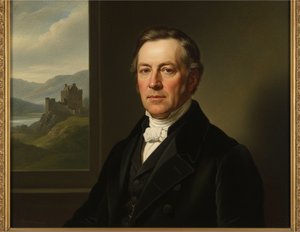
To stand before this portrait of Pringle Fraser is to encounter not merely a likeness, but a carefully constructed moment of contemplation. Painted around 1804, this work captures the essence of early nineteenth-century masculine dignity. The subject commands attention through his direct, almost challenging gaze. He is presented in attire that speaks of respectable standing—the crisp white shirt contrasting sharply with the somber black vest and tie. This deliberate contrast in costume immediately draws the eye, framing a face etched with an air of profound seriousness. It is a portrait that refuses to whisper; it speaks with the quiet authority of established character.
Mastery of Shadow and Light: Technical Brilliance
The technical execution here suggests the hand of a master observer, echoing the traditions perfected by artists like Henry Raeburn, whose influence permeates this style. Notice how the artist has manipulated the background; it is not empty space, but rather a deep, moody atmosphere that seems to absorb all surrounding light. This dramatic chiaroscuro effect serves to push the figure forward, making him leap out from the canvas plane. The focus remains intensely on the planes of his face—the structure around the eyes, the set of the jaw—all rendered with painstaking detail. One can almost feel the texture of the fabric and the subtle sheen in his dark hair.
Historical Echoes: Life at the Turn of the Century
The year 1804 places this portrait squarely within a period of immense social and artistic transition in Britain. The sitter’s formal presentation reflects the rigid codes of gentlemanly conduct prevalent before the sweeping changes that would characterize the Victorian era. These portraits were not just records of appearance; they were statements of lineage, profession, and moral character. Owning or displaying such a piece connects the modern viewer directly to the aspirations and social structures of the Regency period—a time balancing Enlightenment ideals with burgeoning industrial confidence.
Emotional Resonance and Decorative Impact
Emotionally, the portrait is captivating precisely because of its ambiguity. Is the sternness born of deep thought, professional gravity, or perhaps a slight impatience with the viewer? This unresolved tension is what gives the piece its enduring power. For the collector or designer, this painting offers more than mere decoration; it provides an anchor of sophisticated gravitas for any room. A high-quality reproduction allows one to integrate this powerful narrative into contemporary interiors, lending an air of cultivated history and intellectual depth that few modern pieces can match.
Veelgestelde vragen
Hoe verhoudt het onderwerp van "Pringle Fraser" zich tot de gebruikelijke thema's van Henry Raeburn?
De terugkerende thema's van Henry Raeburn omvatten scottish enlightenment, royal patronage, realistic portraiture, dramatic lighting, national identity; "Pringle Fraser" richt zich op scottish painting, portraiture, realism, british art, henry raeburn, ivory miniature, dark atmosphere.
Hoe is "Pringle Fraser" historisch gezien te plaatsen?
"Pringle Fraser" door Henry Raeburn behoort tot de Contemporary Realism-stroming, binnen de 19th Century-periode. Samen geven zij het werk zijn plaats in de kunstgeschiedenis.
Waarom heeft het kunstwerk "Pringle Fraser" deze auteursrechtelijke status?
"Pringle Fraser" door Henry Raeburn is bevindt zich in het publiek domein - de auteursrechten zijn verlopen. De auteursrechtelijke bescherming loopt vanaf het overlijden van de kunstenaar, dat plaatsvond in 1823.
 Voorvertoning
 Verstuur
 Delen
Delen
 Details bekijken
 Gids
Gids

 Download
 Vergelijkbare items
 Röntgenonderzoek
 Diavoorstelling
 Q&A
Q&A Statistieken