

 Bekijk op ware grootte
 Verstuur
 Delen
Delen
 Details bekijken
 Gids voor studentenkunstwerken

 Download
 Vergelijkbare items
 Röntgenonderzoek
 Diavoorstelling
 Statistieken
Untitled


 Lees meer
De kunstwerken die op deze pagina worden weergegeven, zijn beschermd door de auteursrechtwetgeving, wat betekent dat het ons wettelijk niet is toegestaan om identieke reproducties te maken of te verkopen. Deze bescherming wordt gehandhaafd onder internationale overeenkomsten zoals de Conventie van Bern en door nationale wetgeving, waaronder de bepalingen van de Amerikaanse auteurswet - Titel 17. Alle rechten voorbehouden. Reproduceren of distribueren van afbeeldingen is niet toegestaan zonder uitdrukkelijke schriftelijke toestemming van WahooArt.com en de rechthebbenden.
Deze methode voldoet volledig aan de auteursrechtwetgeving, omdat het niet gaat om het kopiëren of dupliceren van het beschermde kunstwerk. In plaats daarvan is er sprake van een creatieve herinterpretatie — een nieuw schilderij dat door het origineel wordt geïnspireerd, maar er niet identiek aan is.
Giclée / Kunstafdrukken
Giclée- of canvasafdruk van museumkwaliteit met een snelle productie en flexibele afwerkingsmogelijkheden. ( Koop handgeschilderd kunstwerk Schakel over naar digitale afbeeldingen)




P118B €10

P118H €10

P118W €10

P438Z €10

P508JH €12

P508YH €12

P805H €10

P805Z €10

P919BZ €10

P919G €10

P919XJ €10

P959ZH €10

P968JZ €12

W106C €8

W218G €10

W218JH €8

W218Y €10

W307PJ €10

W316G €10

W316PJ €8

W316Y €10

W398PJ €8

W4111J €10

W500HY €15

W500JH €15

W692G €12

W849H €8

W940BG €15

W953PJ €8




Kies uit onze vooraf ingestelde maten die overeenkomen met de originele verhoudingen van het kunstwerk.

Voer de breedte en de hoogte in die u nodig heeft, passend bij uw lijst of uw muur. Een afdruk kan alleen worden ingekort, nooit groter worden gemaakt dan het origineel, waardoor een formaat met een andere verhouding een deel van de afbeelding verliest. Wij sturen u een digitaal mockup ter goedkeuring voordat we iets drukken. De afbeelding op deze pagina toont niet de werkelijke uitsnede — dit is alleen te zien op het mockup.
Wereldwijde levering () binnen 2 weken in plaats van de standaard 4/5 weken. (24 oktober)

Gratis wereldwijde expressverzending

Hoogwaardig linnen canvas

Volledige verzendverzekering

Garantie op terugbetaling van invoerrechten

Garantie op exacte kleurweergave

Retourbeleid van 100 dagen (alleen bij defecten)

100% Geld-terug-garantie

Korting bij meerdere afnames
 De optie voor glas is alleen beschikbaar bij een formaat kleiner dan 110 cm.

Untitled
Giclée / Kunstafdrukken
Formaat reproductie
-


Totaalprijs
€ 71
A Meditation on Layers: Exploring Hedda Sterne’s Untitled
Hedda Sterne's "Untitled," created in 1960, stands as a cornerstone of Abstract Expressionism and embodies the artist’s profound engagement with both philosophical inquiry and visual experimentation. Born Hedwig Lindenberg in Bucharest, Romania, Sterne possessed an intellectual lineage that instilled in her a lifelong fascination for challenging conventions and delving into the subconscious—a sensibility perfectly mirrored in her distinctive artistic approach. This piece isn't merely pigment on canvas; it’s a carefully considered distillation of ideas about containment, transformation, and the hidden complexities beneath apparent simplicity.The Visual Language of Depth
The artwork immediately captivates with its horizontal bands of muted beige and darker brown hues, punctuated by circular forms that dominate the upper portion. These shapes aren't presented as static objects but rather as dynamic entities interacting with each other—a visual representation of Sterne’s preoccupation with concepts of duality and interconnectedness. The layering technique is deliberate; thick impasto strokes create a palpable textural surface, suggesting multiple applications of paint and inviting viewers to contemplate the process of creation itself. This physicality speaks to Sterne's belief that art should engage all senses, fostering an immersive experience beyond mere visual perception.Echoes of Philosophical Discourse
Sterne’s artistic explorations were deeply influenced by thinkers like Heidegger and Sartre—figures who wrestled with questions of being and existence. The geometric abstraction of “Untitled” reflects this intellectual framework, eschewing representational imagery in favor of a symbolic language that prioritizes conceptual resonance over literal depiction. The circular forms, reminiscent of cosmological diagrams, hint at an interest in exploring fundamental patterns underlying reality – mirroring the existentialist concern for confronting the absurdity of life and embracing individual responsibility.Impasto Technique: Texture as Expression
The impasto technique—the application of paint thickly onto the canvas—is central to Sterne’s artistic vision. It wasn't simply a stylistic choice; it was a conscious effort to convey emotion and physicality. The visible brushstrokes capture the artist’s gesture, imbuing the artwork with an immediacy that transcends time. This textural richness invites viewers to consider the materiality of art alongside its intellectual content—a testament to Sterne’s conviction that artistic expression should be both aesthetically compelling and psychologically profound.A Legacy of Quiet Contemplation
“Untitled” remains a powerfully evocative piece, prompting reflection on themes of isolation and interconnectedness. Its subdued palette contributes to an atmosphere of contemplative stillness, encouraging viewers to engage in introspection and consider the unspoken narratives embedded within its visual vocabulary. Sterne’s enduring influence stems from her ability to transform abstract forms into vehicles for philosophical contemplation—a legacy that continues to inspire artists and collectors alike.Vragen & Antwoorden
Waar kan ik een voorproefje van "Untitled" bekijken?
Om een reproductie van "Untitled" door Hedda Sterne te bekijken, opent u de Voorvertoning pagina van het kunstwerk.
Welk kleurenpalet wordt gebruikt in "Untitled"?
"Untitled" door Hedda Sterne maakt gebruik van een Earthy kleurenpalet. Het palet vat het algemene kleurkarakter van het werk samen.
Bij welke kunststroming behoort "Untitled" door Hedda Sterne?
"Untitled" door Hedda Sterne behoort tot de Abstract Expressionism-stroming. Deze stroming biedt de stilistische context van het werk.
Biografie van de kunstenaar
A Life Bridging Worlds: The Artistic Journey of Hedda Sterne
Hedda Sterne, born Hedwig Lindenberg in Bucharest, Romania, in 1910, was an artist whose life and work embodied a fascinating intersection of cultures, movements, and personal philosophies. Her journey from the vibrant avant-garde scene of pre-war Europe to the heart of the New York School is a testament to her resilience, intellectual curiosity, and unwavering dedication to artistic exploration. Growing up in a household that valued both music and languages – her brother became a renowned conductor – Sterne received a broad education that fostered an appreciation for nuance and expression. This early exposure, coupled with a burgeoning interest in art history and German philosophical texts, laid the groundwork for a deeply thoughtful and conceptually driven practice. Initially encouraged towards a musical path, she skillfully navigated familial expectations to pursue her true calling: painting. Her formal training began in 1918 under the tutelage of Frederic Storck, a sculptor who had taught her instructor Max Hermann Maxy, setting her on a course that would see her engage with some of the most pivotal artistic currents of the twentieth century.From Bucharest to New York: A Surrealist Foundation
The intellectual and artistic ferment of Bucharest in the 1920s proved crucial in Sterne’s formative years. She became immersed in a thriving avant-garde community, working alongside Dada co-founder Marcel Janco and forging close friendships with artists like Victor Brauner. This period instilled in her an early affinity for Surrealism, which she described as something she “grew up with.” Frequent travels to Vienna, where she studied ceramics, and Paris, where she briefly attended ateliers of Fernand Léger and André Lhote, broadened her artistic horizons and exposed her to the latest developments in European Modernism. These experiences were not merely technical exercises; they were opportunities to absorb different approaches to form, color, and composition, all while deepening her understanding of Surrealist principles like automatism – a technique she would later employ in creating unique collages. The looming shadow of war forced a difficult decision in 1939 when Sterne returned to Bucharest from France for what would be the last time before the outbreak of World War II. The subsequent years were marked by increasing political unrest and, tragically, witnessing the horrors of the Bucharest pogrom in January 1941. After months of struggle securing visas, she finally embarked on a perilous journey to New York aboard the S.S. Excambion in October 1941, leaving behind a life irrevocably altered by conflict.The New York School and Beyond: Finding Her Voice
Arriving in New York, Sterne reunited with her estranged husband, Fritz Stern (later Frederick Stafford), though they would soon adopt the surname “Stafford.” However, she quickly established herself as "Hedda Sterne," subtly reclaiming a connection to her European past while forging a new identity within the burgeoning American art scene. Her proximity to Peggy Guggenheim’s gallery on Beekman Place proved pivotal, reintroducing her to many of the Surrealist artists she had known in Paris – André Breton, Marcel Duchamp, and Max Ernst among them. She also formed a close friendship with Antoine de Saint-Exupéry, even offering crucial advice that influenced his iconic illustrations for *The Little Prince*. Sterne’s work during this period reflected her unique position as an outsider looking in, grappling with the complexities of American culture while retaining a distinctly European sensibility. She became associated with the Abstract Expressionist movement and famously appeared in the 1951 *Life* magazine photograph of “The Irascibles,” though she was the only woman included in the group—a subtle but significant acknowledgment of her presence within this influential circle. However, Sterne resisted easy categorization, consistently pushing boundaries and refusing to be confined by stylistic labels.A Visual Diary: Themes and Techniques
Hedda Sterne’s art is often described as a visual diary, reflecting not only external observations but also internal states of mind and philosophical inquiries. Her paintings, collages, and drawings explore themes of displacement, memory, and the search for meaning in a rapidly changing world. She was particularly fascinated by the interplay between order and chaos, often employing layered textures, fragmented forms, and ambiguous spaces to create works that are both visually compelling and intellectually stimulating. The influence of Surrealism is evident in her early collages, which utilize chance encounters and unexpected juxtapositions to evoke a sense of dreamlike disorientation. Later, she experimented with industrial materials like aerosol spray paint, embracing the immediacy and fluidity of this medium to capture the energy and dynamism of urban life. Her paintings frequently feature abstracted landscapes, architectural motifs, and enigmatic figures, inviting viewers to engage in their own interpretive journeys. Third Avenue El, for example, powerfully conveys the chaotic rhythm of New York City, while her *Tondo* series demonstrates a continued exploration of form and space through circular compositions. Throughout her long career, Sterne remained committed to pushing the boundaries of artistic expression, creating a body of work that is both deeply personal and universally resonant. ## Legacy and Historical Significance Hedda Sterne’s contribution to twentieth-century art extends beyond her individual paintings and collages. She served as a vital bridge between European Modernism and the American avant-garde, bringing with her a unique perspective shaped by a life lived across continents and cultures. Her unwavering commitment to artistic independence and her refusal to conform to prevailing trends paved the way for future generations of artists who challenged conventional norms. While she achieved recognition during her lifetime, including exhibitions at prominent galleries and museums, Sterne’s work has gained increasing attention in recent years as scholars and curators reassess the contributions of women artists within the Abstract Expressionist movement. The establishment of the Hedda Sterne Foundation ensures that her legacy will continue to inspire and challenge audiences for years to come, solidifying her place as a significant figure in the history of modern art—an artist who fearlessly navigated a world in flux, transforming personal experience into enduring visual poetry.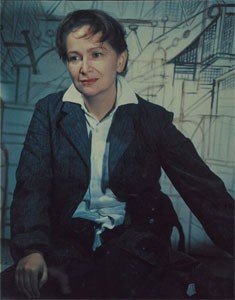
Hedda Sterne
1910 - 2011 , Roemenië
Snelle feiten
- Artistic Movement Or Style: Abstract Expressionisme & Surrealisme
- Artists Or Movements Influenced By This Artist: ['New York School']
- Artists Who Influenced This Artist:
- Marcel Janco
- Victor Brauner
- Fernand Léger
- André Lhote
- Date Of Birth: August 4, 1910
- Date Of Death: 2011
- Full Name: Hedda Sterne
- Nationality: Roemeens-Amerikaans
- Notable Artworks:
- Tondo
- Third Avenue El
- Untitled (D2WW32)
- Place Of Birth: Bucharest, Romania
Gerelateerde artikelen

Pure Chaos & Color: The High-Voltage World of Abstract Expressionism
Dive into the high-voltage world of Abstract Expressionism. Explore the raw energy of Action Painting and the legendary masters of the New York School through a visual journey of pure chaos and color. Discover how to bring bold, high-impact abstract art into your modern space.

Kandinsky's Meesterwerken: 25 Abstracte Kunstparels voor uw Interieur | OriginalUniqueArt
Ontdek de 25 meest iconische werken van Wassily Kandinsky! Duik in zijn abstracte wereld vol kleur, expressionisme & spirituele diepgang. Vind museumkwaliteit reproducties en interieurinspiratie op OriginalUniqueArt.com.

Top 10 Abstract Expressionisme Meesterwerken: Kunst voor uw Interieur | OriginalUniqueArt.com
Ontdek de 10 meest invloedrijke werken van Abstract Expressionisme! Leer over Jackson Pollock, Mark Rothko & meer. Museumkwaliteit kunst reproducties voor uw interieur. Bekijk de collectie op OriginalUniqueArt.com.
Lyrical Abstraction: The Emotional Power of Color and Form in Modern Art History
Explore the profound emotional depth of Lyrical Abstraction. Discover how masters like Raymond Parker used color and form to bridge Impressionism and Abstract Expressionism. Learn about this pivotal movement through our expert-led art history guide.
Beyond the Lines: Mastering the High-Impact World of Contemporary Abstraction
Master the high-impact world of contemporary abstraction. Discover how bold colors, textures, and modern movements like Abstract Expressionism can transform your space with premium, high-energy art curated for the design-conscious professional.