Voorvertoning
 Verstuur
 Delen
Delen
 Details bekijken
 Gids
Gids

 Download
 Vergelijkbare items
 Röntgenonderzoek
 Diavoorstelling
 Q&A
Q&A Statistieken
The Painter's Studio

- 361.0 x 598.0 cm


 Lees meer
Giclée / Kunstafdrukken
Giclée- of canvasafdruk van museumkwaliteit met een snelle productie en flexibele afwerkingsmogelijkheden. ( Bestel handgeschilderde reproductie Schakel over naar digitale afbeeldingen)




P118B €10

P118H €10

P118W €10

P438Z €10

P508JH €12

P508YH €12

P805H €10

P805Z €10

P919BZ €10

P919G €10

P919XJ €10

P959ZH €10

P968JZ €12

W106C €8

W218G €10

W218JH €8

W218Y €10

W307PJ €10

W316G €10

W316PJ €8

W316Y €10

W398PJ €8

W4111J €10

W500HY €15

W500JH €15

W692G €12

W849H €8

W940BG €15

W953PJ €8




Kies uit onze vooraf ingestelde maten die overeenkomen met de originele verhoudingen van het kunstwerk.

Voer de gewenste breedte en hoogte in, passend bij uw lijst of muur. Een afdruk kan alleen worden ingekort en nooit groter worden gemaakt dan het origineel; een formaat met andere verhoudingen zal daarom een deel van de afbeelding verliezen. Wij sturen u een digitaal mockup ter goedkeuring voordat we tot drukwerk overgaan. De afbeelding op deze pagina toont niet de werkelijke uitsnede — dit is alleen te zien op het mockup.
Wereldwijde levering () binnen 2 weken in plaats van de standaard 4/5 weken. (1 november)

Gratis wereldwijde expressverzending

Hoogwaardig linnen canvas

Volledige verzendverzekering

Garantie op terugbetaling van invoerrechten

Garantie op exacte kleurweergave

Retourbeleid van 100 dagen (alleen bij defecten)

100% Geld-terug-garantie

Korting bij meerdere afnames
 De optie voor glas is alleen beschikbaar bij een formaat kleiner dan 110 cm.

The Painter's Studio
Giclée / Kunstafdrukken
Afmetingen reproductie
-


Eindtotaal
€ 72
A Bold Declaration of Reality: Gustave Courbet’s “The Painter’s Studio”
Dr. Steven Zucker begins his exploration of Gustave Courbet's monumental canvas, "The Painter’s Studio," by highlighting its significance as a pivotal moment in artistic history. Rejected from the prestigious Salon of 1855—a decision that fueled Courbet’s rebellious spirit—the artist responded not with despair but with audacious determination: he organized his own exhibition, showcasing this sprawling masterpiece alongside fellow realist artists. This act wasn't merely about circumventing convention; it was a deliberate assertion of artistic freedom and a profound critique of the prevailing academic aesthetic. As Zucker eloquently puts it, “Rejected from a national exhibition, Courbet simply launched his own show to display this enormous work.”- Subject Matter & Composition: The painting depicts a richly populated room—a deliberate provocation against the idealized landscapes favored by Romantic painters—featuring figures representing various strata of society. From the impoverished beggar girl to Napoleon III himself, Courbet meticulously portrays the everyday realities of his time.
- Style & Technique: Courbet’s masterful use of oil paint on canvas exemplifies realism at its most uncompromising. Thick brushstrokes and a muted palette convey texture and depth, capturing the materiality of the scene with remarkable accuracy. The artist eschewed illusionistic techniques, prioritizing direct observation and honest representation.
Symbolism: An Allegory of Artistic Struggle
“The Painter’s Studio” transcends mere depiction; it operates as a complex allegory reflecting Courbet's personal journey and artistic convictions. Each figure within the room carries symbolic weight, embodying ideals antithetical to academic art. The guitar, dagger, and hat serve as emblems of defiance against traditional conventions, while the presence of Alfred Bruchas—a wealthy collector who championed realism—and philosophers Proudhon and Champfler underscores Courbet’s engagement with intellectual discourse.
- The Figures: Courbet himself is positioned at the center, surrounded by benevolent symbols – a woman representing Truth (the muse), a child symbolizing innocence, and a cat embodying independence. These figures represent Courbet's belief in the transformative power of art and its ability to challenge societal norms.
- Representations of Ideals: The couple gazing out the window embodies free love—a rejection of bourgeois morality—further emphasizing Courbet’s humanist perspective.
Historical Context & Significance
Painted in 1855, “The Painter’s Studio” arrived at a time when artistic discourse was fiercely debated. The Salon rejected Courbet's painting due to its unflinching portrayal of social realities and its rejection of idealized beauty. This decision galvanized the realist movement, establishing Courbet as a champion of authenticity and challenging the dominance of academic art.
- The Pavilion of Realism: Courbet’s audacious act of organizing his own exhibition solidified his position as a pioneer of realism and signaled a decisive break from artistic conventions.
- Legacy: “The Painter’s Studio” continues to inspire artists and collectors alike, serving as a testament to Courbet's unwavering commitment to portraying the world truthfully—a legacy that resonates powerfully within the contemporary art landscape.
Emotional Impact & Artistic Inspiration
Courbet’s masterful composition invites contemplation on themes of social justice, artistic freedom, and human connection. The painting's palpable atmosphere captures a moment of intellectual exchange and artistic fervor—a reminder that art can serve as both a mirror to society and a catalyst for transformative change. Its enduring beauty lies in its ability to provoke thought and inspire creativity.
Veelgestelde vragen
Wordt "The Painter's Studio" door Gustave Courbet bewaard in het land van herkomst van de kunstenaar?
Nee - het kunstwerk wordt in het buitenland bewaard. Gustave Courbet werd geboren in Frankrijk, en het originele werk "The Painter's Studio" wordt bewaard in een museum in France.
Welke afdrukinstellingen worden aanbevolen voor "The Painter's Studio" door Gustave Courbet?
Formaat Large, Panoramic oriëntatie: dit is de aanbevolen printinstelling voor "The Painter's Studio" door Gustave Courbet.
Welke emotie straalt het Contemporary Realism-werk "The Painter's Studio" uit?
Binnen de Contemporary Realism-stroming is "The Painter's Studio" vastgelegd met een Mysterious toon.
Biografie kunstenaar
A Rebel’s Brush: The Life and Legacy of Gustave Courbet
Jean Désiré Gustave Courbet, born in Ornans, France, on June 10, 1819, stands as a monumental figure in the history of art – a defiant iconoclast who irrevocably altered the trajectory of painting during the mid-nineteenth century. More than simply capturing visual impressions; his artistic journey embodies a profound rejection of convention and an unwavering dedication to portraying reality with uncompromising honesty. His upbringing within a moderately prosperous bourgeois family fostered an early appreciation for artistic pursuits, nurtured by his mother’s encouragement – a formative influence that propelled him toward a revolutionary vision of artistic expression. Formal training commenced at the École des Beaux-Arts in Paris in 1839, yet Courbet swiftly recognized the stifling limitations imposed by academic dogma and Romantic idealism. While acknowledging debts to artists like Eugène Delacroix and Théodore Géricault – figures who championed dramatic emotion and historical narrative – Courbet resolutely forged his own path, prioritizing observation over imagination and truth above all else. This deliberate divergence from established artistic norms would define his entire career and establish him as the undisputed leader of Realism.The Birth of Realism: Challenging Artistic Conventions
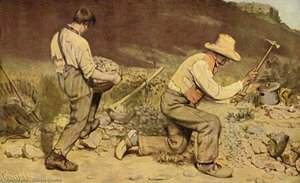
Courbet’s artistic development was characterized by a conscious repudiation of prevailing aesthetic standards. He eschewed mythological tales and heroic allegories, instead focusing intently on the everyday lives of ordinary individuals – particularly laborers and rural inhabitants. This commitment to depicting the world without embellishment—a stance that would soon become synonymous with Realism—encountered vehement opposition from critics accustomed to idealized representations steeped in romantic sentimentality. Early canvases explored landscapes and portraits; however, he swiftly transitioned toward scenes of working-class existence, rendered on monumental scales traditionally reserved for grand historical or religious paintings. This deliberate choice wasn’t merely stylistic; it was a declaration about the inherent dignity and significance of subjects often marginalized by artistic discourse. The Stone Breakers (1849), tragically destroyed during World War II, exemplifies this approach—a stark portrayal of two laborers toiling under oppressive conditions, their faces obscured by exhaustion and despair. Critics deemed such depictions vulgar and unworthy of serious consideration, highlighting the profound challenge Courbet posed to the prevailing artistic sensibilities of his time.Major Works and Artistic Philosophy
Courbet’s artistic philosophy extended beyond subject matter to encompass technique. He championed a direct, impasto style—applying paint thickly onto the canvas—that prioritized the materiality of the medium itself. This method deliberately rejected the smooth surfaces favored by academic painters, emphasizing texture and physicality as crucial elements of visual expression. His most celebrated paintings include A Burial at Ornans (1850-51), a monumental canvas depicting a provincial funeral that provoked considerable controversy upon its exhibition. Unlike Romantic artists who sought to elevate emotion and inspire awe, Courbet presented the mourners with unflinching realism—faces etched with sorrow, boredom, and resignation—challenging viewers to confront uncomfortable truths about human experience. Similarly, Château du Chillon (1874), a breathtaking depiction of the medieval castle overlooking Lake Geneva, showcases Courbet’s meticulous attention to detail and his masterful command of light and color. He sought to capture not merely what he saw but also how it felt—a profound ambition that resonated deeply with fellow artists grappling for new modes of artistic representation.Legacy and Historical Significance
Gustave Courbet's influence on subsequent art movements is undeniable. While acknowledging debts to earlier masters like Caravaggio for their dramatic realism and use of chiaroscuro, his impact transcended mere imitation. He fundamentally reshaped the landscape of painting by liberating artists from the constraints of tradition—encouraging them to explore uncharted territories of visual perception. His unwavering advocacy for artistic freedom cemented his position as a champion of intellectual dissent and fueled the burgeoning movement toward socially engaged art. Courbet’s participation in the Salon des Refusés (1863)—an audacious defiance of official censure—solidified his reputation as an iconoclastic rebel who refused to compromise on his convictions. He died peacefully in Paris on April 29, 1877, leaving behind a legacy that continues to inspire artists and scholars alike – a testament to the transformative power of art to confront societal norms and illuminate the complexities of human existence.
Gustave Courbet
1819 - 1877 , Frankrijk
Belangrijkste feiten
- Artistic Movement Or Style: Realisme
- Artists Or Movements Influenced By This Artist:
- Impressionisme
- Post-impressionisme
- Artists Who Influenced This Artist:
- Eugène Delacroix
- Théodore Géricault
- Caravaggio
- Date Of Birth: 10 juni 1819
- Date Of Death: 31 december 1877
- Full Name: Gustave Courbet
- Nationality: Frans
- Notable Artworks:
- De Steenbakers
- Een begrafenis te Ornans
- De Schilderstudio
- Place Of Birth: Orléans, Frankrijk
Gerelateerde artikelen

Paul Cézanne's Top 25 Meesterwerken: Kleur, Vorm & De Basis van Modern Art | OriginalUniqueArt
Ontdek de 25 meest iconische schilderijen van Paul Cézanne! Duik in zijn kleurrijke wereld, leer over impressionisme & post-impressionisme en bewonder meesterwerken als 'De Baders'. Vind museumkwaliteit reproducties & interieurinspiratie op OriginalUniqueArt.com.

Top 10 Impressionistische Meesterwerken: Kleur, Licht & Emotie voor uw Interieur
Ontdek de top 10 impressionistische meesterwerken van Monet, Renoir & meer! Duik in kleur, licht en emotie met deze iconische schilderijen. Vind museumkwaliteit kunst reproducties voor uw interieur op OriginalUniqueArt.com.
Gustave Courbet: Realism's Revolutionary Vision & the Social Canvas of 19th-Century France
Explore the revolutionary art of Gustave Courbet, pioneer of Realism. Discover his iconic paintings, social commentary, and lasting impact on 19th-century French art history. Expert analysis & insights.
Henri Martin: A Synthesis of Impressionism & Symbolism in the French Landscape Tradition
Explore the captivating world of Henri Martin, a French Post-Impressionist bridging Impressionism & Symbolism. Discover his unique style, influential landscapes, and lasting legacy with OriginalUniqueArt.
Top 10 Realistische Meesterwerken: Kunstgeschiedenis voor uw Interieur | OriginalUniqueArt.com
Ontdek de 10 meest iconische meesterwerken van het Realisme! Van Courbet tot Millet, leer over de kunstenaars, technieken & impact. Vind museumkwaliteit reproducties voor uw interieur op OriginalUniqueArt.com. Exploreer de collectie online!