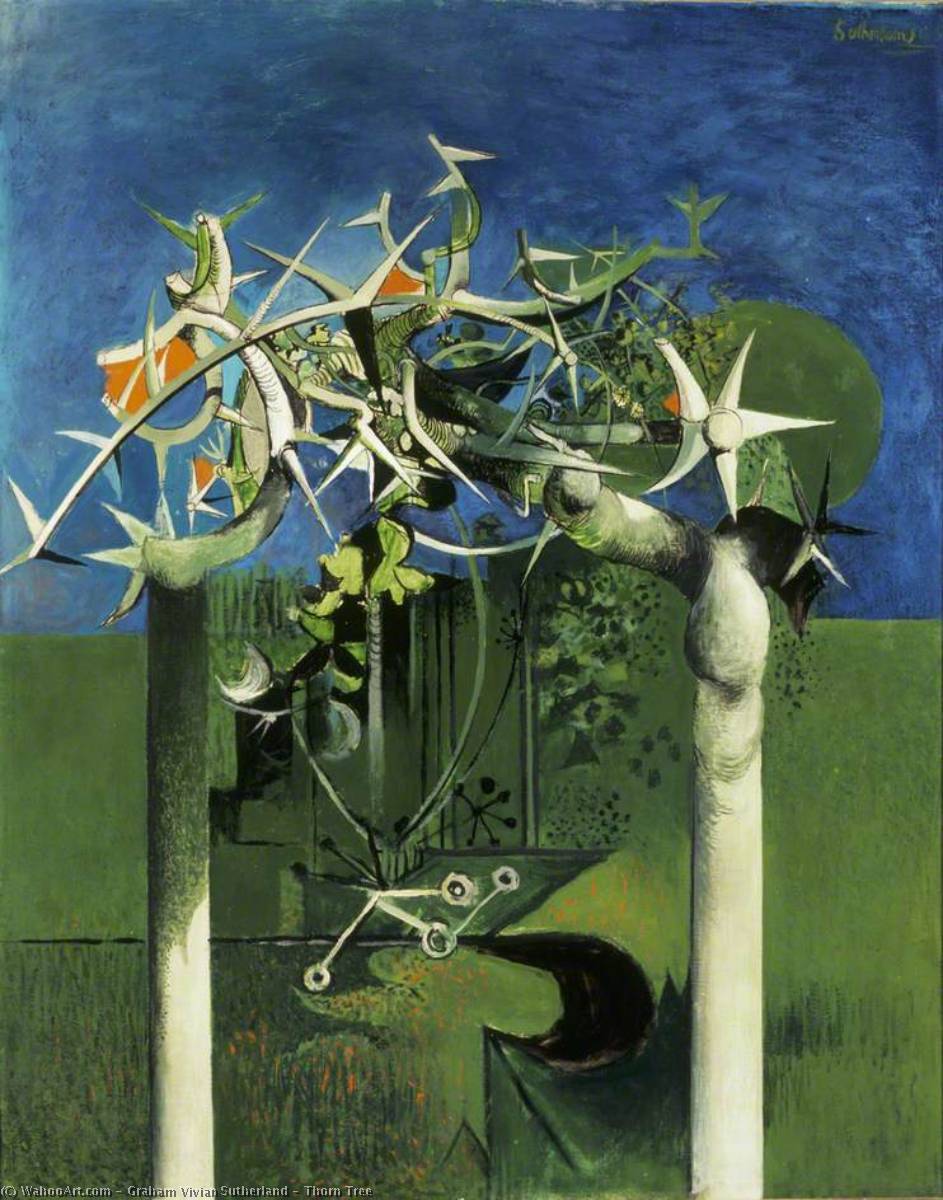
Thorn Tree
Acrylic On Canvas
WallArt
Neo-Romanticism
1946
127.0 x 102.0 cm
British Council Collection
Handgemaakte olieverfreproductie
Met de hand geschilderd in olieverf op canvas in uw gewenste maat en lijst, op bestelling gemaakt door onze kunstenaars.
P118B $10
P118H $10
P118W $10
P438Z $10
P508JH $12
P508YH $12
P805H $10
P805Z $10
P919BZ $10
P919G $10
P919XJ $10
P959ZH $10
P968JZ $12
W106C $8
W218G $10
W218JH $8
W218Y $10
W307PJ $10
W316G $10
W316PJ $8
W316Y $10
W398PJ $8
W4111J $10
W500HY $15
W500JH $15
W692G $12
W849H $8
W940BG $15
W953PJ $8
Kies uit onze vooraf ingestelde maten die overeenkomen met de originele verhoudingen van het kunstwerk.
U kunt uw eigen afmetingen invoeren om in een specifieke lijst of ruimte te passen. Als de door u gekozen maat niet overeenkomt met de verhoudingen van het originele beeld, zullen we het kunstwerk bijsnijden of het schilderij uitbreiden met extra handgeschilderde elementen. Een digitale mockup wordt ter goedkeuring naar u verzonden voordat de productie begint.
Houd er rekening mee dat de preview op het scherm niet de werkelijke uitsnede of uitbreiding weergeeft. Alleen de mockup toont de uiteindelijke compositie nauwkeurig.
Hoewel aangepaste afmetingen mogelijk zijn, raden we aan een maat uit de vooraf gedefinieerde lijst te selecteren om de originele verhoudingen te behouden.
Na de bestelling zal het team van OriginalUniqueArt.com per e-mail contact opnemen voor instructies en een mockup-voorbeeld sturen.
Wereldwijde levering () binnen 3/4 weken in plaats van de standaard 5 weken. (26 juli). Geen concessies aan de kwaliteit.
Gratis wereldwijde expressverzending
Hoogwaardig linnen canvas
Volledige verzendverzekering
Garantie op terugbetaling van invoerrechten
Garantie op exacte kleurweergave
60 dagen retourbeleid (alleen bij defecten)
100% Geld-terug-garantie
Korting bij meerdere afnames
Thorn Tree
Techniek reproductie
Afmetingen reproductie
-
Eindtotaal
-
Beschrijving kunstwerk
A Vision of Verdant Mystery: Graham Vivian Sutherland’s “Thorn Tree”
Graham Vivian Sutherland's "Thorn Tree," painted in 1946, isn’t merely a landscape; it’s an immersion into the heart of Pembrokeshire’s rugged beauty, filtered through the uniquely perceptive eye of one of Britain’s most significant modern artists. This oil on canvas work transcends simple representation, offering instead a deeply layered exploration of nature's inherent strangeness and the quiet drama of the natural world. Sutherland, a master of Neo-Romanticism, skillfully blends the traditional English landscape tradition with the subtle influences of Surrealism and Expressionism – a combination that resulted in powerfully evocative and often unsettling images.
The painting immediately draws the viewer into a dense, almost claustrophobic woodland scene. Towering trees dominate the composition, their branches intertwining to create a complex network of shadows and light. The leaves themselves are rendered with meticulous detail, yet they possess an unnerving quality – not quite realistic, but hinting at something beyond the purely botanical. Birds, perched precariously amongst the foliage, add to the sense of unease and suggest a hidden life within this seemingly still landscape. Sutherland’s use of color is particularly striking; predominantly greens—ranging from deep emerald to muted olive—create an atmosphere of both lushness and melancholy. Subtle hints of brown and grey ground the scene, anchoring it in the earth while simultaneously emphasizing its isolation.
The Painter's Process: Technique and Style
Sutherland’s technique is characterized by a remarkable sensitivity to light and texture. He employed a broken brushstroke method, layering thin washes of paint to build up form and create a shimmering effect that captures the dappled sunlight filtering through the trees. The canvas itself appears almost alive with movement – not in a frenetic way, but rather through the careful manipulation of color and tone. The painting’s surface is rich with impasto—thickly applied paint—particularly around the branches and leaves, giving them a tangible presence. This tactile quality invites the viewer to reach out and touch the scene, blurring the line between observation and participation.
Notably, Sutherland's work during this period reflects his deep connection to Pembrokeshire, a region he revisited repeatedly throughout his career. He wasn’t simply documenting the landscape; he was attempting to capture its essence—its mood, its mystery, and its inherent sense of solitude. The painting embodies a shift in artistic focus away from purely representational art towards a more subjective interpretation of reality.
Symbolism and Interpretation
“Thorn Tree” is rich with symbolic potential. The thorns themselves are a potent motif—representing both defense and pain, beauty and danger. They suggest a world where nature isn’t always benevolent, but rather holds its own secrets and challenges. The birds, often associated with freedom and spirituality, seem trapped within the dense foliage, hinting at a longing for escape. The overall composition can be interpreted as an allegory of the human condition—a struggle to find meaning and connection in a world that is both beautiful and unsettling.
Furthermore, the painting’s creation coincided with post-war Britain, a period marked by uncertainty and social upheaval. Sutherland's exploration of nature’s complexities can be seen as a reflection of this broader sense of disorientation—a search for stability and meaning amidst chaos. The painting’s enduring appeal lies in its ability to resonate with viewers on multiple levels, prompting contemplation about the relationship between humanity and the natural world.
A Timeless Masterpiece: Reproduction and Display
"Thorn Tree" is a captivating work that would be an exceptional addition to any art collection or interior space. Reproductions of this painting capture much of its original power, offering a way to bring Sutherland’s vision into your home. When selecting a reproduction, consider the quality of the print and the canvas material—a fine-art giclée on archival canvas will best preserve the artwork's colors and detail. The painting’s evocative atmosphere would complement a variety of interior styles, from modern minimalist spaces to more traditional settings. Its subtle color palette and complex composition create a focal point that invites contemplation and adds a touch of understated elegance to any room.
Biografie van de kunstenaar
Graham Vivian Sutherland (1903–1980): Een Visionaire Landschapspionista
Graham Vivian Sutherland OM (24 augustus 1903 – 17 februari 1980) was een produktieve Engelse kunstenaar, die bekend staat om zijn onderscheidende stijl die verschillende artistieke benaderingen overbrugde. Hij fuseerde de Engelse traditie van schilderen bij het licht van natuur met Europese avantgarde stromingen zoals Surrealisme en Expressionisme, waardoor hij zich tot één van Groot-Brittannië’s meest invloedrijke moderne kunstenaars ontwikkelde. Sutherland's oeuvre omvatte gravure, tapijtdesign, glaskunst en portretschilderkunst, maar zijn landschappen – vooral die afgebeeldend de ruige schoonheid van Pembrokeshire – bleven zijn handelsmerk. ### Vroege Levensloop en Onderwijs Graham Sutherland werd geboren in Streatham, Londen, het oudste kind van George Humphrey Vivian Sutherland, een advocaat die later dienst deed bij het Landeregistratie en de Onderwijsraad, en Elsie Sutherland (née Foster). Beide ouders hadden artistieke inclinaties, waardoor Graham’s vroegste fascinatie voor tekenen werd aangewakkerd. Hij volgde Homefield Preparatory School in Sutton en vervolgens Epsom College in Surrey tot 1919, waarbij hij een solide klassieke opleiding verkreeg. Erkennende zijn natuurlijke talent voor kunstzaken, begon Sutherland een leerlingschap bij het Midland Railway Locomotive Werk in Derby – een beslissing die afweek van verwachtingen over zijn familie’s juridische beroep – voordat hij zijn ware passie ontdekte in artistieke exploratie door middel van technische hogeschoolstudies. ### Artistieke Ontwikkeling en Invloedrijke Kunstenaars Sutherland begon zijn kunstreis met een focus op gravure en etsen, waarbij hij zijn vaardigheden verbeterde aan Goldsmiths’ School of Art tussen 1921 en 1926. Zijn vormende jaren werden gekenmerkt door blootstelling aan Samuel Palmer’s pastorale landschappen – een verbinding die diepgaand werd gevormd tot zijn vroegste esthetische gevoelens. Sutherland's gravures weerspiegelden de opkomende Surrealistische beweging, beïnvloed door kunstenaars als René Magritte en Giorgio Morandi, waardoor hij bereidheid demonstreerde om te experimenteren met ongebruikelijke technieken en beeldmateriaal. Hij omarmde abstractisme als een manier om emotie over te brengen en de essentie van natuurlijke complexiteit vast te leggen. Een belangrijke invloed op zijn stijl vormden kunstenaars zoals Edvard Munch en Paul Nash, die Sutherland inspireerden tot het verkennen van thema’s als angst en verveling. Hij ontwikkelde een stijl die zowel realistisch als expressief was, waarbij hij een unieke manier vond om de interactie tussen natuur en menselijke ervaring weer te geven. ### Belangrijke Prestaties: Landschapspainting en Het Tapijt voor Coventry Kathedraal Sutherland’s artistieke doorbraak kwam in 1938 aan het licht met zijn bezoek aan Pembrokeshire, Wales – een transformatieve ervaring die zijn levenslange liefde voor het gebied’s dramatische landschap ontstond. Geïnspireerd door Paul Nash en Edvard Munch, produceerde hij een reeks olieverfschilderingen die de etherische schoonheid van de Welsh kust vastlegden, gekenmerkt door krachtige penseelstreken en evocatieve kleurenpaletten. Deze landschappen werden symbool van Sutherland’s artistieke visie, waarbij zowel psychologische diepgang als vormelijke innovatie werden weergegeven. Hij verkreeg een erkenning voor zijn stijl bij het gebruik van kleur en licht, waardoor hij een belangrijke rol speelde in de ontwikkeling van het Neo-Romantische kunststroming. Zijn meest monumentale prestatie was het ontwerpen van het centrale tapijt voor Coventry Kathedraal – een collaboratieve onderneming die symbool stond voor verzoening na de vernietiging van de Tweede Wereldoorlog. Dit ambitieuze project liet Sutherland’s meesterschap zien bij kunstvormgeving en bevestigde zijn nalatenschap als cultureel icoon. ### Portretschilderkunst en Laatste Jaar Sutherland bleef gedurende zijn carrière prachtige portretten schilderen, waaronder Winston Churchill – een controversieel werk dat aanzienlijke aandacht en debat veroorzaakte over kunstinterpretatie en historische vertegenwoordiging. Hij doceerde gravure aan Chelsea School of Art en Goldsmiths College, waarbij hij de talenten van jonge kunstenaars ontwikkelde en zijn kennis verspreidde van artistieke principes. In 1955 verwierf Sutherland een villa nabij Nice, waarbij hij een leven buitenlandse woonplaats omarmde dat hem in staat stelde om opnieuw verbinding te maken met zijn artistische inspiratie. Ondanks kritiek over sommige van zijn latere werken – vooral die verkennende religieuze thema’s – bleef Sutherland trouw aan zijn kunstzinnige zoektocht tot zijn dood in 1980, waardoor hij een blijvende verzameling kunstwerken achterliet die bekend staan om hun originaliteit en emotionele resonans. ### Collecties Sutherland's werk wordt aangehouden in belangrijke musea wereldwijd, waaronder Abbot Hall Art Gallery, ACGB, Bolton Art Gallery, Brighton en Hove Musea en Kunstgalerieën, BMAG, Bristol Museum en Art Gallery, BC, Cheltenham Art Gallery, Doncaster Museum Service, Fitzwilliam Museum, Glasgow Musea en Kunstgalerieën, GAC, Harris Museum en Art Gallery, Hepworth Wakefield, Herbert Art Gallery, Imperial War Museum, Kirklees Musea en Kunstgalerieën, Leeds Musea en Kunstgalerieën, Leicester Kunst en Musea Dienst, Museum of London, NMNI, NPG, NMW, Northampton Museum en Art Gallery, Norwich Kathedraal Museum, Pallant House Gallery, Potteries Museum en Art Gallery, Rugby Museum en Art Gallery, Rye Kunstgalerie, Southampton Kunstgalerie, Stirling Universiteit Kunstcollectie, Swindon Kunstgalerie, Tate Gallery, Universiteit van Warwick Kunstcollectie en Whitworth Kunstgalerie, Manchester.Graham Vivian Sutherland

1903 - 1980 , Verenigd Koninkrijk
Belangrijkste feiten
- Artistic Movement Or Style: Surrealism
- Artists Or Movements Influenced By This Artist: ['Paul Nash']
- Artists Who Influenced This Artist:
- Samuel Palmer
- F.L. Griggs
- Date Of Birth: August 24, 1903
- Date Of Death: February 17, 1980
- Full Name: Graham Vivian Sutherland
- Nationality: British
- Notable Artworks:
- Flying Bomb Depot
- Entrance to a Lane
- Place Of Birth: London, England

De optie voor glas is alleen beschikbaar bij een formaat kleiner dan 110 cm.