Schakel over naar print
 Lees meer







































 Voor kunstwerken of reproducties die aan één zijde groter zijn dan 105 cm (ongeveer 41 inch), wordt de lijst als een losse set verzonden. Deze methode garandeert een veilige levering en voorkomt schade tijdens het transport.


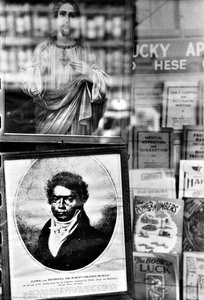
A Moment Frozen in Shadow: Gordon Parks’ “Untitled, Harlem, New York”
Gordon Parks' "Untitled, Harlem, New York," captured in 1948, isn’t merely a photograph; it’s a distilled essence of urban tension and the quiet desperation simmering beneath the surface of mid-20th century America. This gelatin silver print, measuring a modest 11 x 11 cm, punches far beyond its size, delivering a visceral experience that speaks volumes about race, poverty, and the precariousness of daily life in Harlem. The image immediately commands attention with its stark contrasts – an almost brutal interplay of light and shadow that sculpts figures into arresting silhouettes against a crumbling brick wall. It’s a scene ripped from the streets, raw and unvarnished, offering a rare glimpse into a world often obscured by societal narratives.
Composition and Technique: A Masterclass in Documentary Realism
Parks' compositional choices are deliberate and powerfully effective. The photograph is dominated by a man gripping a baseball bat, his arm raised in a gesture that simultaneously suggests threat and vulnerability. This central figure anchors the scene, drawing the viewer’s eye while the surrounding figures – a group of men huddled nearby – contribute to a palpable sense of unease. The diagonal lines created by the bat and the man's posture are expertly utilized to create dynamism and movement within the static frame. The photographer’s slightly angled perspective adds an element of immediacy, as if we’ve stumbled upon this confrontation unexpectedly. Parks masterfully employs the techniques of documentary photography, prioritizing realism over idealized representation. The grainy texture, a hallmark of gelatin silver prints from that era, lends authenticity to the scene, grounding it in the tangible reality of Harlem life.
Historical Context and the Shadow of Segregation
To fully appreciate “Untitled, Harlem, New York,” one must understand its historical context. Captured during a period of intense racial segregation and economic hardship, the photograph reflects the realities faced by African Americans in urban America. Parks’ work was initially commissioned for Life magazine as part of a federal government project documenting poverty and social issues. This assignment thrust him into the heart of Harlem's struggles, forcing him to confront the systemic inequalities that shaped the lives of its residents. The dilapidated building in the background serves as a potent symbol of neglect and decay – a visual representation of the challenges faced by communities marginalized by societal structures. Parks’ ability to capture this atmosphere of hardship speaks volumes about his commitment to portraying the truth, however uncomfortable it may be.
Symbolism and Emotional Resonance
The baseball bat is undoubtedly the photograph's most potent symbol – a loaded weapon representing potential violence and aggression. However, the man holding it isn’t depicted as a menacing villain; rather, his posture suggests a guarded defensiveness, perhaps born of years of facing adversity. The overall mood is one of anxiety and uncertainty, fueled by the dark setting and the tense body language of the figures. Parks doesn't offer easy answers or simplistic judgments; he simply presents a moment frozen in time, inviting viewers to contemplate the complexities of human experience within a context of social injustice. The photograph evokes a deep sense of empathy, prompting reflection on themes of power, vulnerability, and the enduring struggle for dignity.
A Legacy of Powerful Imagery
Gordon Parks’ “Untitled, Harlem, New York” stands as a testament to his extraordinary talent and unwavering commitment to social justice. His work continues to resonate today, reminding us of the importance of confronting uncomfortable truths and amplifying marginalized voices. Reproductions of this iconic image offer a powerful way to engage with history and contemplate the ongoing challenges of inequality. It’s more than just a photograph; it's a window into a specific time and place, a poignant reminder of the human cost of systemic injustice, and a compelling example of documentary photography at its finest.
Veelgestelde vragen
In welke stroming en in welk tijdperk kan "Untitled, Harlem, New York" door Gordon Parks worden geplaatst?
"Untitled, Harlem, New York" door Gordon Parks behoort tot de Documentary Photography-stroming, uit de Moderne tijd-periode van de maker.
Hoe harmonieus is het kleurgebruik in "Untitled, Harlem, New York" door Gordon Parks?
"Untitled, Harlem, New York" door Gordon Parks vertoont een Strong Color Unity kleurharmonie.
Is "Untitled, Harlem, New York" typerend voor het werk van Gordon Parks?
De terugkerende thema's van Gordon Parks omvatten social justice, documentary realism, race relations, urban america, government project; "Untitled, Harlem, New York" richt zich op harlem, conflict, 1948, photography, black and white, tension, urban life.
 Verstuur
 Delen
Delen
 Details bekijken
 Gids
Gids

 Download
 Vergelijkbare items
 Diavoorstelling
 Vraag & antwoord
 Statistieken