Tekstgrootte

() ·

Een schilderij speciaal voor u gemaakt, met de hand

Het Heilige Alegorie

Handgemaakte olieverfreproductie

Met de hand geschilderd in olieverf op canvas in uw gewenste maat en lijst, op bestelling gemaakt door onze kunstenaars. ( Schakel over naar print Schakel over naar digitale afbeeldingen)

Beschrijving verzamelobject

Een prachtige reproductie van Giovanni Bellinis 'Het Heilige Alegorie', een mysterieus kunstwerk uit de Renaissance dat een complexe allegorie weergeeft en een serene omgeving biedt.

Biografie kunstenaar

Giovanni Bellini (1430-1516): De Venetiaanse meester achter serene Madonnen & adembenemende landschappen. Invloedrijk, met invloeden van Giorgione & Titian.

vanaf ·

Hoofdstuk 1

Hoe groot moet het zijn?

Schuif om de afmetingen te wijzigen; de afbeelding aan de linkerzijde toont de lijst in de werkelijke breedte. De oorspronkelijke verhoudingen blijven behouden.

Standaardformaat
op maat gemaakt
CM
INCH

Kies uit onze vooraf ingestelde maten die overeenkomen met de originele verhoudingen van het kunstwerk.

breedte
hoogte

Voer de breedte en hoogte in die u nodig heeft, passend bij uw lijst of uw muur. Omdat dit handgeschilderd is, kan de kunstenaar bij een afmeting met een andere beeldverhouding iets meer rondom het schilderij schilderen of juist iets meer weglaten — u kiest zelf. Wij sturen u een digitaal mockup ter goedkeuring voordat het schilderwerk begint. De afbeelding die op deze pagina wordt getoond, is niet het uiteindelijke resultaat — alleen de mockup geeft dit weer.


Hoofdstuk 2

Hoe moet het worden geleverd?

Kies de randen van het canvas

Kies uw lijst

Corner sample of the WhiteWrap canvas edge finish, stretched on massief hout bars
Wit €1
Corner sample of the BlurSideWrap canvas edge finish, stretched on massief hout bars
Vervagende randen €1
Corner sample of the ExtendedWrap canvas edge finish, stretched on massief hout bars
Doorlopende rand €1
Corner sample of the P118B picture frame: gegoten polystyreen, 5 cm wide and 3 cm thick
P118B €10
Corner sample of the P118H picture frame: gegoten polystyreen, 5 cm wide and 3 cm thick
P118H €10
Corner sample of the P118W picture frame: gegoten polystyreen, 5 cm wide and 3 cm thick
P118W €10
Corner sample of the P438Z picture frame: gegoten polystyreen, 5.5 cm wide and 3.5 cm thick
P438Z €10
Corner sample of the P508JH picture frame: gegoten polystyreen, 7 cm wide and 3.5 cm thick
P508JH €12
Corner sample of the P508YH picture frame: gegoten polystyreen, 7 cm wide and 3.5 cm thick
P508YH €12
Corner sample of the P805H picture frame: gegoten polystyreen, 5 cm wide and 3.5 cm thick
P805H €10
Corner sample of the P805Z picture frame: gegoten polystyreen, 5 cm wide and 3.5 cm thick
P805Z €10
Corner sample of the P919BZ picture frame: gegoten polystyreen, 7 cm wide and 3.5 cm thick
P919BZ €10
Corner sample of the P919G picture frame: gegoten polystyreen, 7 cm wide and 3.5 cm thick
P919G €10
Corner sample of the P919XJ picture frame: gegoten polystyreen, 7 cm wide and 3.5 cm thick
P919XJ €10
Corner sample of the P959ZH picture frame: gegoten polystyreen, 5 cm wide and 3 cm thick
P959ZH €10
Corner sample of the P968JZ picture frame: gegoten polystyreen, 6 cm wide and 4 cm thick
P968JZ €12
Corner sample of the W106C picture frame: massief hout, 5 cm wide and 3 cm thick
W106C €8
Corner sample of the W218G picture frame: massief hout, 5 cm wide and 3 cm thick
W218G €10
Corner sample of the W218JH picture frame: massief hout, 5 cm wide and 3 cm thick
W218JH €8
Corner sample of the W218Y picture frame: massief hout, 5 cm wide and 3 cm thick
W218Y €10
Corner sample of the W307PJ picture frame: massief hout, 6 cm wide and 3 cm thick
W307PJ €10
Corner sample of the W316G picture frame: massief hout, 6 cm wide and 3 cm thick
W316G €10
Corner sample of the W316PJ picture frame: massief hout, 6 cm wide and 3 cm thick
W316PJ €8
Corner sample of the W316Y picture frame: massief hout, 6 cm wide and 3 cm thick
W316Y €10
Corner sample of the W398PJ picture frame: massief hout, 5 cm wide and 3 cm thick
W398PJ €8
Corner sample of the W4111J picture frame: massief hout, 6.5 cm wide and 3.5 cm thick
W4111J €10
Corner sample of the W500HY picture frame: massief hout, 7 cm wide and 5 cm thick
W500HY €15
Corner sample of the W500JH picture frame: massief hout, 7 cm wide and 5 cm thick
W500JH €15
Corner sample of the W692G picture frame: massief hout, 8 cm wide and 4 cm thick
W692G €12
Corner sample of the W849H picture frame: massief hout, 5 cm wide and 3 cm thick
W849H €8
Corner sample of the W940BG picture frame: massief hout, 7.5 cm wide and 4.5 cm thick
W940BG €15
Corner sample of the W953PJ picture frame: massief hout, 6 cm wide and 3.5 cm thick
W953PJ €8
Corner sample of the H24-GOLD picture frame: gesneden hout met gesso, 10 cm wide and 6 cm thick
H24-GOLD €30
Corner sample of the H24-SILVER picture frame: gesneden hout met gesso, 10 cm wide and 6 cm thick
H24-SILVER €30
Corner sample of the H36-GOLD picture frame: gesneden hout met gesso, 15 cm wide and 6.5 cm thick
H36-GOLD €45
Corner sample of the H36-SILVER picture frame: gesneden hout met gesso, 15 cm wide and 6.5 cm thick
H36-SILVER €45
Lijstvoorbeeld
Ingelijst

Lijstrand: . Totale afmetingen inclusief lijst: .

Hoofdstuk 3

Wie schildert het, en moet er iets veranderen?

Voorbeelden van wat aangepast kan worden: Vervang het gezicht door een foto van de klant; Voeg een huisdier toe (bijv. vervang de kat door een hond); Voeg een verborgen boodschap toe aan de achtergrond; Wijzig het landschap of de elementen in de achtergrond.
Na de bestelling zal het team van OriginalUniqueArt.com per e-mail contact opnemen met de klant voor instructies en een mockup-voorbeeld verstrekken

Wereldwijde levering () binnen 3 tot 4 weken in plaats van de standaard 5 weken. (5 november). Zonder concessies aan de kwaliteit.

Hoofdstuk 4

De laatste hand aan

Een naambordje, zoals in een museum?

Details van de gegraveerde bronzen plaat

This elegant plaque features the artist's name and the title of the artwork, finely engraved for a timeless presentation.

It is made from bronze with a refined, elegant finish. The text is precisely laser-engraved for a sharp and permanent result. Measuring 9x2 cm, the plaque is compact yet easy to read. It's built to be durable and scratch-resistant, offering a professional, museum-quality look. Mounting is simple thanks to the included adhesive backing.

Details transparante acrylplaat

The plaque includes essential engraved details such as the artist's name, the title of the artwork, the date it was created, the type of media used-like oil on canvas or watercolor-a brief description of the piece, and a QR code that links to the complete artwork information.

It is crafted from clear acrylic, offering a sleek, modern appearance. The text is UV-engraved in black to ensure strong visual contrast. With a size of 10x15 cm, it ensures optimal readability. It comes equipped with two metal hooks for secure wall mounting. The plaque is designed to be weather-resistant, making it suitable for various environments, and it includes interactive features that work seamlessly with smartphone scanning.

Details zwarte acrylplaat

This elegant plaque includes engraved information such as the artist's name, the title of the artwork, the date it was created, the type of media used (like oil on canvas or watercolor), a short description of the artwork, and a QR code for quick access to more information.

The plaque itself is made from refined black acrylic with a premium finish. The text is laser-engraved in white for high contrast and readability. Its size is 10x15 cm, designed to be easy to read. It comes with two metal hooks for professional mounting. The design is sleek and fits any interior style. It is also weather-resistant and durable, with built-in digital integration for mobile compatibility.

Een beschermende vernis?

Wanneer heeft u het nodig?

Hoofdstuk 5

Uw schilderij, zoals u het heeft besteld

Het Heilige Alegorie

Druktechniek

Afmetingen reproductie

-

Geselecteerde topkunstenaars

Meer detail, verfijning en extra productietijd

-

Lijst voor reproductie

-

-

Voor kunstwerken of reproducties die aan één zijde groter zijn dan 105 cm (ongeveer 41 inch), wordt de lijst als een losse set verzonden. Deze methode garandeert een veilige levering en voorkomt schade tijdens het transport.

Professionele montage vereist - dit is geen doe-het-zelfproduct.
De set moet worden gemonteerd en het canvas moet worden gespannen door een ervaren professionele lijstenmaker, met gebruik van houtlijm (niet inbegrepen), een doekspanter en klemmen om de sponningen recht te houden terwijl de lijm droogt. Onjuiste montage of een ongelijkmatige spanning op het canvas kan het kunstwerk permanent beschadigen en wordt niet gedekt door onze garantie.

  • Alle massief houten onderdelen zijn inbegrepen, nauwkeurig op maat gesneden voor montage.

  • Te monteren met de meegeleverde schroeven, plus houtlijm voor de hoekverbindingen, die niet wordt meegeleverd en door uw lijstenmaker moet worden aangeschaft.

  • Professioneel gereedschap is vereist en niet inbegrepen: een spanner voor canvas en klemmen om de latten recht te houden terwijl de lijm droogt.

Belangrijk:
De hoekverbindingen vereisen houtlijm, de latten moeten met lijmklemmen worden vastgehouden tot de lijm volledig is opgedroogd, en het spannen van het canvas op het samengestelde frame vereist een doekspanter. Geen van deze artikelen is inbegrepen in de set. Wij adviseren u om een ervaren professionele lijstenmaker te raadplegen voordat u deze maat bestelt.

Naamplaatje

-

-

Beschermende vernislaag

Glanzende vernis (versterkt de kleuren en biedt bescherming tegen licht en vocht)

-

Mijn kunstwerk aanpassen

Voorbeelden van aanpassingen: vervang het gezicht door een eigen foto; voeg een huisdier toe (bijv. vervang de kat door een hond); verwerk een verborgen boodschap in de achtergrond; wijzig het landschap of andere elementen op de achtergrond.

-

Spoedlevering

Wereldwijde levering () binnen 3 tot 4 weken in plaats van de standaard 5 weken. (5 november). Geen concessies aan de kwaliteit.

-

Spoedlevering

Wereldwijde levering naar binnen 5 weken. (12 november).

Inbegrepen

Eindtotaal

€ 268

Totaalprijs € 268

De optie voor glas is alleen beschikbaar bij een formaat kleiner dan 110 cm.

Inbegrepen bij elke bestelling

  • Gratis wereldwijde expressverzending
  • Hoogwaardig linnen canvas
  • Volledige verzendverzekering
  • Garantie op terugbetaling van invoerrechten
  • Garantie op exacte kleurweergave
  • Retourbeleid van 100 dagen (alleen bij defecten)
  • 100% Geld-terug-garantie
  • Korting bij meerdere afnames

Giovanni Bellini’s Sacred Allegory: A Window into Venetian Renaissance Spirituality

Giovanni Bellini, een naam synoniem voor de bloeiende Renaissance in Venetië, staat als een belangrijke figuur tussen de tradities van Byzantijnse kunst en de innovatieve geest die de 16e eeuw zou definiëren. Geboren rond 1430 – hoewel sommige bronnen suggereren 1433 – binnen een familie die diep geworteld was in de kunstwereld, was Bellini’s reis één van voortdurende evolutie, gekenmerkt door een diepe gevoeligheid voor kleur, licht en de opkomende humanisme van zijn tijd. De exacte aard van zijn familiale relaties is gedebatteerd; Jacopo Bellini werd lange tijd beschouwd als zijn vader, maar moderne wetenschap wijst steeds meer aan dat Jacopo Bellini Giovanni’s oudere halfbroer was, met Gentile Bellini als zijn neef en niet een broeder. Ondanks deze ingewikkeldheden groeide jong Giovanni op in een atelier vol creativiteit en technische expertise, waar hij de fundamenten van schilderkunst leerde van jonge leeftijd. Zijn initiële opleiding vond plaats onder invloed van zijn vader Jacopo Bellini, die zelf een bekroonde kunstenaar was, waardoor Giovanni vanaf het begin werd blootgesteld aan de hoogste standaard van artistieke praktijk. Deze omgeving voedde zijn talent en leidde tot een stijl die zowel elegant als emotioneel resonerende zou worden.

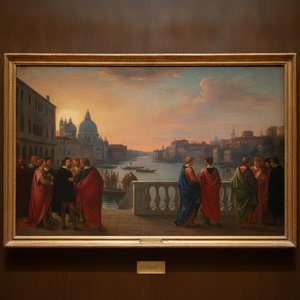
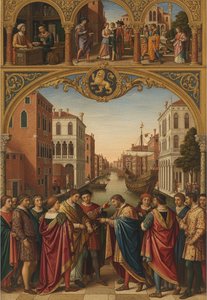
  • Subject Matter: De compositie van *Sacred Allegory* draait om een religieuze scène, waarin verschillende personen staan op een balkon tegenover het water. Een groep mensen wordt afgebeeld terwijl ze een gesprek voeren en mogelijk over religieuze zaken nadenken, wat een prachtige illustratie vormt van de tijdloze thema’s van spiritualiteit en contemplatie.
  • Style: Bellini’s stijl kenmerkt zich door een combinatie van Byzantijnse invloed en Renaissance humanisme. Hij gebruikt een gedetailleerde manier om vormen weer te geven, waarbij hij aandacht schenkt aan licht en schaduw om een gevoel van ruimte en diepte te creëren. Zijn werk wordt gekenmerkt door een prachtige balans tussen harmonie en beweging, wat het een bijzondere schoonheid geeft.

  • Technique: Bellini gebruikte de tempera techniek, waarbij pigmenten worden aangebracht op een ondergrond van lijm en goud. Deze methode gaf hem een uitzonderlijke controle over kleurintensiteit en lichteffecten, waardoor hij prachtige kleuren kon bereiken die nog steeds vandaag de dag verbluffend zijn. Een bijzonder belangrijk element is het gebruik van *sfumato*, een techniek waarbij kleuren worden vervaagd om een subtiele atmosfeer te creëren en vormen te laten overlappen zonder scherp zichtbaar te zijn.

Historical Context: Venice at the Dawn of Humanism

Het werk ontstond tijdens het hoogtepunt van de Venetiaanse Renaissance, een periode gekenmerkt door een nieuwe interesse voor klassieke kunst en filosofie en een groeiende aandacht voor menselijke emoties en ervaringen. De kunstenaars van deze tijd waren geïnspireerd door ideeën over proportioneelheid, harmonie en schoonheid die teruggaan tot Griekenland en Rome, maar ze waren ook actief betrokken bij wetenschappelijke ontdekkingen en filosofische debatten. Bellini’s *Sacred Allegory* is een prachtige weergave van deze tijdlijn en biedt een kijkje achter de schermen van het intellectuele leven in Venetië tijdens zijn tijd. De kunstenaar heeft een gevoel voor historische nauwkeurigheid laten zien, terwijl hij tegelijkertijd een emotionele reactie oproept bij de kijker.

Symbolism: Layers of Meaning

De compositie van *Sacred Allegory* is doordrenkt met symbolische betekenissen die verwijzen naar verschillende religieuze en filosofische ideeën. De aanwezigheid van een aantal personen, elk gekleed in prachtige gewaden, staat voor verschillende aspecten van het menselijk leven, zoals wijsheid, kracht en liefde. De afbeelding van een vogeld is een klassieke symbool van hoop en spirituele groei, terwijl de achtergrond met water een verwijzing is naar zowel fysieke schoonheid als het mysterie van het universum. Een zorgvuldige analyse van deze symbolen onthult een complexe reeks ideeën over het goede leven en het doel van het bestaan.

Emotional Impact: A Moment of Reflection

Het kunstwerk roept een gevoel van sereniteit en contemplatie op bij de kijker, waardoor hij wordt uitgenodigd om na te denken over belangrijke vragen over het leven en het universum. De prachtige kleuren en lichteffecten creëren een warme en uitnodigende atmosfeer die een gevoel van rust en harmonie bevordert. Bovendien spreekt Bellini’s stijl rechtstreeks tot het hart, waardoor hij een emotionele reactie oproept bij iedereen die zijn werk aanschouwt. Een kunstwerk als *Sacred Allegory* blijft een bron van inspiratie voor kunstenaars en kunstliefhebbers over de hele wereld.

Veelgestelde vragen

Waar is "Het Heilige Alegorie" door Giovanni Bellini tegenwoordig te zien?

Het originele werk "Het Heilige Alegorie" is te bewonderen in Galleria degli Uffizi, Florence, Italy.

Is "Het Heilige Alegorie" een van de meest populaire werken van Giovanni Bellini?

"Het Heilige Alegorie" door Giovanni Bellini heeft een populariteitsniveau van Gerenommeerd. Deze classificatie weerspiegelt hoe breed het werk wordt erkend.

In welk jaar werd "Het Heilige Alegorie" door Giovanni Bellini gemaakt?

"Het Heilige Alegorie" door Giovanni Bellini werd gecreëerd in 1490.

Meer over dit schilderij

Voorvertoning Bekijk in AR Schakel over naar print Schakel over naar digitale afbeeldingen Verstuur
Details bekijken Gids Toevoegen aan favorieten Download Vergelijkbare items Röntgenonderzoek Diavoorstelling Vraag & antwoord Statistieken

In cijfers

  • 1490het jaar waarin het werd geschilderd
  • 29lijsten om uit te kiezen
  • standaardmaten, in hun eigen verhoudingen
  • 5weken om te schilderen en te leveren
Giovanni Bellini

Giovanni Bellini

1433 - 1516, Italië

Snelle feiten over Giovanni Bellini

  • Artistic Movement Or Style: Venetiaanse School
  • Artists Or Movements Influenced By This Artist:
    • Giorgione
    • Titian
  • Artists Who Influenced This Artist:
    • Jacopo Bellini
    • Gentile Bellini
    • Mantegna
  • Date Of Birth: c. 1430
  • Date Of Death: 1516
  • Full Name: Giovanni Bellini
  • Nationality: Italiaans
  • Notable Artworks:
    • St. Jerome
    • Transfiguratie
  • Place Of Birth: Venetië, Italië

Biografie kunstenaar

A Venetian Master: The Life and Legacy of Giovanni Bellini

Giovanni Bellini, a name inextricably linked to the heart of Venice, stands as a pivotal figure bridging the twilight of the Byzantine era and the dawn of the High Renaissance. Born around 1430 – though some sources suggest 1433 – into a family deeply rooted in the artistic traditions of the city, his life was a continuous evolution, marked by an unparalleled sensitivity to color, light, and the burgeoning humanism that would define the 16th century. The precise details of his familial relationships have long been debated; for years, Jacopo Bellini was considered his father, but modern scholarship increasingly points towards Jacopo being Giovanni’s elder half-brother, with Gentile Bellini as his nephew rather than sibling. Regardless of these intricate family dynamics, young Giovanni grew up immersed in a vibrant workshop, absorbing the foundational techniques and artistic principles from an early age. His initial training likely involved mastering the traditional tempera methods prevalent at the time, but it was his innate talent for observation, coupled with a profound emotional intelligence, that would ultimately distinguish him as a truly exceptional artist.

Early Influences and Artistic Foundations

The artistic landscape of 15th-century Venice presented a fascinating confluence of influences – a unique blend of Byzantine grandeur, the emerging styles of Florence, and the distinctive Venetian tradition. The city’s position as a major trading hub exposed its artists to diverse cultural currents and ideas from across Europe and beyond. Simultaneously, the enduring legacy of Byzantium continued to exert a powerful pull on Venetian art, particularly in its use of rich colors, elaborate ornamentation, and spiritual themes. Bellini's early works reflect this complex interplay of influences. Initially, his style bore the unmistakable mark of his father, Jacopo, and his brother, Gentile, characterized by meticulous detail, a restrained emotional palette, and a focus on formal precision. However, even within these early pieces, subtle hints of his future brilliance began to emerge – a delicate handling of light, an increasing interest in naturalistic settings, and a remarkable ability to imbue religious figures with a palpable sense of human pathos and vulnerability. The influence of Andrea Mantegna, his brother-in-law, is also readily apparent during this period, particularly in the clarity of line, the monumental scale of figures, and the use of perspective – elements that would profoundly shape Bellini’s own artistic development. Bellini's early commissions often involved collaborative projects, allowing him to hone his skills alongside some of Venice’s most accomplished painters.

The Revolution of Oil Paint: A New Language for Color

Giovanni Bellini’s true breakthrough came with the adoption and masterful exploitation of oil paint. While not the inventor of this technique – it had been introduced to Italy from the East earlier in the century – Bellini was among the first Venetian artists to fully embrace its potential, transforming the very language of painting. Unlike tempera, which demanded a swift, linear approach and often resulted in brittle colors, oil paint allowed for unprecedented blending, richer hues, subtle gradations of tone, and a remarkable degree of luminosity. This newfound freedom fundamentally altered Bellini’s artistic process, enabling him to create paintings that possessed an astonishing depth and vibrancy. His use of color became increasingly sophisticated, moving away from the often-harsh, overly bright palette favored by earlier Venetian painters towards a more nuanced, harmonious, and emotionally resonant range of tones. He masterfully captured the effects of light and atmosphere, imbuing his landscapes with a sense of serenity, mystery, and profound realism – a departure from the stylized representations common in previous generations. This revolutionary approach to oil paint not only transformed Bellini’s own work but also laid the foundation for the distinctive style that would come to define the Venetian school—a style celebrated throughout Europe for its sensuousness, coloristic richness, and atmospheric perspective.

Major Works and Artistic Evolution

As Giovanni Bellini matured, his artistic vision continued to evolve with remarkable sophistication. His altarpieces, such as those created for the churches of San Zaccaria and Santa Corona, demonstrate his ability to construct complex compositions filled with symbolic meaning, intricate detail, and profound emotional resonance. The *Transfiguration*, now housed in the Capodimonte Museum in Naples, stands as a prime example of this artistic evolution – a serene depiction of Christ’s transformation combined with a masterful use of light, color, and perspective. He also served as conservator of the paintings within Doge's Palace, further solidifying his position as Venice’s leading artist and cultural figure. Throughout his career, Bellini explored a wide range of subjects – from religious scenes to portraits, landscapes, and mythological narratives—each imbued with his unique artistic sensibility. His later works are characterized by a heightened sense of spirituality, a greater emphasis on the emotional expression of figures, and an increasingly lyrical use of color.

A Lasting Legacy: Influence and Remembrance

Giovanni Bellini’s impact extended far beyond his own lifetime. He became a mentor to a generation of younger painters, including Giorgione and Titian, who would inherit his techniques, aesthetic principles, and artistic vision—adapting them to their own individual styles and contributing to the golden age of Venetian painting. His influence can be seen in countless works created by artists throughout Europe, solidifying his place as one of the most important figures in Western art history. Bellini’s legacy is not simply one of technical brilliance; it is a testament to the power of art to transcend time and connect us to the enduring values of human experience. From the serene beauty of his Madonnas to the dramatic intensity of his religious scenes, Bellini's work continues to inspire awe and admiration centuries after its creation—a vibrant reminder of Venice’s artistic heritage and a profound exploration of the mysteries of faith, beauty, and the human spirit.

Snelle feiten

  • Title: Sacred Allegory
  • Movement: Venetian Renaissance
  • Year: 1490
  • Influences: Byzantine art
  • Artistic style: Realistic

Kunstquiz

Er is slechts één goed antwoord op elke vraag.

Vraag 1:
¿Quién pintó esta obra maestra?
Vraag 2:
¿En qué museo se encuentra actualmente esta pintura?
Vraag 3:
¿Cuándo aproximadamente fue creada esta obra?
Vraag 4:
¿Cuál es el tema principal de esta pintura?
Vraag 5:
¿Qué técnica pictórica predominante utilizó Bellini en esta obra?