Schakel over naar print
 Lees meer







































 Voor kunstwerken of reproducties die aan één zijde groter zijn dan 105 cm (ongeveer 41 inch), wordt de lijst als een losse set verzonden. Deze methode garandeert een veilige levering en voorkomt schade tijdens het transport.


A Symphony of Virtue: The Eternal Resonance of Vasari’s Justice
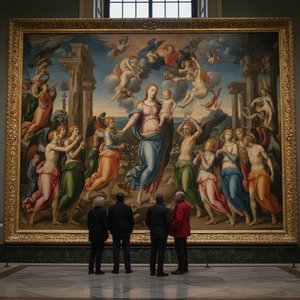
In the grand tapestry of the Italian Renaissance, few works capture the profound intersection of moral philosophy and visual splendor as exquisitely as Giorgio Vasari’s “Justice.” Completed in 1542, this monumental oil on panel is far more than a mere depiction of a virtue; it is a carefully orchestrated visual sermon. As one gazes upon the central figure, a woman draped in flowing, luminous robes, there is an immediate sense of the profound stability she represents. Her face, serene yet resolute, serves as the emotional anchor for the entire composition. Through Vasari’s masterful hand, the painting transcends its historical moment to become a timeless emblem of human dignity and the pursuit of truth, making it a captivating centerpiece for any collection dedicated to the intellectual depth of the sixteenth century.
The brilliance of this masterpiece lies in its intricate layer of symbolism, where every element serves a higher allegorical purpose. The figure of Justice is famously blindfolded, a poignant reminder of her impartiality and the refusal to be swayed by personal bias. In her left hand, she holds the scales, balanced with delicate precision, while her right hand rests upon a sword—a symbol of the necessary power required to enforce law and maintain order. Beneath her throne, a globe signifies her universal jurisdiction, suggesting that justice is not merely a local concern but a cosmic principle. This symbolic language is further enriched by the presence of three men engaged in earnest conversation; they represent the voices of reason and deliberation, embodying the Renaissance ideal that true justice arises from thoughtful discourse and the weighing of evidence.
The Elegance of Mannerism and Artistic Mastery
To appreciate “Justice” is to witness the height of the Mannerist style. Moving away from the balanced naturalism of the High Renaissance, Vasari embraces a more sophisticated and tension-filled aesthetic. The figures possess an elegant elongation, and their poses are characterized by a dramatic, almost theatrical grace that directs the viewer's eye through the composition in a rhythmic dance. This stylistic choice creates a sense of movement and intellectual energy, preventing the allegorical subject from feeling static or purely instructional. Vasari’s technique is nothing short of virtuosic; his ability to manipulate light and shadow—the chiaroscuro—bestows a remarkable three-dimensionality upon the drapery and the flesh, lending a palpable realism to the otherwise stylized forms.
For the discerning collector or interior designer, a high-quality reproduction of this work offers more than just aesthetic beauty; it brings a sense of historical gravity and intellectual prestige to a space. The painting’s rich textures and complex narrative invite prolonged contemplation, making it an ideal focal point for a library, a formal study, or a sophisticated gallery wall. It serves as a conversation piece that bridges the gap between the classical past and the modern interior, embodying a legacy of wisdom and strength. Owning a tribute to Vasari’s “Justice” is an invitation to surround oneself with the enduring ideals of balance, truth, and the magnificent artistry of the Italian Renaissance.
Veelgestelde vragen
Wat zijn de reproductierechten van "Justice" in Gallerie dell’Accademia?
Het originele "Justice" bevindt zich in Gallerie dell’Accademia en het werk is bevindt zich in het publiek domein - de auteursrechten zijn verlopen.
Wordt "Justice" door Giorgio Vasari bewaard in het land van herkomst van de kunstenaar?
Ja - het kunstwerk wordt bewaard in het land van herkomst van de kunstenaar. Giorgio Vasari werd geboren in Italië, en het originele werk "Justice" wordt bewaard in een museum in Italië.
Welke kunstenaar en welke stijl staan achter "Justice"?
"Justice" werd gecreëerd door Giorgio Vasari in de Baroque-stijl. De kunstenaar en de stroming bepalen de traditie van het werk.
 Voorvertoning
 Verstuur
 Delen
Delen
 Details bekijken
 Gids
Gids

 Download
 Vergelijkbare items
 Röntgenonderzoek
 Diavoorstelling
 Vraag & antwoord
 Statistieken