Schakel over naar print
 Lees meer







































 Voor kunstwerken of reproducties die aan één zijde groter zijn dan 105 cm (ongeveer 41 inch), wordt de lijst als een losse set verzonden. Deze methode garandeert een veilige levering en voorkomt schade tijdens het transport.


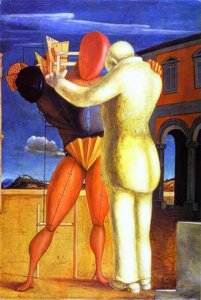
A Dreamscape of Surrealism: Exploring Giorgio de Chirico’s “Ariadne”
Giorgio de Chirico's "Ariadne," completed in 1913, stands as a cornerstone of Surrealist art and a testament to the artist’s profound engagement with philosophical ideas. More than just a depiction of myth—the tale of Ariadne abandoning Theseus on Naxos—it embodies a deeper exploration into the human psyche, mirroring de Chirico's own anxieties about isolation and displacement during his relocation to Paris following World War I. The painting resides within the Metropolitan Museum of Art’s collection, where its haunting beauty continues to captivate audiences worldwide.- Subject Matter & Narrative Context: De Chirico draws inspiration from Greek mythology, specifically the story of Ariadne—a princess abandoned by her lover Theseus—to convey a narrative of abandonment and vulnerability. However, unlike traditional depictions emphasizing heroic action, “Ariadne” presents a serene, almost melancholic scene of slumbering beauty within an unsettling urban space.
- Style & Technique: The artwork exemplifies Surrealist style, characterized by illogical perspective, dreamlike atmosphere, and juxtaposition of incongruous elements. De Chirico meticulously employs graphite alongside oil paint on canvas, layering textures to create a palpable sense of stillness punctuated by subtle distortions—a technique that deliberately disrupts conventional realism.
Symbolism: Echoes of Schopenhauer & Nietzsche’s Philosophy
De Chirico's artistic vision was heavily influenced by the existential philosophies of Arthur Schopenhauer and Friedrich Nietzsche. The desolate square—a recurring motif in his oeuvre—represents a void, mirroring Schopenhauer’s concept of “Will”—the relentless striving that underlies all existence—and highlighting the inherent loneliness of human consciousness. Similarly, Nietzsche's ideas about overcoming nihilism resonate within the painting’s stillness; Ariadne’s repose suggests an acceptance of fate and a confrontation with the abyss.- Spatial Illusion & Perspective: De Chirico masterfully manipulates spatial illusion, employing distorted perspective to heighten the unsettling atmosphere. The elongated shadows cast by unseen buildings contribute to this sense of disorientation, mirroring Nietzsche’s critique of Western metaphysics and its inability to grasp fundamental truths.
Emotional Impact & Artistic Legacy
“Ariadne” transcends mere visual representation; it evokes a profound emotional response—a palpable feeling of melancholy and contemplation. The painting's muted palette—dominated by earthy tones—underscores its contemplative mood, inviting viewers to confront existential questions about life, death, and the human condition. De Chirico’s influence extends far beyond Surrealism, shaping subsequent generations of artists who sought to explore the subconscious mind and challenge conventional artistic conventions. It remains a powerful emblem of the Surrealist movement's ambition to liberate art from rational constraints and unlock the mysteries of inner experience.- Concluding Remarks: Ultimately, “Ariadne” serves as an enduring reminder that art possesses the capacity to illuminate not only visual beauty but also the complexities of human thought and emotion—a legacy that continues to inspire artists and collectors alike.
Veelgestelde vragen
Welke kleur domineert de compositie van "untitled (8848)" door Giorgio de Chirico?
Espresso (#3c2825) is de dominante kleur van "untitled (8848)" door Giorgio de Chirico.
Is "untitled (8848)" typerend voor het werk van Giorgio de Chirico?
"untitled (8848)" verbeeldt roman arcades, shadows, masks, surrealism, mythology, isolation, perspective, terwijl de bekende thema's van Giorgio de Chirico schopenhauer philosophy, surrealist style, mythological symbolism, artistic alienation, legacy exploration zijn. Een vergelijking tussen beide laat zien hoe het werk zich verhoudt tot de gebruikelijke onderwerpen van de kunstenaar.
Welke ruimte past bij de kleuren van "untitled (8848)" door Giorgio de Chirico?
Met zijn Earthy palet wordt "untitled (8848)" door Giorgio de Chirico aanbevolen voor een Living Room. De kleuren zijn een van de redenen voor dit advies.
 Voorvertoning
 Verstuur
 Delen
Delen
 Details bekijken
 Gids
Gids

 Download
 Vergelijkbare items
 Röntgenonderzoek
 Diavoorstelling
 Q&A
Q&A Statistieken