Text size

() ·

A painting made for you, by hand

The Troubadour

Handgemaakte olieverfreproductie

Met de hand geschilderd in olieverf op canvas in uw gewenste maat en lijst, op bestelling gemaakt door onze kunstenaars. ( Schakel over naar print Schakel over naar digitale afbeeldingen)

Beschrijving verzamelobject

Explore the captivating world of Giorgio de Chirico and his groundbreaking Metaphysical painting movement. Discover the philosophical depths & surreal imagery that influenced generations of artists.

Biografie kunstenaar

Ontdek de dromerige wereld van Giorgio de Chirico (1888-1978), de stichter van de metafysische kunst. Verken surrealistische stadsscènes, filosofische thema's & iconische mannequins. Beïnvloedde het surrealisme.

from ·

Chapter 1

How large should it be?

Slide to change the size; the picture on the left shows the frame at its real width. The proportions of the original are kept.

Standaardformaat
op maat gemaakt
CM
INCH

Kies uit onze vooraf ingestelde maten die overeenkomen met de originele verhoudingen van het kunstwerk.

breedte
hoogte

Voer de breedte en hoogte in die u nodig heeft, passend bij uw lijst of uw muur. Omdat dit handgeschilderd is, kan de kunstenaar bij een afmeting met een andere beeldverhouding iets meer rondom het schilderij schilderen of juist iets meer weglaten — u kiest zelf. Wij sturen u een digitaal mockup ter goedkeuring voordat het schilderwerk begint. De afbeelding die op deze pagina wordt getoond, is niet het uiteindelijke resultaat — alleen de mockup geeft dit weer.


Chapter 2

How should it arrive?

Choose the edges of the stretched canvas

Choose your frame

Corner sample of the WhiteWrap canvas edge finish, stretched on massief hout bars
White €1
Corner sample of the BlurSideWrap canvas edge finish, stretched on massief hout bars
Blurside €1
Corner sample of the ExtendedWrap canvas edge finish, stretched on massief hout bars
Extended €1
Corner sample of the P118B picture frame: gegoten polystyreen, 5 cm wide and 3 cm thick
P118B €10
Corner sample of the P118H picture frame: gegoten polystyreen, 5 cm wide and 3 cm thick
P118H €10
Corner sample of the P118W picture frame: gegoten polystyreen, 5 cm wide and 3 cm thick
P118W €10
Corner sample of the P438Z picture frame: gegoten polystyreen, 5.5 cm wide and 3.5 cm thick
P438Z €10
Corner sample of the P508JH picture frame: gegoten polystyreen, 7 cm wide and 3.5 cm thick
P508JH €12
Corner sample of the P508YH picture frame: gegoten polystyreen, 7 cm wide and 3.5 cm thick
P508YH €12
Corner sample of the P805H picture frame: gegoten polystyreen, 5 cm wide and 3.5 cm thick
P805H €10
Corner sample of the P805Z picture frame: gegoten polystyreen, 5 cm wide and 3.5 cm thick
P805Z €10
Corner sample of the P919BZ picture frame: gegoten polystyreen, 7 cm wide and 3.5 cm thick
P919BZ €10
Corner sample of the P919G picture frame: gegoten polystyreen, 7 cm wide and 3.5 cm thick
P919G €10
Corner sample of the P919XJ picture frame: gegoten polystyreen, 7 cm wide and 3.5 cm thick
P919XJ €10
Corner sample of the P959ZH picture frame: gegoten polystyreen, 5 cm wide and 3 cm thick
P959ZH €10
Corner sample of the P968JZ picture frame: gegoten polystyreen, 6 cm wide and 4 cm thick
P968JZ €12
Corner sample of the W106C picture frame: massief hout, 5 cm wide and 3 cm thick
W106C €8
Corner sample of the W218G picture frame: massief hout, 5 cm wide and 3 cm thick
W218G €10
Corner sample of the W218JH picture frame: massief hout, 5 cm wide and 3 cm thick
W218JH €8
Corner sample of the W218Y picture frame: massief hout, 5 cm wide and 3 cm thick
W218Y €10
Corner sample of the W307PJ picture frame: massief hout, 6 cm wide and 3 cm thick
W307PJ €10
Corner sample of the W316G picture frame: massief hout, 6 cm wide and 3 cm thick
W316G €10
Corner sample of the W316PJ picture frame: massief hout, 6 cm wide and 3 cm thick
W316PJ €8
Corner sample of the W316Y picture frame: massief hout, 6 cm wide and 3 cm thick
W316Y €10
Corner sample of the W398PJ picture frame: massief hout, 5 cm wide and 3 cm thick
W398PJ €8
Corner sample of the W4111J picture frame: massief hout, 6.5 cm wide and 3.5 cm thick
W4111J €10
Corner sample of the W500HY picture frame: massief hout, 7 cm wide and 5 cm thick
W500HY €15
Corner sample of the W500JH picture frame: massief hout, 7 cm wide and 5 cm thick
W500JH €15
Corner sample of the W692G picture frame: massief hout, 8 cm wide and 4 cm thick
W692G €12
Corner sample of the W849H picture frame: massief hout, 5 cm wide and 3 cm thick
W849H €8
Corner sample of the W940BG picture frame: massief hout, 7.5 cm wide and 4.5 cm thick
W940BG €15
Corner sample of the W953PJ picture frame: massief hout, 6 cm wide and 3.5 cm thick
W953PJ €8
Corner sample of the H24-GOLD picture frame: gesneden hout met gesso, 10 cm wide and 6 cm thick
H24-GOLD €30
Corner sample of the H24-SILVER picture frame: gesneden hout met gesso, 10 cm wide and 6 cm thick
H24-SILVER €30
Corner sample of the H36-GOLD picture frame: gesneden hout met gesso, 15 cm wide and 6.5 cm thick
H36-GOLD €45
Corner sample of the H36-SILVER picture frame: gesneden hout met gesso, 15 cm wide and 6.5 cm thick
H36-SILVER €45
Lijstvoorbeeld
Ingelijst

Moulding: . Overall size with the frame: .

Chapter 3

Who paints it, and should anything change?

Examples of what can be changed: Replace face with customer photo; Add pet (e.g., replace cat with dog); Include hidden message in background; Change background landscape or elements.
After order, OriginalUniqueArt.com team will email client for instructions and provide a mockup preview

Wereldwijde levering () binnen 3 tot 4 weken in plaats van de standaard 5 weken. (2 november). Zonder concessies aan de kwaliteit.

Chapter 4

The finishing touches

A nameplate, as in a museum?

Details van de gegraveerde bronzen plaat

This elegant plaque features the artist's name and the title of the artwork, finely engraved for a timeless presentation.

It is made from bronze with a refined, elegant finish. The text is precisely laser-engraved for a sharp and permanent result. Measuring 9x2 cm, the plaque is compact yet easy to read. It's built to be durable and scratch-resistant, offering a professional, museum-quality look. Mounting is simple thanks to the included adhesive backing.

Details transparante acrylplaat

The plaque includes essential engraved details such as the artist's name, the title of the artwork, the date it was created, the type of media used-like oil on canvas or watercolor-a brief description of the piece, and a QR code that links to the complete artwork information.

It is crafted from clear acrylic, offering a sleek, modern appearance. The text is UV-engraved in black to ensure strong visual contrast. With a size of 10x15 cm, it ensures optimal readability. It comes equipped with two metal hooks for secure wall mounting. The plaque is designed to be weather-resistant, making it suitable for various environments, and it includes interactive features that work seamlessly with smartphone scanning.

Details zwarte acrylplaat

This elegant plaque includes engraved information such as the artist's name, the title of the artwork, the date it was created, the type of media used (like oil on canvas or watercolor), a short description of the artwork, and a QR code for quick access to more information.

The plaque itself is made from refined black acrylic with a premium finish. The text is laser-engraved in white for high contrast and readability. Its size is 10x15 cm, designed to be easy to read. It comes with two metal hooks for professional mounting. The design is sleek and fits any interior style. It is also weather-resistant and durable, with built-in digital integration for mobile compatibility.

A protective varnish?

When do you need it?

Chapter 5

Your painting, as you ordered it

The Troubadour

Druktechniek

Afmetingen reproductie

-

Geselecteerde topkunstenaars

Meer detail, verfijning en extra productietijd

-

Lijst voor reproductie

-

-

Voor kunstwerken of reproducties die aan één zijde groter zijn dan 105 cm (ongeveer 41 inch), wordt de lijst als een losse set verzonden. Deze methode garandeert een veilige levering en voorkomt schade tijdens het transport.

Professionele montage vereist - dit is geen doe-het-zelfproduct.
De set moet worden gemonteerd en het canvas moet worden gespannen door een ervaren professionele lijstenmaker, met gebruik van houtlijm (niet inbegrepen), een doekspanter en klemmen om de sponningen recht te houden terwijl de lijm droogt. Onjuiste montage of een ongelijkmatige spanning op het canvas kan het kunstwerk permanent beschadigen en wordt niet gedekt door onze garantie.

  • Alle massief houten onderdelen zijn inbegrepen, nauwkeurig op maat gesneden voor montage.

  • Te monteren met de meegeleverde schroeven, plus houtlijm voor de hoekverbindingen, die niet wordt meegeleverd en door uw lijstenmaker moet worden aangeschaft.

  • Professioneel gereedschap is vereist en niet inbegrepen: een spanner voor canvas en klemmen om de latten recht te houden terwijl de lijm droogt.

Belangrijk:
De hoekverbindingen vereisen houtlijm, de latten moeten met lijmklemmen worden vastgehouden tot de lijm volledig is opgedroogd, en het spannen van het canvas op het samengestelde frame vereist een doekspanter. Geen van deze artikelen is inbegrepen in de set. Wij adviseren u om een ervaren professionele lijstenmaker te raadplegen voordat u deze maat bestelt.

Naamplaatje

-

-

Beschermende vernislaag

Glanzende vernis (versterkt de kleuren en biedt bescherming tegen licht en vocht)

-

Mijn kunstwerk aanpassen

Voorbeelden van aanpassingen: vervang het gezicht door een eigen foto; voeg een huisdier toe (bijv. vervang de kat door een hond); verwerk een verborgen boodschap in de achtergrond; wijzig het landschap of andere elementen op de achtergrond.

-

Spoedlevering

Wereldwijde levering () binnen 3 tot 4 weken in plaats van de standaard 5 weken. (2 november). Geen concessies aan de kwaliteit.

-

Spoedlevering

Wereldwijde levering naar binnen 5 weken. (9 november).

Inbegrepen

Eindtotaal

€ 267

Totaalprijs € 267

De optie voor glas is alleen beschikbaar bij een formaat kleiner dan 110 cm.

Included with every order

  • Gratis wereldwijde expressverzending
  • Hoogwaardig linnen canvas
  • Volledige verzendverzekering
  • Garantie op terugbetaling van invoerrechten
  • Garantie op exacte kleurweergave
  • Retourbeleid van 100 dagen (alleen bij defecten)
  • 100% Geld-terug-garantie
  • Korting bij meerdere afnames

Giorgio De Chirico’s “Il Trovatore”: A Dreamscape of Medieval Echoes

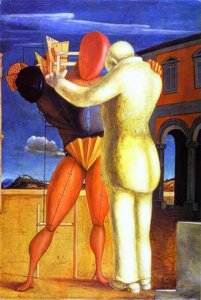
The painting "Il Trovatore," created circa 1950-1955 by Giorgio de Chirico, stands as a cornerstone of Metaphysical Art—a movement that profoundly challenged the conventions of Surrealism and cemented De Chirico’s place among the most influential artists of the 20th century. More than just an image, it's a meticulously crafted illusion designed to unsettle the viewer and invite contemplation on themes of memory, alienation, and the elusive nature of reality. This essay delves into the intricacies of this iconic artwork, exploring its visual language, historical significance, and enduring emotional resonance.
  • Subject Matter: At first glance, “Il Trovatore” presents a stark juxtaposition between medieval armor and modern architectural elements—a statue or sculpture dominates the composition, embodying an archaic figure amidst a desolate Roman piazza bathed in the fading light of sunset. This deliberate pairing underscores De Chirico’s fascination with reconciling disparate temporal realms, mirroring Nietzsche's exploration of eternal recurrence.
  • Style & Technique: De Chirico’s signature style—characterized by flattened perspectives, geometric abstraction, and unsettling stillness—is powerfully evident in “Il Trovatore.” The artist employs a muted palette dominated by ochre hues and deep shadows, creating an atmosphere of profound melancholy and mystery. Precise brushstrokes contribute to the painting's textural richness, emphasizing the sculptural quality of both the statue and the surrounding environment.
  • Historical Context: Painted during De Chirico’s “New” Metaphysical period—following a hiatus from Surrealism—the artwork reflects a renewed engagement with his earlier stylistic explorations. Influenced by thinkers like Nietzsche and Schopenhauer, De Chirico sought to capture the psychological landscape of the subconscious mind, mirroring the anxieties of postwar Europe. The painting's formal vocabulary anticipates developments in Pop Art, signaling a rejection of artistic dogma and embracing repetition as a means of conveying profound ideas.
  • Symbolism: The statue itself—a nameless figure clad in medieval armor—represents an idealized past confronting the bleak realities of the present. Its facelessness symbolizes the loss of identity and reinforces De Chirico’s preoccupation with existential questions. Furthermore, the geometric forms—triangular supports and measuring instruments—echo classical architectural principles, hinting at a yearning for order amidst chaos. The statue's stance subtly resembles that of the Italian contrapposto as he rests most of his weight on his left foot, suggesting that he is both brave and strong and instilling him with a superhero-like quality.
  • Emotional Impact: “Il Trovatore” succeeds in eliciting a visceral response from the viewer—a feeling of disorientation, unease, and profound contemplation. The painting’s luminous sky contrasts sharply with the shadowed piazza, amplifying the sense of solitude and highlighting the statue's enigmatic gaze. Like Picasso’s Guernica, De Chirico’s masterpiece confronts viewers with uncomfortable truths about human existence, prompting reflection on themes of memory, loss, and the elusive nature of time.

Exploring De Chirico’s Metaphysical Vision

Giorgio de Chirico's Metaphysical Art sought to transcend representational illusionism, delving into the realm of psychological experience—a radical departure from prevailing artistic trends. Inspired by Nietzsche’s concept of eternal recurrence and Schopenhauer’s pessimism, De Chirico aimed to depict not what *is*, but what *might be,* capturing fleeting glimpses of subconscious thought and emotion. This approach is powerfully realized in “Il Trovatore,” where the artist abandons conventional perspective and employs geometric abstraction to convey a sense of timelessness and unease—a hallmark of his distinctive artistic vision.

The Influence of Nietzsche & Schopenhauer

De Chirico’s intellectual engagement with philosophers like Friedrich Nietzsche and Arthur Schopenhauer profoundly shaped his artistic sensibilities. Nietzsche's assertion that life is an endless repetition of finite moments fueled De Chirico’s fascination with cyclical patterns and the exploration of psychological states—themes central to “Il Trovatore.” Similarly, Schopenhauer’s pessimistic worldview—characterized by a belief in the inherent suffering of existence—influenced De Chirico’s use of muted colors and unsettling imagery. These philosophical currents served as guiding forces for De Chirico's artistic endeavors, informing his stylistic choices and enriching the symbolic depth of his paintings.

A Precursor to Pop Art: Embracing Repetition & Challenging Artistic Conventions

“Il Trovatore” represents a pivotal moment in De Chirico’s artistic trajectory—a return to his earlier style after a period of experimentation with Surrealism. Recognizing the limitations of representational illusionism, De Chirico championed repetition as a means of conveying profound ideas—a strategy that foreshadowed developments in Pop Art and signaled a rejection of artistic dogma. Like Andy Warhol's silkscreen canvases, “Il Trovatore” deliberately confronts viewers with familiar images rendered in strikingly simple forms—a deliberate provocation against the prevailing aesthetic sensibilities of the time.

Veelgestelde vragen

Hoe kan ik de afbeelding van "The Troubadour" door Giorgio de Chirico downloaden?

De afbeelding van "The Troubadour" door Giorgio de Chirico is te downloaden op de Downloaden-pagina van het kunstwerk: een digitale afbeelding in hoge resolutie om te downloaden.

Welke afmeting van "The Troubadour" door Giorgio de Chirico past in de aanbevolen kamer?

Voor een Living Room wordt voor "The Troubadour" een afdruk van Large aanbevolen.

Welke afmeting voor de reproductie wordt aanbevolen voor "The Troubadour" door Giorgio de Chirico?

Voor "The Troubadour" wordt een afdrukformaat van Large aanbevolen. Andere formaten zijn beschikbaar met dezelfde verhoudingen.

More about this painting

Voorvertoning Bekijk in AR Schakel over naar print Schakel over naar digitale afbeeldingen Verstuur
Details bekijken Gids Toevoegen aan favorieten Download Vergelijkbare items Röntgenonderzoek Diavoorstelling Q&A Statistieken

In numbers

  • 29frames to choose from
  • standard sizes, in its own proportions
  • 5weeks to paint and deliver it

About the original

Giorgio de Chirico

Giorgio de Chirico

1888 - 1978, Griekenland

Quick facts about Giorgio de Chirico

  • Artistic Movement Or Style: Metafysische kunst
  • Artists Or Movements Influenced By This Artist:
    • Surrealisme
    • René Magritte
  • Artists Who Influenced This Artist:
    • Arnold Böcklin
    • Max Klinger
  • Date Of Birth: 10 juli 1888
  • Date Of Death: 20 november 1978
  • Full Name: Giorgio de Chirico
  • Nationality: Italiaans
  • Notable Artworks:
    • Het Vrezen van de Denkende
    • De Enigma van een Herfst Middag
    • Het Lied van de Liefde
  • Place Of Birth: Volos, Griekenland

Biografie kunstenaar

Giorgio de Chirico: Een Droomlandschap van de Geest

Giorgio de Chirico, geboren in 1888 in Volos, Griekenland, als zoon van Italiaanse ouders – een Genoese moeder en een Siciliaanse vader – begon zijn artistieke reis met een unieke combinatie van klassieke erfenis en een groeiend gevoel van moderne vervreemding. Zijn vroege opleiding aan de Athenische Polytechnische Academie legde een basis in traditionele technieken, maar het was zijn latere studie in München die zijn creatieve geest werkelijk ontvloog. Daar, midden in de intellectuele fermentatie van Europa vóór de oorlog, ontmoette hij de werken van Arnold Böcklin en Max Klinger, kunstenaars wiens symbolische landschappen en spookachtige beelden een diepe indruk op hem achterlieten. Even invloedrijk waren de filosofische stromingen van die tijd – de schrijfsels van Friedrich Nietzsche, Arthur Schopenhauer en Otto Weininger – die thema’s van existentialisme, de irrationele aard van menselijk verlangen en de subjectieve aard van realiteit onderzochten. Deze ideeën zouden centraal staan in de baanbrekende artistieke visie van de Chirico.

De Geboorte van Metafysische Kunst

Omstreeks 1909 begon er een unieke stijl te ontstaan uit de verkenningen van de Chirico – een stijl die hij zelf “Metafysieke” kunst noemde. Dit was niet slechts een stijlinnovatie; het was een diepe poging om de verborgen realiteiten onder de oppervlakte van alledaagse ontmoetingen vast te leggen, om de onheilspellende poëzie te onthullen die in vertrouwdere ruimtes schommelde. Een cruciale gebeurtenis vond plaats tijdens een bezoek aan Florence en een ervaring in Piazza Santa Croce, wat leidde tot zijn iconische ‘Metafysische Plaatsverkeer’ serie. Deze schilderijen kenmerken zich door hun spookachtige stilte, lange dramatische schaduwen, logische perspectieven en de aanwezigheid van klassieke architectuur gecombineerd met onheilspellende elementen zoals gezichtsloze mannekens en reusachtige standbeelden. Het effect is diep verontrustend, roept een gevoel van nostalgie, isolatie en een bijna ondraaglijke heimwee naar iets verloren of ontoegankelijks op. De Chirico richtte de *Scuola Metafisica* op, wat een diepe impact had op Surrealisme, hoewel hij later afstand nam van de interpretaties van zijn werk door deze stroming. Zijn schilderijen waren niet bedoeld als illustraties van dromen, maar eerder als pogingen om realiteit vast te leggen buiten het zichtbare wereld – een rijk waar tijd en ruimte vloeibaar zijn en de grenzen tussen bewustzijn en onbewustzijn vervagen. Bekende werken zoals *De Verjagde Denkbeeld*, *Het Enigma van de Herfstmiddag* en *Het Lied van de Liefde* illustreren deze spookachtige esthetiek, uitnodigend kijkers om na te denken over de mysteries van het bestaan ​​en de kwetsbaarheid van menselijke perceptie.

Een Verandering in Stijl en een Duurzaam Erfgoed

Na de Eerste Wereldoorlog, rond 1919, nam de artistieke weg van de Chirico een onverwachte wending. Hij verwierp zijn eerdere metafysische benadering en omarmde daarentegen een meer traditionele neoclassieke of neobaroque stijl. Deze verschuiving werd met aanzienlijke controverse ontvangen; velen betreurden het verlies van de innovatieve geest die zijn vroege werk had gedefinieerd. De Chirico bleef echter vasthoudend aan zijn artistieke keuzes, herhaalde thema’s uit zijn verleden, maar presenteerde ze met een andere esthetische gevoeligheid. Hij bleef schilderen en exposeren gedurende zijn hele leven, verkende verschillende stijlen en onderwerpen terwijl hij tegelijkertijd een consistente toewijding aan vakmanschap en technische vaardigheid behield. Ondanks de kritiek is zijn invloed op latere generaties van kunstenaars niet te overschatten. Zijn innovatieve gebruik van ruimte, perspectief en symboliek daagde conventionele artistieke normen uit en legde de basis voor nieuwe vormen van expressie.

Invloeden en Duurzaam Erfgoed

  • Gevloed door: Arnold Böcklin, Max Klinger, Friedrich Nietzsche, Arthur Schopenhauer.
  • Gevloed door: Surrealisme, met name kunstenaars zoals René Magritte en Salvador Dalí. Zijn werk had ook invloed op latere stromingen zoals Magic Realism, die een verhoogde gevoeligheid voor mysterie en psychologische diepte zocht in alledaagse realiteit.
De Chirico’s werken staan ​​als een cruciale brug tussen de late 19e-eeuwse Symbolistische beweging en de opkomst van Surrealisme in het begin van de 20e eeuw. Hij werd direct beïnvloed door kunstenaars als Arnold Böcklin en Max Klinger, wiens evocatieve beelden een diepe indruk op hem achterlieten met betrekking tot mythologie en het onderbewustzijn. Filosofen zoals Nietzsche en Schopenhauer boden hem een kader om thema’s van existentiële angst, vervreemding en de zoektocht naar betekenis in een schijnbaar betekenisloze wereld te verkennen. Echter, de invloed van de Chirico strekte zich verder uit dan Surrealisme. Kunstenaars als René Magritte en Salvador Dalí werden diep geïnspireerd door zijn metafysische schilderijen, waarbij ze zijn technieken van juxtapositie, logisch perspectief en symbolische beelden gebruikten om hun eigen droomwerelden te creëren. Zijn werk heeft ook invloed gehad op latere bewegingen zoals Magic Realism, die een verhoogde gevoeligheid voor mysterie en psychologische diepte zochten in alledaagse realiteit. Vandaag de dag worden de schilderijen van de Chirico tentoongesteld in belangrijke musea wereldwijd, waaronder het museum gewijd aan zijn werk nabij de Spaanse Trappen in Rome, waardoor zijn nalatenschap als een van de belangrijkste figuren in de 20e-eeuwse kunst gegarandeerd blijft. Hij heeft niet alleen een corpus van kunstwerken achtergelaten, maar ook een nieuwe manier van kijken – een manier om de wereld te zien als een plaats van verborgen betekenissen, onheilspellende schoonheid en duurzame mysterie.

Snelle feiten

  • Artist: Giorgio de Chirico
  • Title: The Troubadour
  • Movement: Metaphysical Art
  • Subject or theme: Medieval figure, Philosophical contemplation

Kunstquiz

Er is slechts één goed antwoord op elke vraag.

Vraag 1:
What artistic movement is Giorgio De Chirico’s ‘The Troubadour’ associated with?
Vraag 2:
The painting depicts a man dressed in medieval armor holding what object?
Vraag 3:
What is the overall atmosphere conveyed by ‘The Troubadour’?
Vraag 4:
Which philosophical influence significantly shaped De Chirico's artistic vision?
Vraag 5:
The painting utilizes architectural elements reminiscent of what historical period?