Bekijk op ware grootte
 Verstuur
 Delen
Delen
 Details bekijken
 Gids voor studentenkunstwerken

 Download
 Vergelijkbare items
 Röntgenonderzoek
 Diavoorstelling
 Statistieken
An Amazon


 Lees meer
De kunstwerken die op deze pagina worden weergegeven, zijn beschermd door de auteursrechtwetgeving, wat betekent dat het ons wettelijk niet is toegestaan om identieke reproducties te maken of te verkopen. Deze bescherming wordt gehandhaafd onder internationale overeenkomsten zoals de Conventie van Bern en door nationale wetgeving, waaronder de bepalingen van de Amerikaanse auteurswet - Titel 17. Alle rechten voorbehouden. Reproduceren of distribueren van afbeeldingen is niet toegestaan zonder uitdrukkelijke schriftelijke toestemming van WahooArt.com en de rechthebbenden.
Deze methode voldoet volledig aan de auteursrechtwetgeving, omdat het niet gaat om het kopiëren of dupliceren van het beschermde kunstwerk. In plaats daarvan is er sprake van een creatieve herinterpretatie — een nieuw schilderij dat door het origineel wordt geïnspireerd, maar er niet identiek aan is.
Giclée / Kunstafdrukken
Giclée- of canvasafdruk van museumkwaliteit met een snelle productie en flexibele afwerkingsmogelijkheden. ( Koop handgeschilderd kunstwerk Schakel over naar digitale afbeeldingen)




P118B €10

P118H €10

P118W €10

P438Z €10

P508JH €12

P508YH €12

P805H €10

P805Z €10

P919BZ €10

P919G €10

P919XJ €10

P959ZH €10

P968JZ €12

W106C €8

W218G €10

W218JH €8

W218Y €10

W307PJ €10

W316G €10

W316PJ €8

W316Y €10

W398PJ €8

W4111J €10

W500HY €15

W500JH €15

W692G €12

W849H €8

W940BG €15

W953PJ €8




Kies uit onze vooraf ingestelde maten die overeenkomen met de originele verhoudingen van het kunstwerk.

U kunt uw eigen afmetingen opgeven om in een specifieke lijst of ruimte te passen. Als de door u gekozen maat niet overeenkomt met de proporties van het originele kunstwerk, zullen wij de afbeelding bijsnijden of uitbreiden met een gespiegelde of effen rand. Een digitaal mockup wordt ter goedkeuring naar u verzonden voordat de productie begint.
Houd er rekening mee dat de preview op het scherm de werkelijke bijsneding of uitbreiding niet weergeeft. Alleen de mockup toont de uiteindelijke compositie nauwkeurig.
Hoewel aangepaste maten beschikbaar zijn, raden wij aan een afmeting uit de vooraf bepaalde lijst te kiezen om de originele proporties te behouden.
Wereldwijde levering () binnen 2 weken in plaats van de standaard 4/5 weken. (12 oktober)

Gratis wereldwijde expressverzending

Hoogwaardig linnen canvas

Volledige verzendverzekering

Garantie op terugbetaling van invoerrechten

Garantie op exacte kleurweergave

Retourbeleid van 100 dagen (alleen bij defecten)

100% Geld-terug-garantie

Korting bij meerdere afnames
 De optie voor glas is alleen beschikbaar bij een formaat kleiner dan 110 cm.

An Amazon
Giclée / Kunstafdrukken
Formaat reproductie
-


Totaalprijs
€ 70
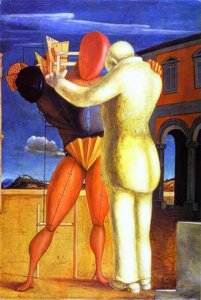
A Vision of Isolation: The Haunting Dreamscape of An Amazon
In the quiet, unsettling corridors of early twentieth-century modernism, few images possess the arresting power of Giorgio de Chirico’s "An Amazon." Completed in 1913, this masterpiece serves as a profound cornerstone of what would become known as Surrealist art, capturing a moment that feels suspended between reality and a fever dream. At first glance, the viewer is met with a striking tableau: a woman clad in a vibrant scarlet dress, perched atop a magnificent chestnut horse against the backdrop of a desolate, sun-scorched hillside. Yet, to look merely at the surface is to miss the profound existential weight de Chirico intended to convey. The painting is not simply a portrait of a rider; it is a meticulously crafted window into the human psyche, designed to provoke contemplation about solitude, strength, and the heavy silence of the unknown.
The subject matter draws deeply from the well of classical mythology, invoking the legendary Amazons—the fierce, independent warrior women of antiquity. By placing this mythic figure within such a stark, lonely landscape, de Chirimento injects a sense of heroic grandeur into an otherwise bleak setting. However, he deliberately avoids the trappings of romantic idealism. Instead of a triumphant conqueror, we see a woman whose gaze is directed inward, suggesting a state of deep introspection or perhaps a quiet resignation to her isolation. The horse, too, transcends its role as a mere beast of burden; it stands as a symbol of stability and groundedness amidst the turbulent, unseen emotions that haunt the composition.
The Architecture of a Dream: Technique and Spatial Distortion
De Chirico’s technical mastery lies in his ability to blend meticulous realism with a disorienting, dreamlike abstraction. He employs a precise hand to render the tactile details of the scene—the coarse texture of the horse’s mane, the heavy folds of the scarlet fabric, and the ruggedness of the rocky terrain. This level of detail creates a convincing illusion of reality that makes the subsequent distortions all the more unsettling. Through a technique reminiscent of Cubism but pushed toward a much more profound psychological depth, de Chirico manipulates perspective and scale to create an illogical space. The hillside does not follow the rules of conventional landscape painting; instead, it exists in muted, oppressive tones of ochre and brown, creating a sense of heavy, stagnant air.
This chromatic harmony—or perhaps disharmony—is central to the painting's emotional impact. The sudden, piercing brightness of the woman’s red dress acts as a focal point that vibrates against the desaturated earth tones, pulling the viewer’s eye into the center of this lonely drama. For collectors and interior designers, this piece offers a unique tension; it possesses the classical elegance required for sophisticated spaces, yet its avant-garde spirit provides a conversational edge that challenges the mundane. It is a work that does not merely decorate a wall but commands the atmosphere of a room, inviting guests to linger in its shadows and wonder about the stories hidden within its stillness.
A Legacy of Metaphysical Mystery
To understand "An Amazon," one must understand the era of Metaphysical Art that de Chirico pioneered. Influenced by the existential philosophies of Nietzsche and Schopenhauer, the artist sought to reveal the unsettling poetry hidden within the mundane. His work often features long, stretching shadows and empty spaces that evoke a sense of nostalgia and dread. In "An Amazon," this is achieved through the deliberate use of negative space and the isolation of the central figures. The presence of other distant figures in the periphery only serves to heighten the feeling of being alone in a vast, indifferent world.
For those seeking to bring a piece of art history into their personal collections, a high-quality reproduction of "An Amazon" offers more than just visual beauty; it offers an entry point into the subconscious. It is a painting for the thinker, the dreamer, and the aesthete—a timeless reminder that beneath the surface of our daily lives, there exists a deeper, more mysterious layer of reality waiting to be explored. Whether placed in a contemporary gallery setting or a classic study, this work continues to resonate with the same haunting, beautiful intensity it possessed over a century ago.
Vragen & Antwoorden
Is "An Amazon" in zijn geheel eerder licht of donker?
De helderheid van "An Amazon" door Giorgio de Chirico is vastgelegd op deep_shadow, met een luminantie van Dark.
Wat is de dominante kleur van "An Amazon" door Giorgio de Chirico?
"An Amazon" neigt naar een Golden Yellow Range tint.
Kan ik "An Amazon" door Giorgio de Chirico bekijken voordat ik bestel?
Een voorproefje van "An Amazon" door Giorgio de Chirico is beschikbaar op de Voorvertoning-pagina van het kunstwerk.
Wat voor soort kunstwerk is "An Amazon" door Giorgio de Chirico?
"An Amazon" door Giorgio de Chirico wordt geclassificeerd als WallArt. De categorie beschrijft het type kunstwerk dat het origineel is.
Is "An Amazon" een beroemd kunstwerk uit de Surrealist Dreamscape-stroming?
"An Amazon" staat geregistreerd als Iconic onder de werken uit de Surrealist Dreamscape in de catalogus.
Waar kan ik een digitale afbeelding van "An Amazon" door Giorgio de Chirico kopen?
Om een digitaal bestand van "An Amazon" door Giorgio de Chirico te verkrijgen, kunt u een download van een digitale afbeelding in hoge resolutie bestellen via deze pagina.
Zijn er werken die lijken op "An Amazon"?
Werken die lijken op "An Amazon" staan vermeld op de Vergelijkbare werken-pagina van het kunstwerk.
Wat is het kleurenpalet van "An Amazon" door Giorgio de Chirico?
De kleuridentiteit van "An Amazon" door Giorgio de Chirico: een Earthy palet, gedomineerd door Sap Green (#73643e).
Biografie van de kunstenaar
Giorgio de Chirico: Een Droomlandschap van de Geest
Giorgio de Chirico, geboren in 1888 in Volos, Griekenland, als zoon van Italiaanse ouders – een Genoese moeder en een Siciliaanse vader – begon zijn artistieke reis met een unieke combinatie van klassieke erfenis en een groeiend gevoel van moderne vervreemding. Zijn vroege opleiding aan de Athenische Polytechnische Academie legde een basis in traditionele technieken, maar het was zijn latere studie in München die zijn creatieve geest werkelijk ontvloog. Daar, midden in de intellectuele fermentatie van Europa vóór de oorlog, ontmoette hij de werken van Arnold Böcklin en Max Klinger, kunstenaars wiens symbolische landschappen en spookachtige beelden een diepe indruk op hem achterlieten. Even invloedrijk waren de filosofische stromingen van die tijd – de schrijfsels van Friedrich Nietzsche, Arthur Schopenhauer en Otto Weininger – die thema’s van existentialisme, de irrationele aard van menselijk verlangen en de subjectieve aard van realiteit onderzochten. Deze ideeën zouden centraal staan in de baanbrekende artistieke visie van de Chirico.De Geboorte van Metafysische Kunst
Omstreeks 1909 begon er een unieke stijl te ontstaan uit de verkenningen van de Chirico – een stijl die hij zelf “Metafysieke” kunst noemde. Dit was niet slechts een stijlinnovatie; het was een diepe poging om de verborgen realiteiten onder de oppervlakte van alledaagse ontmoetingen vast te leggen, om de onheilspellende poëzie te onthullen die in vertrouwdere ruimtes schommelde. Een cruciale gebeurtenis vond plaats tijdens een bezoek aan Florence en een ervaring in Piazza Santa Croce, wat leidde tot zijn iconische ‘Metafysische Plaatsverkeer’ serie. Deze schilderijen kenmerken zich door hun spookachtige stilte, lange dramatische schaduwen, logische perspectieven en de aanwezigheid van klassieke architectuur gecombineerd met onheilspellende elementen zoals gezichtsloze mannekens en reusachtige standbeelden. Het effect is diep verontrustend, roept een gevoel van nostalgie, isolatie en een bijna ondraaglijke heimwee naar iets verloren of ontoegankelijks op. De Chirico richtte de *Scuola Metafisica* op, wat een diepe impact had op Surrealisme, hoewel hij later afstand nam van de interpretaties van zijn werk door deze stroming. Zijn schilderijen waren niet bedoeld als illustraties van dromen, maar eerder als pogingen om realiteit vast te leggen buiten het zichtbare wereld – een rijk waar tijd en ruimte vloeibaar zijn en de grenzen tussen bewustzijn en onbewustzijn vervagen. Bekende werken zoals *De Verjagde Denkbeeld*, *Het Enigma van de Herfstmiddag* en *Het Lied van de Liefde* illustreren deze spookachtige esthetiek, uitnodigend kijkers om na te denken over de mysteries van het bestaan en de kwetsbaarheid van menselijke perceptie.Een Verandering in Stijl en een Duurzaam Erfgoed
Na de Eerste Wereldoorlog, rond 1919, nam de artistieke weg van de Chirico een onverwachte wending. Hij verwierp zijn eerdere metafysische benadering en omarmde daarentegen een meer traditionele neoclassieke of neobaroque stijl. Deze verschuiving werd met aanzienlijke controverse ontvangen; velen betreurden het verlies van de innovatieve geest die zijn vroege werk had gedefinieerd. De Chirico bleef echter vasthoudend aan zijn artistieke keuzes, herhaalde thema’s uit zijn verleden, maar presenteerde ze met een andere esthetische gevoeligheid. Hij bleef schilderen en exposeren gedurende zijn hele leven, verkende verschillende stijlen en onderwerpen terwijl hij tegelijkertijd een consistente toewijding aan vakmanschap en technische vaardigheid behield. Ondanks de kritiek is zijn invloed op latere generaties van kunstenaars niet te overschatten. Zijn innovatieve gebruik van ruimte, perspectief en symboliek daagde conventionele artistieke normen uit en legde de basis voor nieuwe vormen van expressie.Invloeden en Duurzaam Erfgoed
- Gevloed door: Arnold Böcklin, Max Klinger, Friedrich Nietzsche, Arthur Schopenhauer.
- Gevloed door: Surrealisme, met name kunstenaars zoals René Magritte en Salvador Dalí. Zijn werk had ook invloed op latere stromingen zoals Magic Realism, die een verhoogde gevoeligheid voor mysterie en psychologische diepte zocht in alledaagse realiteit.

Giorgio de Chirico
1888 - 1978 , Griekenland
Snelle feiten
- Artistic Movement Or Style: Metafysische kunst
- Artists Or Movements Influenced By This Artist:
- Surrealisme
- René Magritte
- Artists Who Influenced This Artist:
- Arnold Böcklin
- Max Klinger
- Date Of Birth: 10 juli 1888
- Date Of Death: 20 november 1978
- Full Name: Giorgio de Chirico
- Nationality: Italiaans
- Notable Artworks:
- Het Vrezen van de Denkende
- De Enigma van een Herfst Middag
- Het Lied van de Liefde
- Place Of Birth: Volos, Griekenland
Gerelateerde artikelen

Oil on Canvas: A Historical & Technical Exploration of a Timeless Artistic Medium
Explore the rich history & enduring techniques of oil painting on canvas. Discover the science behind its longevity, conservation practices, and contemporary relevance. Expert insights for art enthusiasts.

The Enduring Legacy of Oil on Canvas: Technique, History & Aesthetic Impact
Explore the rich history & techniques of oil painting – from Renaissance masters to Impressionism. Discover pigments, layering methods, and why this timeless medium endures. Expert insights for artists & art enthusiasts.

Crimson Threads of Narrative: Exploring Symbolism & Representation in Artworks Featuring the Red Dress
Explore the rich symbolism of the red dress in art history! From ancient power displays to iconic portraits like Cézanne’s 'Madame Cezanne', discover the cultural and artistic significance behind this captivating color. Expert analysis & insights.
The Noble Steed on Canvas: A Historical & Artistic Exploration of Horse Painting Across Cultures
Explore the rich history of horse painting! Discover masterpieces from Stubbs to Munnings & learn about symbolism, techniques & artists. Find museum-quality reproductions at OriginalUniqueArt.

The Enduring Power of Painting: A Historical & Contemporary Exploration of Form and Emotion
Explore the rich history & enduring techniques of oil painting with OriginalUniqueArt. Discover masterpieces, learn about art collecting, and find authentic handmade reproductions crafted by skilled artists.