

 Bekijk op ware grootte
 Verstuur
 Delen
Delen
 Details bekijken
 Gids voor studentenkunstwerken

 Download
 Vergelijkbare items
 Röntgenonderzoek
 Diavoorstelling
 Statistieken
Merry Company
 Acrylic On Canvas
- WallArt
- Baroque Painting
 1623
1623 125.0 x 157.0 cm
 Staatsgalerie Stuttgart
 Lees meer
Handgemaakte olieverfreproductie
Met de hand geschilderd in olieverf op canvas in uw gewenste maat en lijst, op bestelling gemaakt door onze kunstenaars. ( Schakel over naar print Schakel over naar digitale afbeeldingen)




P118B €10

P118H €10

P118W €10

P438Z €10

P508JH €12

P508YH €12

P805H €10

P805Z €10

P919BZ €10

P919G €10

P919XJ €10

P959ZH €10

P968JZ €12

W106C €8

W218G €10

W218JH €8

W218Y €10

W307PJ €10

W316G €10

W316PJ €8

W316Y €10

W398PJ €8

W4111J €10

W500HY €15

W500JH €15

W692G €12

W849H €8

W940BG €15

W953PJ €8




Kies uit onze vooraf ingestelde maten die overeenkomen met de originele verhoudingen van het kunstwerk.

U kunt uw eigen afmetingen invoeren om in een specifieke lijst of ruimte te passen. Als de door u gekozen maat niet overeenkomt met de verhoudingen van het originele beeld, zullen we het kunstwerk bijsnijden of het schilderij uitbreiden met extra handgeschilderde elementen. Een digitale mockup wordt ter goedkeuring naar u verzonden voordat de productie begint.
Houd er rekening mee dat de preview op het scherm niet de werkelijke uitsnede of uitbreiding weergeeft. Alleen de mockup toont de uiteindelijke compositie nauwkeurig.
Hoewel aangepaste afmetingen mogelijk zijn, raden we aan een maat uit de vooraf gedefinieerde lijst te selecteren om de originele verhoudingen te behouden.
Na de bestelling zal het team van OriginalUniqueArt.com per e-mail contact opnemen met de klant voor instructies en een mockup-voorbeeld sturen.
Wereldwijde levering () binnen 3 tot 4 weken in plaats van de standaard 5 weken. (12 oktober). Zonder concessies aan de kwaliteit.

Gratis wereldwijde expressverzending

Hoogwaardig linnen canvas

Volledige verzendverzekering

Garantie op terugbetaling van invoerrechten

Garantie op exacte kleurweergave

Retourbeleid van 100 dagen (alleen bij defecten)

100% Geld-terug-garantie

Korting bij meerdere afnames
 De optie voor glas is alleen beschikbaar bij een formaat kleiner dan 110 cm.

Merry Company
Reproductiemethode
Formaat reproductie
-


Totaalprijs
€ 259
A Dance in Shadow: Gerard van Honthorst’s “Merry Company”
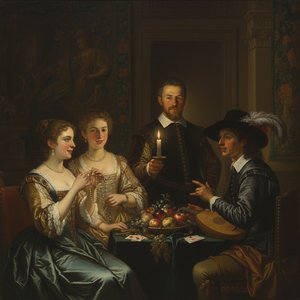
Gerard van Honthorst's "Merry Company," painted in 1623, isn’t merely a depiction of a tavern scene; it’s a carefully orchestrated tableau of light, social interaction, and the subtle drama inherent in human connection. This remarkable work, now residing within the Alte Pinakothek in Munich, offers a captivating glimpse into the vibrant heart of the Dutch Golden Age – a period defined by burgeoning wealth, artistic innovation, and a fascination with capturing the nuances of everyday life.
The painting immediately draws the eye with its masterful use of chiaroscuro, a technique borrowed directly from Caravaggio and central to Honthorst’s signature style. Deep shadows engulf much of the composition, creating an atmosphere of intimacy and drawing attention to the illuminated figures clustered around a table laden with goblets, wine glasses, and platters of food. This dramatic interplay of light and dark isn't simply aesthetic; it serves to heighten the sense of drama and immediacy, as if we are witnessing a fleeting moment frozen in time.
The Setting: A Tavern’s Embrace
The scene unfolds within what appears to be a richly appointed tavern – though the specific location remains somewhat elusive. The details suggest a comfortable, well-established establishment, likely frequented by merchants and members of the local elite. Notice the carefully rendered furniture, the warm glow emanating from unseen candles, and the abundance of drinkware. The composition is deliberately crowded, reflecting the lively atmosphere of a social gathering. Several figures are seated, engaged in conversation or perhaps enjoying music – though the instruments themselves aren’t explicitly visible, their presence is strongly implied.
A key element to note is the inclusion of several women amongst the men. This was relatively uncommon in Dutch genre paintings of this era, and suggests a deliberate attempt by Honthorst to portray a more balanced and inclusive representation of social life. The women are not merely decorative; they actively participate in the conversation and revelry, contributing to the overall sense of merriment.
A Caravaggistic Influence: Light and Emotion
Honthorst’s debt to Caravaggio is undeniable. Like his Italian predecessor, he understood the power of light to shape perception and evoke emotion. The strong directional lighting casts dramatic shadows that sculpt the figures' faces and bodies, emphasizing their expressions and gestures. The use of a single, unseen light source creates a sense of immediacy and realism, as if we are present at this lively gathering ourselves.
Furthermore, Honthorst’s attention to detail is remarkable. From the folds of the clothing to the textures of the furniture, every element contributes to the overall sense of authenticity. The figures themselves are rendered with a subtle psychological depth – their expressions ranging from jovial amusement to quiet contemplation. This level of realism was highly valued by Dutch artists during this period and reflects Honthorst’s skill as a portraitist.
Symbolism and Social Commentary
Beyond its immediate visual appeal, “Merry Company” offers subtle insights into the social dynamics of 17th-century Holland. The painting can be interpreted as a celebration of prosperity and leisure – hallmarks of the Dutch Golden Age. However, it also subtly hints at the potential pitfalls of excess and indulgence. The abundance of drink and merriment serves as a reminder of the importance of moderation and self-control.
The inclusion of figures like the older woman holding a candle is particularly intriguing. Her presence suggests a contemplation on time, beauty, and mortality – themes that were frequently explored in Dutch art during this period. The flickering candlelight symbolizes both love and vanity, highlighting the transient nature of earthly pleasures. “Merry Company” isn’t simply a depiction of a social gathering; it's a carefully constructed meditation on life, death, and the human condition.
A Timeless Masterpiece
Gerard van Honthorst’s “Merry Company” remains a captivating masterpiece – a testament to his artistic skill and his profound understanding of light, emotion, and the complexities of human interaction. Its dramatic chiaroscuro, rich detail, and subtle symbolism continue to resonate with viewers today, offering a glimpse into the vibrant world of 17th-century Holland.
Vragen & Antwoorden
In welk jaar werd "Merry Company" door Gerard van Honthorst gemaakt?
"Merry Company" dateert uit 1623. Deze datum plaatst het werk binnen de carrière van Gerard van Honthorst en de betreffende tijdperk.
Wie is de maker van "Merry Company" en uit welk jaar stamt het werk?
"Merry Company" werd in 1623 gecreëerd door Gerard van Honthorst.
Is "Merry Company" een beroemd kunstwerk uit de Baroque Painting-stroming?
Binnen de Baroque Painting-stroming heeft "Merry Company" een Recognized populariteitsniveau.
Wat stelt "Merry Company" door Gerard van Honthorst voor?
De onderwerpen van "Merry Company" zijn merry company, dutch golden age, caravaggism, tavern scene, group portrait, chiaroscuro, festive gathering.
Is "Merry Company" door Gerard van Honthorst een licht of een donker kunstwerk?
De helderheid van "Merry Company" door Gerard van Honthorst is vastgelegd op deep_shadow, met een luminantie van Dark.
Welke plaatsing past bij het formaat van "Merry Company" door Gerard van Honthorst?
Met zijn Landscape-vorm wordt een reproductie van "Merry Company" aanbevolen voor een Living Room.
Voor welke ruimte wordt "Merry Company" door Gerard van Honthorst aanbevolen?
Een reproductie van "Merry Company" past uitstekend in een Living Room.
Hoe oud was Gerard van Honthorst toen "Merry Company" werd gemaakt?
Gerard van Honthorst was 33 jaar oud bij het creëren van "Merry Company" in 1623. De leeftijd is berekend op basis van het geboortejaar van de kunstenaar, 1590.
Biografie van de kunstenaar
Een leven verlicht: De wereld van Gerard van Honthorst
Gerard van Honthorst, geboren in Utrecht in 1592, was een uitzonderlijk kunstenaar die de Nederlandse Gouden Eeuw met zijn dramatische en lichtrijke schilderingen verrijkte. Zijn jeugd werd gevormd door zijn vader, een decoratieschilder, en onder de begeleiding van Abraham Bloemaert legde hij een stevige basis in techniek en compositie. Maar het was een reis naar Rome die zijn artistieke ontwikkeling radicaal veranderde. Daar, midden in de energieke sfeer van de Italiaanse Barok, ontmoette hij Caravaggio – een ontmoeting die zijn kenmerkende stijl zou definiëren en hem de bijnaam “Gherardo delle Notti” opleverde, ofwel Gerard van de Nachts. De dramatische toepassing van tenebrism, waarbij scherpe contrasten tussen licht en donker werden gebruikt, werd zijn handtekening, waardoor zijn doeken een intense spanning en emotionele diepte kregen. Het was niet zomaar imitatie; Honthorst vertaalde Caravaggio’s innovaties naar een uniek Nederlands perspectief, met de focus op intieme scènes verlicht door kunstmatige lichtbronnen – kaarsen, lampen en vuurplaatsen – waardoor een sfeer ontstond die zowel realistisch als theatralisch was. Deze beheersing van het licht was meer dan alleen technische vaardigheid; het was een manier om karakter te onthullen, de kijker in het emotionele hart van elke scène te trekken.Van Romeinse Glorie naar Nederlandse Meesterschap
Honthorst’s tijd in Rome was gekenmerkt door aanzienlijke erkenning en patronage. Hij won de gunst van de elite van de stad, waaronder Vincenzo Giustiniani, voor wie hij het krachtige “Christ Before the High Priest” schilderde – een werk dat zijn meesterschap over licht en schaduw perfect demonstreert. Deze schilderij, nu te zien in de National Gallery in Londen, toont niet alleen zijn technische bekwaamheid, maar ook zijn vermogen om diepgaande psychologische lagen in zijn figuren weer te geven. Hij versterkte zijn reputatie verder door te werken voor Cosimo II de' Medici, de Groothertog van Toscane, en later voor kardinaal Barberini, de latere paus Urbanus VIII. Deze connecties brachten hem in contact met de meest invloedrijke kunstenaars en intellectuelen van het tijdperk. Honthorst’s stijl evolueerde voortdurend, waarbij hij elementen uit de Italiaanse Barok combineerde met zijn eigen Nederlandse gevoeligheid. Hij was een meester in het creëren van sfeer en emotie, en zijn werken werden vaak gekenmerkt door hun dramatische composities en levendige kleuren.De Utrechtse Caravaggisten
Honthorst behoorde tot de *Utrechtse Caravaggisten*, een groep Nederlandse schilders die zich lieten inspireren door Caravaggio’s radicale realisme en tenebrism. Naast Hendrick ter Brugghen en Dirck van Baburen was hij een sleutelfiguur in deze beweging, die de Italiaanse Barokstijl naar Nederland bracht. Hun werk werd gekenmerkt door een nadruk op genre scènes verlicht door kunstmatige lichtbronnen, hun meesterlijke portretten en hun vermogen om emoties over te brengen door middel van het gebruik van clair-obscur. Honthorst’s focus op intieme scènes, vaak met een dramatische compositie en een sterke nadruk op licht en schaduw, onderscheidde hem van andere Nederlandse schilders van zijn tijd. Hij was niet alleen een imitator; hij ontwikkelde een eigen stijl die uniek was voor hem.Een Courtier en Collaborateur
Na zijn terugkeer naar Utrecht rond 1620 vestigde Honthorst zich snel als een toonaangevende portretschilder in de Nederlandse Republiek. Zijn vermogen om niet alleen fysieke gelijkenis, maar ook karakter en sociale status van zijn onderwerpen vast te leggen, maakte hem zeer gewild bij rijke kooplieden, edelen en zelfs koningen. Hij werd in 1623 president van het Sint-Lucasgilde in Utrecht, een bewijs van zijn toenemende invloed binnen de artistieke gemeenschap. Deze periode was gekenmerkt door een overvloed aan opdrachten, waardoor Honthorst zijn stijl verder kon verfijnen en een eigen stem ontwikkelde binnen de Nederlandse schilderkunst. Hij reisde naar Engeland om te werken voor koning Karel I en Lord Dorchester, en werkte samen met andere kunstenaars zoals Peter Paul Rubens. Deze samenwerkingen waren niet alleen bedoeld om de werkdruk te verlichten; ze waren intellectuele uitwisselingen die de artistieke wereld rijkder maakten.Erfgoed en de Utrechtse Caravaggisten
Gerard van Honthorst’s invloed reikte verder dan zijn leven. Hij was een sleutelfiguur in de *Utrechtse Caravaggisten* beweging – een groep Nederlandse schilders die zich lieten inspireren door Caravaggio’s dramatische realisme en tenebrism. Naast Hendrick ter Brugghen en Dirck van Baburen was hij een belangrijke vertegenwoordiger van deze stroming, die de Italiaanse Barokstijl naar Nederland bracht. Zijn nadruk op genre scènes verlicht door kunstmatige lichtbronnen, zijn meesterlijke portretten en zijn vermogen om emoties over te brengen door middel van het gebruik van clair-obscur hebben een blijvende stempel gedrukt op de ontwikkeling van de Nederlandse Gouden Eeuw schilderkunst. Zijn werk blijft vandaag de dag publiek worden gewaardeerd, en zijn dramatische schoonheid en psychologische diepgang blijven tijdloze kwaliteiten. Hij overleed in Utrecht in 1656, waarbij hij een oeuvre achterliet dat de artistieke wereld nog steeds verrijkt en ons herinnert aan de kracht van licht en schaduw om de menselijke conditie te onthullen.
Gerard van Honthorst
1590 - 1656 , Nederland
Snelle feiten
- Artistic Movement Or Style: Barok, Caravaggisme
- Artists Or Movements Influenced By This Artist: ['Utrechtse Caravaggisten']
- Artists Who Influenced This Artist: ['Caravaggio']
- Date Of Birth: 4 november 1592
- Date Of Death: 27 april 1656
- Full Name: Gerard Hermansz. van Honthorst
- Nationality: Nederlands
- Notable Artworks: ['Christ in de Olijf']
- Place Of Birth: Utrecht, Nederland
Gerelateerde artikelen

Top 10 Nederlandse Barok Meesterwerken: Kunstgeschiedenis voor uw Interieur
Ontdek de 10 meest iconische meesterwerken van de Nederlandse Barok! Leer over Rembrandt, Vermeer en andere Hollandse meesters. Prachtige reproducties voor uw interieur op OriginalUniqueArt.com – museumkwaliteit kunstprints & decoratie.
Gerard van Honthorst: Illuminating the Dutch Golden Age with Caravaggism & Courtly Grace
Explore the captivating world of Gerard van Honthorst, a Dutch Golden Age master renowned for his dramatic chiaroscuro & courtly portraits. Discover his life, art, and lasting influence on Baroque painting.
Cornelis van Poelenburch: Bridging Mannerism & the Dutch Baroque Landscape
Discover Cornelis van Poelenburch, a pivotal Dutch Baroque landscape painter bridging Mannerism & Italianate styles. Explore his life, key works, and lasting influence on 17th-century art with OriginalUniqueArt.

Rembrandt's Meesterwerken: De Top 25 – Kunst voor uw Interieur | OriginalUniqueArt
Ontdek de 25 meest iconische schilderijen van Rembrandt van Rijn! Duik in de Gouden Eeuw, bewonder zijn portretten & zelfportretten. Museumkwaliteit reproducties voor uw interieur op OriginalUniqueArt.com. Bekijk de collectie!

Golden Age Reflections: Dutch Baroque Painting & Cultural Innovation
Explore the Dutch Golden Age of painting! Discover key artists like Vermeer & ter Borch, their innovative techniques, and the rich cultural context behind these Baroque masterpieces. Learn about collecting & appreciating this iconic art period.
