Schakel over naar print
 Lees meer







































 Voor kunstwerken of reproducties die aan één zijde groter zijn dan 105 cm (ongeveer 41 inch), wordt de lijst als een losse set verzonden. Deze methode garandeert een veilige levering en voorkomt schade tijdens het transport.


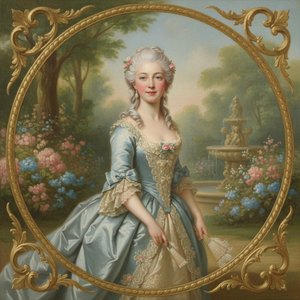
A Portrait of Elegance: Madame Bergeret by François Boucher
François Boucher’s “Madame Bergeret,” completed in 1766, stands as a quintessential exemplar of Rococo artistry—a style synonymous with aristocratic refinement and sensual beauty. More than just a depiction of a woman, it's an immersive experience into the opulent aesthetic sensibilities of Louis XV’s court, capturing not merely likeness but also an idealized vision of feminine grace.
Composition & Setting: An Interior Oasis
The painting centers on Madame Bergeret herself, positioned slightly off-center within a softly lit interior space dominated by a verdant curtain. This deliberate framing immediately establishes intimacy and directs the viewer’s gaze outwards towards an imagined garden vista—a motif prevalent in Rococo landscapes designed to evoke tranquility and pastoral charm. The artist skillfully employs size diminution to heighten depth perception, subtly emphasizing the grandeur of the surroundings.
Color Palette & Texture: Delicate Layers
Boucher’s masterful use of color is characterized by muted tones—primarily creams, whites, and pale greens—accentuated by splashes of sapphire blue in ribbons and a decorative fan. Hints of rose and peach permeate the floral bouquet, creating a harmonious blend that reflects the prevailing Rococo preference for pastel hues. The artist achieves remarkable textural depth through layering thin glazes of oil paint, resulting in surfaces shimmering with silk-like sheen and capturing the delicate petals of flowers alongside the rougher texture of the curtain fabric—a testament to Boucher’s meticulous technique.
Style & Technique: Rococo Precision
“Madame Bergeret” embodies the hallmarks of Rococo painting. The artist’s brushstrokes are exceptionally smooth and blended, prioritizing subtlety and grace over dramatic gesture. Boucher meticulously renders form through careful shading—creating soft contours that define Madame Bergeret's figure while simultaneously conveying a sense of ethereal luminescence. Influenced by artists like Jean-Honoré Fragonard and Antoine Watteau, Boucher’s approach aligns with the broader stylistic trends of his time, prioritizing decorative embellishment and capturing fleeting moments of beauty.
Symbolism & Emotional Resonance: Beauty and Contemplation
Beyond its visual splendor, “Madame Bergeret” resonates with symbolic significance. The flowers—particularly roses—represent femininity, love, and the ephemeral nature of time—themes central to Rococo art’s exploration of human emotion. Madame Bergeret's serene expression suggests a state of calm contemplation—a quiet confidence that speaks to the idealized portraiture of the era. This artwork continues to captivate viewers today not only for its exquisite craftsmanship but also for its ability to evoke feelings of elegance, serenity, and timeless beauty.
Veelgestelde vragen
Wat is de aanbevolen afdrukmaat voor "Madame Bergeret"?
Voor "Madame Bergeret" wordt een afdrukformaat van Large aanbevolen. Andere formaten zijn beschikbaar met dezelfde verhoudingen.
Met welke techniek is "Madame Bergeret" gemaakt?
François Boucher gebruikte de Oil On Canvas-techniek voor "Madame Bergeret". De techniek bepaalt de materiële aard van het originele werk.
Kan ik "Madame Bergeret" in meer detail bekijken?
"Madame Bergeret" kan laag voor laag worden onderzocht op de Röntgenanalyse pagina van het kunstwerk, een interactieve viewer geïnspireerd op de lichttafel van een restaurator met elf optische lagen van de afbeelding.
 Voorvertoning
 Verstuur
 Delen
Delen
 Details bekijken
 Gids
Gids

 Download
 Vergelijkbare items
 Röntgenonderzoek
 Diavoorstelling
 Q&A
Q&A Statistieken