Olieverfversie
 Alles over Stalingrad







































 Voor kunstwerken of reproducties die aan één zijde groter zijn dan 105 cm (ongeveer 41 inch), wordt de lijst als een losse set verzonden. Deze methode garandeert een veilige levering en voorkomt schade tijdens het transport.


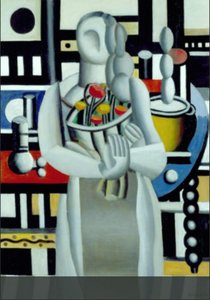
The Creation of Stalingrad by Fernand Léger
In 1924, Fernand Léger turned his gaze toward the heavy, rhythmic pulse of industrial labor. His painting, Stalingrad, emerged from this fascination with the intersection of man and machine. The canvas captures a moment of intense industrial collaboration, where the human form and the mechanical tool become inseparable. It is a scene of construction and movement, a study of how steel and muscle work in tandem to reshape a landscape.
The work is rooted in the language of Cubism, utilizing fragmented planes to organize the chaos of the machine age. At the same time, it carries the simplified, direct clarity often associated with Naïve Art. This duality allows the subject matter to remain grounded. The heavy machinery and the workers are not mere decorations; they are the structural bones of the composition. Fernand Léger sought to translate the energy of the modern era into a visual reality of intersecting lines and solid forms.
Steel pistons and heavy cranes define the space. The work exists in the tension between the organic and the manufactured. It is a quiet record of strength.
Artistic Movements and Stylistic Influences
The canvas is anchored in the fractured logic of Cubism. It follows the path cleared by the pioneers of the movement, breaking the world into a sequence of overlapping planes and geometric shards. This is not a soft dissolution of form, but a structural dismantling. The artist’s own hand developed a specific variation of this language, often called Tubism, which emphasizes cylindrical, tubular shapes. These rounded, mechanical volumes replace the organic curves of the natural world with the hard, rhythmic precision of the machine age.
There is a heavy, industrial pulse within these shapes. The work looks toward the future, acting as a forerunner to the Pop Art movement that would emerge decades later. By treating modern, mechanical subjects with such directness, the artist bridges the gap between fine art and the objects of a consumer society. The painting captures a moment where the human figure and the machine become inseparable parts of a single, moving mechanism. Steel and shadow define the new reality.
Veelgestelde vragen
Is Stalingrad handgeschilderd of een print?
Met de hand geschilderd: een professioneel kunstenaar kopieert Stalingrad in olieverf op linnen canvas.
Welke maat moet ik kiezen voor Stalingrad?
Het origineel heeft de afmetingen 32 x 50 cm. De afmetingen variëren van 29.9 x 33.4 cm (€224) tot 217.2 x 242.6 cm (€1760); in de tabel op deze pagina vindt u de verschillende opties en de bijbehorende prijzen.
Hoe lang duurt de bezorging?
De levertijd bedraagt 4 tot 5 weken, inclusief gratis wereldwijde expressverzending; op deze pagina wordt een optie voor spoedproductie aangeboden. U kunt het binnen 100 dagen zonder voorwaarden retourneren voor een volledige terugbetaling.
Welk medium heeft Fernand Léger gebruikt voor Stalingrad?
Oil On Canvas
 Voorvertoning

 Verstuur
 Delen
 Details bekijken
 Informatieblad


 Download
 Vergelijkbare items
 Röntgenonderzoek
 Diavoorstelling
 Vraag & antwoord

 Statistieken