Olieverfversie
 Alles over Staircase 19







































 Voor kunstwerken of reproducties die aan één zijde groter zijn dan 105 cm (ongeveer 41 inch), wordt de lijst als een losse set verzonden. Deze methode garandeert een veilige levering en voorkomt schade tijdens het transport.


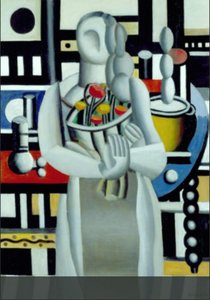
Fernand Léger, a prominent figure in the Cubism movement, created "Staircase" in 1914. This painting is a quintessential example of Cubist art, characterized by its geometric forms and fragmented objects.
Composition and Elements
The scene depicts a stairwell with various objects scattered throughout the space. Multiple cups of different sizes are placed on the steps, some closer to the viewer and others further away. A bowl is located near the center of the painting, while a vase is positioned towards the left side. Several bottles are scattered throughout the scene, with one close to the top right corner, another in the middle-right area, and two more on the bottom right side. A chair can be seen near the center of the painting, while a clock is located towards the upper left corner.Cubism and Proto-Cubism
Cubism, pioneered by Pablo Picasso and Georges Braque, revolutionized painting and visual arts in the early 20th century. The movement influenced artistic innovations in music, ballet, literature, and architecture. Cubist subjects are analyzed, broken up, and reassembled in an abstract form, depicting multiple perspectives to represent the subject in a greater context. Proto-Cubism, also referred to as Protocubism, Early Cubism, and Pre-Cubism or Précubisme, is an intermediary transition phase in the history of art chronologically extending from 1906 to 1910. This period is characterized by a move towards the radical geometrization of form and a reduction or limitation of the color palette.Artistic Influences
Fernand Léger's "Staircase" reflects the influence of Paul Cézanne's late works, which represented three-dimensional forms in a more geometric manner. The painting also showcases the artist's adherence to the principles of Cubism, as seen in the fragmented objects and multiple perspectives.Relevance and Legacy
Cubism has been considered the most influential art movement of the 20th century. Its impact was far-reaching and wide-ranging in the arts and popular culture. The movement introduced collage as a modern art form and influenced various offshoots, including Orphism, abstract art, Futurism, Suprematism, Dada, Constructivism, De Stijl, and Art Deco. In conclusion, Fernand Léger's "Staircase" is a significant work in the Cubist movement, showcasing the artist's skillful use of geometric forms and fragmented objects. The painting reflects the influence of Cézanne and the principles of Cubism, contributing to the movement's lasting impact on modern art.Veelgestelde vragen
Is Staircase 19 handgeschilderd of een print?
Met de hand geschilderd: een professioneel kunstenaar kopieert Staircase 19 in olieverf op linnen canvas.
Welke maat moet ik kiezen voor Staircase 19?
De afmetingen variëren van 28.3 x 35.4 cm (€179) tot 196.6 x 245.8 cm (€1587); in de tabel op deze pagina vindt u de verschillende opties en de bijbehorende prijzen.
Hoe lang duurt de bezorging?
De levertijd bedraagt 4 tot 5 weken, inclusief gratis wereldwijde expressverzending; op deze pagina wordt een optie voor spoedproductie aangeboden. U kunt het binnen 100 dagen zonder voorwaarden retourneren voor een volledige terugbetaling.
Waar is het origineel van Staircase 19?
Het origineel maakt deel uit van de collectie van het Kunstmuseum Basel, Bazel.
Welk medium heeft Fernand Léger gebruikt voor Staircase 19?
Acrylic On Canvas
 Voorvertoning

 Verstuur
 Delen
 Details bekijken
 Informatieblad


 Download
 Vergelijkbare items
 Röntgenonderzoek
 Diavoorstelling
 Vraag & antwoord

 Statistieken