Cubist Style
Mechanical Elements (Fernand Léger)
Fernand Léger (1881–1955) maakte Mechanical Elements. Het behoort tot de Cubist Style-stroming. Het is gemaakt van Oil On Canvas. Het is te vinden in Metropolitan Museum of Art in New York, Verenigde Staten van Amerika.
- Oil On Canvas
- Metropolitan Museum of Art, New York

 Voorvertoning

 Met de hand geschilderd olieverfwerk
 Verstuur
 Delen
 Informatieblad


 Download
 Vergelijkbare items
 Röntgenonderzoek
 Diavoorstelling
 Vraag & antwoord

 Statistieken
Mechanical Elements, in het kort
- Titel
- Mechanical Elements
- Kunstenaar
- Fernand Léger (1881–1955)
- Geboren in [jaar]
- Argentan, Frankrijk
- Medium
- Oil On Canvas
- Te zien in
- Metropolitan Museum of Art, New York, Verenigde Staten van Amerika
- Beweging
- Cubist Style
- Periode
- Modern
- Onderwerp
- mechanical elements, cubism, geometry, industrial design, abstraction, assemblage
Wat stelt Mechanical Elements voor?
A Vision of Industrial Harmony
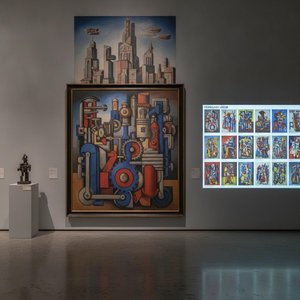
Fernand Léger’s “Mechanical Elements,” painted in 1924, stands as a striking testament to the burgeoning fascination with technology during the interwar period. More than just a depiction of gears and pipes—though undeniably prominent—the artwork embodies Léger's ambitious goal: to synthesize Cubist fragmentation with the dynamism of the machine age, creating an aesthetic that simultaneously challenged artistic conventions and reflected the transformative realities of modern life.
Born Joseph Fernand Henri Léger in Argentan, Normandy, 1881, Léger embarked on a journey from rural landscapes to the epicenter of Parisian avant-garde. Initially drawn to architecture, his artistic path swiftly pivoted toward painting after arriving in Paris around 1900, fueled by an unwavering conviction that art could engage with the complexities of its time.
Cubism Revisited: Geometric Precision
Léger’s stylistic evolution is inextricably linked to Cubism. Influenced profoundly by Picasso and Braque, he adopted the fractured perspective and simultaneous viewpoints characteristic of this revolutionary movement—a deliberate rejection of traditional representation in favor of exploring spatial relationships through geometric forms. However, Léger didn't simply replicate Cubist principles; he pushed them further, distilling them into a simplified vocabulary of circles, squares, and lines.
“Mechanical Elements” exemplifies this approach brilliantly. The canvas is dominated by interlocking geometric shapes—primarily circles and squares—arranged in a rhythmic pattern that evokes the precision and repetition found in industrial machinery. These forms aren’t merely decorative; they actively contribute to conveying a sense of movement and energy, mirroring the ceaseless pace of urban life.
Symbolism Beyond Mechanism
While the artwork's visual language speaks directly to the influence of technology, Léger imbued “Mechanical Elements” with deeper symbolic resonance. The repetition of geometric shapes isn’t merely a stylistic device; it represents an attempt to capture the impersonal logic and order inherent in industrial processes—a deliberate contrast to the organic forms favored by Impressionism and Post-Impressionism.
Furthermore, Léger's use of color – predominantly shades of gray punctuated by vibrant accents – underscores this thematic preoccupation. Gray symbolizes the materiality of metal and concrete, while bursts of color represent human vitality and creativity—a harmonious blend reflecting Léger’s belief that art could coexist with technological advancement without sacrificing beauty or emotional depth.
A Legacy of Innovation
"Mechanical Elements" cemented Léger's position as a pioneer of Tubism – a variant of Cubism developed by Léger himself—characterized by the use of tubular forms to represent objects and figures. This innovative technique anticipated developments in Pop Art decades later, demonstrating Léger’s enduring influence on subsequent generations of artists.
Today, reproductions of “Mechanical Elements” continue to captivate audiences with their bold aesthetic and intellectual ambition. They serve as a powerful reminder that art can not only reflect the spirit of its time but also actively shape our understanding of it—a timeless masterpiece celebrating both geometric precision and human resilience.
In welk museum bevindt Mechanical Elements zich?
Metropolitan Museum of Art
New York, Verenigde Staten van Amerika
Oorsprong en geschiedenis van het Metropolitan Museum of Art Het Metropolitan Museum of Art begon met een visie die werd gedeeld door een groep zakenlieden, financiers en vooraanstaande kunstenaars en denkers. Na de oprichting in 1870 zocht de instelling naar een permanente thuishaven om haar groeiende collectie onder te brengen. Voordat het museum zich op de huidige locatie vestigde, maakte het een korte periode door in het Douglas Mansion-landgoed aan West 14th Street.


Hoogwaardige afbeeldingen van Mechanical Elements

Publiek domein: de kunstenaar is overleden in 1955.
Andere formaten, uitsneden en citatie →Fernand Léger, Mechanical Elements, Metropolitan Museum of Art. Publiek domein
De kleuren zijn door een digitale expert afgestemd op het origineel en het bestand is zorgvuldig geretoucheerd, trouw aan de penseelstreken van de kunstenaar.
Koop het bestand in hoge resolutieVragen over Mechanical Elements, beantwoord
In welk museum is het originele werk "Mechanical Elements" te zien?
Het originele "Mechanical Elements" door Fernand Léger wordt bewaard in Metropolitan Museum of Art, New York, Verenigde Staten van Amerika. Een reproductie maakt het mogelijk om het werk thuis tentoon te stellen.
Met welk medium is "Mechanical Elements" door Fernand Léger uitgevoerd?
Het medium van "Mechanical Elements" door Fernand Léger is Oil On Canvas. Reproducties zijn bedoeld om de uitstraling van deze techniek weer te geven.
Wat wordt er afgebeeld in "Mechanical Elements" door Fernand Léger?
"Mechanical Elements" door Fernand Léger toont: mechanical elements, cubism, geometry, industrial design, abstraction, assemblage, modern art.
Is de afbeelding van "Mechanical Elements" door Fernand Léger vrij van auteursrecht?
De auteursrechtelijke status van "Mechanical Elements" door Fernand Léger: het werk is bevindt zich in het publiek domein - de auteursrechten zijn verlopen. Dit bepaalt of reproducties van de afbeelding vrijelijk mogen worden gemaakt.
Wie is de kunstenaar achter "Mechanical Elements"?
"Mechanical Elements" is gemaakt door Fernand Léger. De informatie op deze pagina beschrijft het originele werk van Fernand Léger.
Bij welke kunststroming behoort "Mechanical Elements" door Fernand Léger?
"Mechanical Elements" door Fernand Léger behoort tot de Cubist Style-stroming. Deze stroming biedt de stilistische context van het werk.
Uit welke fase van de carrière van Fernand Léger is "Mechanical Elements"?
"Mechanical Elements" vertegenwoordigt de Mechanical Period van Fernand Léger.
Wat is de reden voor de auteursrechtelijke status van "Mechanical Elements" door Fernand Léger?
De auteursrechtstatus van "Mechanical Elements" - bevindt zich in het publiek domein - de auteursrechten zijn verlopen - is gebaseerd op het overlijden van de kunstenaar in 1955.
Is "Mechanical Elements" gebleven in het geboorteland van de kunstenaar?
Nee - het kunstwerk wordt in het buitenland bewaard. Fernand Léger werd geboren in Frankrijk, en het originele werk "Mechanical Elements" wordt bewaard in een museum in Verenigde Staten van Amerika.
Over de kunstenaar, Fernand Léger

1881–1955, Frankrijk
Fernand Léger
Het Leven van Fernand Léger Het verhaal van Fernand Léger begint in het dorp Argentan, gelegen in de regio Orne in Neder-Normandië. Hij kwam op 4 februari 1881 ter wereld als enige zoon. Zijn vroege jaren werden gevormd door de stilte van het Franse platteland en de aanwezigheid van zijn moeder, Marie-Adèle Daunou. Zijn vader, een man die zijn brood verdiende als veehandelaar, overleed toen Fernand nog een jong jongetje was, waardoor het kind werd opgevoed door zijn moeder in een huishouden dat werd gekenmerkt door haar vroomheid en een zekere bescheidenheid.
Ook van Fernand Léger
 De Stad1919
 De Mechanicus1920
 Drie vrouwen1921
 Nadenken in het Bos1910

Essays over Mechanical Elements
 Cubism Unveiled: How Picasso and Braque Redefined Modern Art through Geometric RevolutionExplore the revolutionary world of Cubism. Discover how Pablo Picasso and Georges Braque dismantled perspective to redefine modern art thro…
 Mastering the Machine Age: The 25 Best Artworks by Fernand LégerImmerse yourself in the vibrant world of Fernand Léger. Explore 25 iconic masterpieces of Cubism and Tubism, from bold geometric forms to m…
 Top 10 Kunstwerken met een Industriële Sfeer | OriginalUniqueArt.comOntdek 10 iconische kunstwerken die de rauwe schoonheid van industriële landschappen en stadsgezichten vastleggen. Van impressionisme tot a…