 Olieverfversie
 Alles over Der Strolch







































 Voor kunstwerken of reproducties die aan één zijde groter zijn dan 105 cm (ongeveer 41 inch), wordt de lijst als een losse set verzonden. Deze methode garandeert een veilige levering en voorkomt schade tijdens het transport.


Identification of Der Strolch by Ferdinand von Rayski
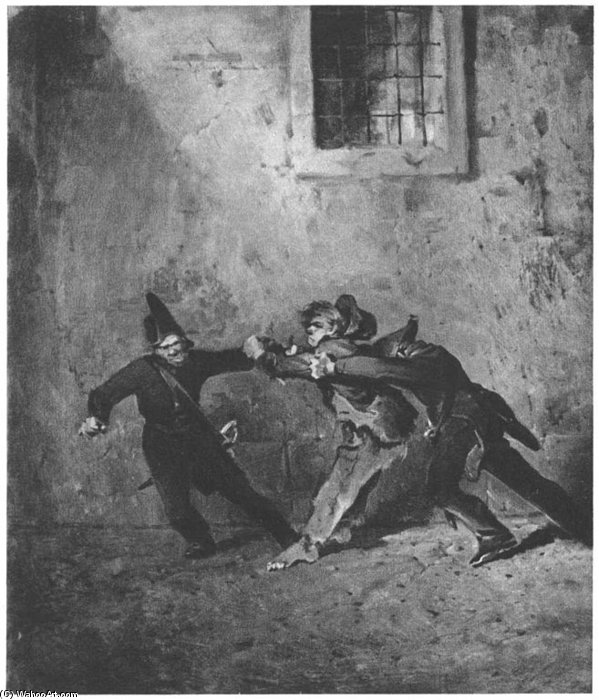
In this work, titled Der Strolch (The Vagabond), Ferdinand von Rayski presents a solitary figure set within a rugged natural landscape. Painted about the 1850s, the piece moves away from the formal portraiture often associated with the artist's earlier career, focusing instead on a more grounded, social narrative. The subject is a vagabond, positioned amidst the textures of the outdoors, creating a sense of isolation within the environment.
The painting explores complex social themes, specifically the tension inherent in a confrontation with authority. While the final composition focuses on the individual, preparatory studies for this work reveal a more direct interaction, depicting the figure alongside two policemen. This detail suggests a deeper layer of social commentary regarding the status of the wanderer in the mid-nineteenth century.
Composition and Visual Elements
The composition centers on a moment of intense confrontation. Three figures are clustered tightly toward the middle of the frame, creating a sense of immediate tension. This grouping forces the viewer into the center of the struggle, where the physical altercation unfolds. The arrangement of the bodies is not static; instead, the diagonal lines formed by their limbs and torsos contribute to a palpable dynamism. This movement suggests a sudden, unresolved conflict caught in a fleeting instant.
There is a certain weight to the way the figures occupy the space. The interaction between the individuals is defined by their proximity and the energy of their struggle. By concentrating the action in the center, the artist ensures that the eye remains fixed on the core of the tension. The spatial relationship between the subjects creates a feeling of urgency, as if the viewer has stumbled upon a private, desperate moment of friction.
Technique and Material Details
Executed in oil, this work from about the 1850s reveals a remarkably loose execution. Rather than adhering to the rigid, polished finish often associated with academic traditions, the artist employs a more fluid application of paint. This approach allows for a seamless integration of human elements into the expansive outdoor scenes, ensuring the figure feels an inseparable part of the rugged landscape rather than a mere addition to the scenery.
The handling of light is particularly subtle here. One can observe how the illumination interacts with the natural environment, creating delicate effects upon the foliage and the path. These nuances in light and shadow provide a sense of atmospheric depth, grounding the composition in a specific, lived moment. The brushwork captures the textures of the terrain with a directness that prioritizes the immediate visual impression of the setting.
Veelgestelde vragen
Is Der Strolch handgeschilderd of een print?
Met de hand geschilderd: een professioneel kunstenaar kopieert Der Strolch in olieverf op linnen canvas.
Welke maat moet ik kiezen voor Der Strolch?
De afmetingen variëren van 34.2 x 29.3 cm (€245) tot 248.1 x 212.3 cm (€2004); in de tabel op deze pagina vindt u de verschillende opties en de bijbehorende prijzen.
Hoe lang duurt de bezorging?
De levertijd bedraagt 4 tot 5 weken, inclusief gratis wereldwijde expressverzending; op deze pagina wordt een optie voor spoedproductie aangeboden. U kunt het binnen 100 dagen zonder voorwaarden retourneren voor een volledige terugbetaling.
Welk medium heeft Ferdinand von Rayski gebruikt voor Der Strolch?
Oil
 Voorvertoning

 Verstuur
 Delen
 Details bekijken
 Informatieblad


 Download
 Vergelijkbare items
 Röntgenonderzoek
 Diavoorstelling
 Vraag & antwoord

 Statistieken


