

 Voorvertoning
 Verstuur
 Delen
Delen
 Details bekijken
 Gids
Gids

 Download
 Vergelijkbare items
 Röntgenonderzoek
 Diavoorstelling
 Statistieken
Meditation
 Oil On Canvas
- WallArt
- Symbolism
 1893
1893- 19th Century
 48.0 x 65.0 cm
 Ohara Museum of Art
 Lees meer
Giclée / Kunstafdrukken
Giclée- of canvasafdruk van museumkwaliteit met een snelle productie en flexibele afwerkingsmogelijkheden. ( Bestel handgeschilderde reproductie Schakel over naar digitale afbeeldingen)




P118B €10

P118H €10

P118W €10

P438Z €10

P508JH €12

P508YH €12

P805H €10

P805Z €10

P919BZ €10

P919G €10

P919XJ €10

P959ZH €10

P968JZ €12

W106C €8

W218G €10

W218JH €8

W218Y €10

W307PJ €10

W316G €10

W316PJ €8

W316Y €10

W398PJ €8

W4111J €10

W500HY €15

W500JH €15

W692G €12

W849H €8

W940BG €15

W953PJ €8




Kies uit onze vooraf ingestelde maten die overeenkomen met de originele verhoudingen van het kunstwerk.

Voer de gewenste breedte en hoogte in, passend bij uw lijst of muur. Een afdruk kan alleen worden ingekort en nooit groter worden gemaakt dan het origineel; een formaat met andere verhoudingen zal daarom een deel van de afbeelding verliezen. Wij sturen u een digitaal mockup ter goedkeuring voordat we tot drukwerk overgaan. De afbeelding op deze pagina toont niet de werkelijke uitsnede — dit is alleen te zien op het mockup.
Wereldwijde levering () binnen 2 weken in plaats van de standaard 4/5 weken. (26 oktober)

Gratis wereldwijde expressverzending

Hoogwaardig linnen canvas

Volledige verzendverzekering

Garantie op terugbetaling van invoerrechten

Garantie op exacte kleurweergave

Retourbeleid van 100 dagen (alleen bij defecten)

100% Geld-terug-garantie

Korting bij meerdere afnames
 De optie voor glas is alleen beschikbaar bij een formaat kleiner dan 110 cm.

Meditation
Giclée / Kunstafdrukken
Afmetingen reproductie
-


Eindtotaal
€ 71
The Soul in Stillness: A Journey into Carrière’s Meditation
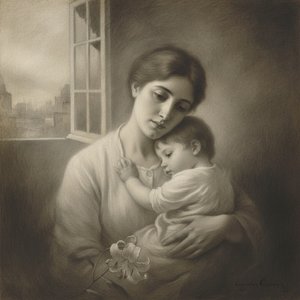
In the quiet corners of art history, few works possess the haunting, introspective power of Eugène Anatole Carrière’s 1893 masterpiece, Meditation. This oil on canvas is far more than a mere portrait; it is an invitation into the private sanctuary of the human psyche. At first glance, the viewer is met with the profound stillness of a young woman lost in thought, her presence commanding the space through a deliberate lack of movement. Carrière, a titan of the French Symbolist movement, eschews the fleeting light and vibrant energy of his Impressionist contemporaries to instead cultivate an atmosphere of eternal, somber reflection. The subject does not interact with the world outside the frame; rather, she exists in a state of profound interiority, making the painting a poignant testament to the beauty found within solitude and the weight of unspoken thoughts.
The technical brilliance of Meditation lies in Carrière’s masterful command over a restricted, almost monochromatic palette. Eschewing bright colors, the artist utilizes a sophisticated range of deep browns, velvety blacks, and subtle, earthy undertones of muted red and orange. This choice is not merely aesthetic but deeply psychological, serving to shroud the subject in a sense of mystery and melancholy. Through an ambitious layering process and the meticulous application of glazing techniques, Carrière achieves a luminous depth that seems to glow from within the canvas itself. The texture of the paint is remarkably tactile, creating a soft, skin-like quality in the figure’s face and a heavy, luxurious feel to her garments. His brushwork, while controlled, retains an organic fluidity that mirrors the natural contours of the human form, lending the piece a dreamlike, ethereal quality that borders on the supernatural.
Symbolism and the Echoes of the Subconscious
To understand Meditation is to understand the heart of Symbolism. During the fin-de-sięcle period, artists sought to represent ideas and emotions rather than the literal external world. In this work, every element serves a symbolic purpose. The woman’s downward gaze and slumped, vulnerable posture act as visual metaphors for grief, introspection, or perhaps an existential longing. The flattened composition—where the background dissolves into a hazy, indistinct void—strips away all worldly distractions, forcing the viewer to confront the subject's emotional state directly. There is no landscape to provide context, only the raw, unadulterated presence of feeling.
For the discerning collector or interior designer, this painting offers a profound sense of gravitas and emotional depth. It is a piece that does not merely decorate a wall but transforms the atmosphere of a room, bringing a sense of quiet sophistication and intellectual weight. Whether placed in a contemporary gallery setting or a classic study, Meditation acts as an anchor of tranquility. Its somber tones and rich textures provide a perfect counterpoint to modern minimalism or complement the ornate grandeur of traditional decor. Owning a high-quality reproduction of this work allows one to possess a fragment of the Symbolist soul, a permanent window into the profound beauty of the human spirit in repose.
Veelgestelde vragen
Is "Meditation" gebleven in het geboorteland van de kunstenaar?
Nee - het kunstwerk wordt in het buitenland bewaard. "Meditation" bevindt zich in Japan, terwijl Eugène Anatole Carrière werd geboren in Frankrijk.
Kan ik "Meditation" in meer detail bekijken?
De Röntgenanalyse-pagina van "Meditation" door Eugène Anatole Carrière is een interactieve viewer waarmee u door elf optische lagen van het kunstwerk kunt glijden, inclusief een weergave in röntgenstijl.
Wat voegt "Meditation" door Eugène Anatole Carrière toe aan een interieur?
De Calm sfeer van "Meditation" door Eugène Anatole Carrière past perfect bij de aanbevolen ruimte: een Living Room.
Biografie kunstenaar
**early life and training**
Eugène Anatole Carrière, a name synonymous with haunting monochrome landscapes and intimate domestic scenes, was born on January 16, 1849, in Gournay-sur-Marne, Seine-Saint-Denis. His upbringing, far from the bustling artistic centers of Paris, provided a grounding that would profoundly shape his distinctive style. Initially destined for a career in printing – a practical trade learned during his youth – Carrière’s passion for art ignited early, fueled by an encounter with the masterpieces of Peter Paul Rubens at the Louvre Museum. This pivotal experience irrevocably altered his course, leading him to pursue formal training at the École des Beaux-Arts in Paris and later under the tutelage of Alexandre Cabanel, a renowned academic painter. These formative years instilled within him both a deep respect for artistic tradition and the nascent desire to forge his own unique path.**artistic style and influences**
Carrière’s oeuvre is instantly recognizable by its pervasive use of brown monochrome – a deliberate departure from the vibrant palettes favored by many of his contemporaries. This carefully constructed palette, often described as “almost porcelain-like,” creates an atmosphere of quiet contemplation and ethereal beauty. The influence of Rubens remains palpable in the luminous quality of Carrière’s early works, while the somber mood and psychological depth owe a debt to the Symbolist movement gaining momentum at the time. Notably, his experiences as a prisoner of war in Dresden during the Franco-Prussian War profoundly impacted his artistic sensibilities, contributing to the melancholic undertones that permeate many of his paintings. The artist’s ability to evoke emotion through subtle shifts in tone and texture is a testament to his exceptional technical skill and profound understanding of color theory.**the young mother (1879) and other early works**
One of Carrière's most celebrated early pieces, *The Sick Child (Montargis)*, offers a poignant glimpse into the artist’s evolving artistic vision. This work, now housed at the Musée des Beaux-Arts de Rouen, marked a significant shift towards depicting scenes of domestic life – particularly those centered around motherhood and childhood. The painting captures a tender moment between a mother and child, rendered with remarkable sensitivity and realism. Similarly, *The First Communion (Toulon)* showcases Carrière’s ability to imbue seemingly ordinary subjects with profound emotional resonance. His portrait of Louis-Henri Devillez, a highly praised work from 1887, exemplifies his skill in capturing the essence of his subjects – their personalities, emotions, and inner lives. These early works established the foundation for Carrière's distinctive style and cemented his reputation as a master of psychological realism.**influence and legacy**
Carrière’s monochrome aesthetic has resonated deeply with artists across generations. Notably, Pablo Picasso drew inspiration from Carrière’s work during his Blue Period, adopting a similar palette to convey themes of melancholy and despair. The artist's influence extends beyond individual painters; his innovative use of color and his exploration of intimate human experiences have had a lasting impact on the development of modern art. Eugène Carrière was also an influential teacher at Académie de la Palette, nurturing the talents of future artists such as Henri Matisse and André Derain. His legacy continues to inspire artists today, demonstrating the enduring power of simplicity, emotion, and artistic vision.**notable works and exhibitions**
Beyond the pieces already mentioned, Carrière’s oeuvre includes a wealth of compelling paintings, each offering a unique perspective on the human condition. *The Sick Child (Montargis)*, *The Young Mother*, *First Communion (Toulon)*, and *Portrait of Louis-Henri Devillez* are among his most recognized works, exhibited at the Société Nationale des Beaux-Arts, which Carrière himself helped establish. His contributions to the art world extend beyond his paintings, as he also played an influential role as an art teacher at Académie de la Palette. His work is now displayed in museums across France and internationally, including the Musée d'Orsay in Paris, ensuring that his artistic legacy continues to be celebrated for generations to come.
Eugène Anatole Carrière
1849 - 1906 , Frankrijk
Belangrijkste feiten
- Artistic Movement Or Style: Symbolisme, Monochrome
- Artists Or Movements Influenced By This Artist: ['Pablo Picasso']
- Artists Who Influenced This Artist: ['Peter Paul Rubens']
- Date Of Birth: 16 januari 1849
- Date Of Death: 27 maart 1906
- Full Name: Eugène Anatole Carrière
- Nationality: Frans
- Notable Artworks:
- De Zieke Kind
- Het Eerste Communie
- Place Of Birth: Gournay-sur-Marne, Frankrijk
Gerelateerde artikelen

De Blijvende Erfenis van Olieverf op Doek: Techniek, Geschiedenis en Hedendaagse Praktijk
Ontdek de rijke geschiedenis en technieken van olieverfschilderen. Van Renaissance meesterwerken tot moderne toepassingen, leer over pigmenten, glazuur en conservering.

Oil on Canvas: A Historical & Technical Exploration of a Timeless Artistic Medium
Explore the rich history & enduring techniques of oil painting on canvas. Discover the science behind its longevity, conservation practices, and contemporary relevance. Expert insights for art enthusiasts.
Eugène Carrière: The 'Peintre d'Âme' & Symbolist Portraiture’s Intimate Vision
Explore the haunting world of Eugène Carrière, a pivotal French Symbolist artist known for his deeply intimate portraits & 'peinture d'âme'. Discover his life, style, and lasting influence on modern masters like Picasso. Shop high-quality reproductions at OriginalUniqueArt.

The Enduring Legacy of Oil on Canvas: Technique, History & Aesthetic Impact
Explore the rich history & techniques of oil painting – from Renaissance masters to Impressionism. Discover pigments, layering methods, and why this timeless medium endures. Expert insights for artists & art enthusiasts.

The Enduring Power of Painting: A Historical & Contemporary Exploration of Form and Emotion
Explore the rich history & enduring techniques of oil painting with OriginalUniqueArt. Discover masterpieces, learn about art collecting, and find authentic handmade reproductions crafted by skilled artists.