Schakel over naar print
 Lees meer







































 Voor kunstwerken of reproducties die aan één zijde groter zijn dan 105 cm (ongeveer 41 inch), wordt de lijst als een losse set verzonden. Deze methode garandeert een veilige levering en voorkomt schade tijdens het transport.


Street, Dresden – A Window Into Expressionist Anxiety
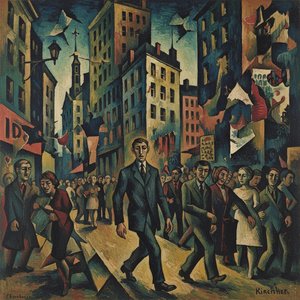
Ernst Ludwig Kirchner’s “Street Scene, Dresden,” painted in 1908 and reworked in 1919, stands as a cornerstone of German Expressionism. More than just a depiction of urban life—though undeniably capturing the dynamism of Dresden at the turn of the century—it's an intensely felt exploration of psychological unease and societal disillusionment, rendered with uncompromising visual language.
- Composition & Perspective: The painting abandons traditional perspective, compressing space into a claustrophobic tableau. Figures jostle for position, merging into amorphous masses that convey a palpable sense of disorientation. Kirchner deliberately avoids a focal point, directing the viewer’s gaze across the canvas with energetic brushstrokes and contrasting hues – a technique characteristic of Expressionist artists who prioritized emotional impact over realistic representation.
- Color Palette & Brushwork: Kirchner employs a jarring color palette dominated by pinks, greens, reds, blues, and yellows. These colors aren’t used to accurately portray the Dresden street; instead, they serve as conduits for emotion. Thick impasto brushstrokes—visible throughout the canvas—create a tactile surface and amplify the painting's expressive force. The use of complementary colors intensifies this visual drama.
- Symbolism & Emotional Resonance: Beyond its formal elements, “Street Scene” resonates with profound symbolic significance. The distorted figures embody anxieties about modernity and social fragmentation – themes prevalent in Expressionist thought. Kirchner’s aim wasn't to simply record what he saw but to convey the artist’s inner turmoil and capture the pervasive feeling of alienation that defined the era.
- Technique & Materials: Executed in oil paint on canvas, Kirchner’s method involved applying pigment with vigorous brushstrokes—a hallmark of Expressionist painting. This technique prioritizes texture and immediacy, mirroring the artists' desire to express raw emotion directly onto the surface of the artwork.
The influence of Impressionism is evident in Kirchner’s initial approach, yet he swiftly rejected academic conventions, embracing a style that prioritized subjective experience over objective observation. “Street Scene, Dresden” exemplifies this commitment, offering viewers a glimpse into the artist's psyche and cementing Kirchner’s place as one of Germany’s most important figures in modern art.
- Further Exploration: You can delve deeper into Kirchner’s artistic journey by visiting Smarthistory for a detailed analysis of the painting and its context. Alternatively, admire “Eisenbahnüberführung an der Löbtauer Straße in Dressen-Friedrichstadt” Smarthistory and “untitled (2500)” Smarthistory for similar stylistic explorations.
A reproduction of “Street Scene, Dresden” would bring Kirchner’s emotive vision into any interior space, serving as a powerful reminder of the anxieties and complexities inherent in the early 20th century – a timeless testament to artistic innovation and psychological depth.
Veelgestelde vragen
Wat stelt "Street, Dresden" door Ernst Ludwig Kirchner voor, en welke stemming straalt het uit?
"Street, Dresden" door Ernst Ludwig Kirchner combineert urban landscape, crowd, expressionism, color palette, distortion, impasto texture, psychological anxiety met een Dramatic atmosfeer.
Welke afmeting voor de reproductie wordt aanbevolen voor "Street, Dresden" door Ernst Ludwig Kirchner?
Voor "Street, Dresden" wordt een afdrukformaat van Large aanbevolen. Andere formaten zijn beschikbaar met dezelfde verhoudingen.
Wie heeft "Street, Dresden" gemaakt en in welke stijl is het uitgevoerd?
"Street, Dresden" werd gecreëerd door Ernst Ludwig Kirchner in de Expressionist Style-stijl. De kunstenaar en de stroming bepalen de traditie van het werk.
 Voorvertoning
 Verstuur
 Delen
Delen
 Details bekijken
 Gids
Gids

 Download
 Vergelijkbare items
 Röntgenonderzoek
 Diavoorstelling
 Q&A
Q&A Statistieken