

 Bekijk op ware grootte
 Verstuur
 Delen
Delen
 Details bekijken
 Gids voor studentenkunstwerken

 Download
 Vergelijkbare items
 Röntgenonderzoek
 Diavoorstelling
 Statistieken
Masks


 Lees meer
Giclée / Kunstafdrukken
Giclée- of canvasafdruk van museumkwaliteit met een snelle productie en flexibele afwerkingsmogelijkheden. ( Koop handgeschilderd kunstwerk Schakel over naar digitale afbeeldingen)




P118B €10

P118H €10

P118W €10

P438Z €10

P508JH €12

P508YH €12

P805H €10

P805Z €10

P919BZ €10

P919G €10

P919XJ €10

P959ZH €10

P968JZ €12

W106C €8

W218G €10

W218JH €8

W218Y €10

W307PJ €10

W316G €10

W316PJ €8

W316Y €10

W398PJ €8

W4111J €10

W500HY €15

W500JH €15

W692G €12

W849H €8

W940BG €15

W953PJ €8




Kies uit onze vooraf ingestelde maten die overeenkomen met de originele verhoudingen van het kunstwerk.

Voer de breedte en de hoogte in die u nodig heeft, passend bij uw lijst of uw muur. Een afdruk kan alleen worden ingekort, nooit groter worden gemaakt dan het origineel, waardoor een formaat met een andere verhouding een deel van de afbeelding verliest. Wij sturen u een digitaal mockup ter goedkeuring voordat we iets drukken. De afbeelding op deze pagina toont niet de werkelijke uitsnede — dit is alleen te zien op het mockup.
Wereldwijde levering () binnen 2 weken in plaats van de standaard 4/5 weken. (21 oktober)

Gratis wereldwijde expressverzending

Hoogwaardig linnen canvas

Volledige verzendverzekering

Garantie op terugbetaling van invoerrechten

Garantie op exacte kleurweergave

Retourbeleid van 100 dagen (alleen bij defecten)

100% Geld-terug-garantie

Korting bij meerdere afnames
 De optie voor glas is alleen beschikbaar bij een formaat kleiner dan 110 cm.

Masks
Giclée / Kunstafdrukken
Formaat reproductie
-


Totaalprijs
€ 71
The Enigmatic Dance of Masks – A Study in Emil Nolde’s Expressionist Vision
Emil Nolde's "Masks," painted in 1911, isn’t merely a depiction of carnival revelry; it’s a profound exploration of identity, hidden desires, and the unsettling duality inherent within human nature. Created during his time as a key member of Die Brücke – “The Bridge” – a group pushing the boundaries of German Expressionism in Dresden and Berlin, the painting embodies the movement's core tenets: a rejection of academic realism in favor of raw emotion, bold color, and a focus on subjective experience. Nolde himself described his interest in "the grotesque expression of power" and “elemental force,” sentiments powerfully realized within this captivating composition.
The scene unfolds against a deceptively simple blue background, immediately drawing the viewer’s eye to the central figures – five distinct masks suspended in an ambiguous space. Each mask isn't simply a representation of a face; it’s a carefully constructed symbol, radiating a potent emotional charge. The leftmost mask, a dark red and toothy visage, hints at aggression and perhaps even menace. Nearby, an upside-down pink mask suggests vulnerability and a suppressed sadness. Nolde masterfully employs a technique reminiscent of primitive tribal art – particularly the masks of Solomon Islands and Yoruna Indians from Brazil – drawing inspiration from non-Western cultures to amplify the painting’s primal energy. These references weren't merely decorative; they represented a deliberate attempt to tap into fundamental human emotions, divorced from rational thought.
A Symphony of Color and Impasto
Nolde’s masterful use of color is central to the painting’s impact. He abandons subtle gradations in favor of vibrant, almost jarring hues – fiery oranges, deep blues, and stark reds – applied with a thick impasto technique. This layering of paint creates a tactile surface, inviting the viewer to reach out and feel the energy contained within each mask. The brushstrokes are visible, deliberate, and intensely expressive, mirroring the turbulent emotions conveyed by the figures. This physicality of the paint itself contributes significantly to the painting’s unsettling atmosphere; it feels as though the masks are not merely objects on a canvas but living entities, pulsating with hidden power.
The composition is deliberately unbalanced, further enhancing the sense of unease. The placement of the masks – some close to the viewer, others receding into the distance – creates a dynamic tension, suggesting a perpetual state of shifting identities and concealed motivations. Nolde’s decision to depict these masks in isolation amplifies their symbolic weight, forcing the viewer to confront each one individually and contemplate its hidden meaning.
Historical Context and Lasting Resonance
“Masks” was painted during a period of intense social and political upheaval in Germany – a time marked by rapid industrialization, growing anxieties about modernity, and the rise of nationalist ideologies. Die Brücke’s rejection of traditional artistic conventions reflected a broader cultural rebellion against established norms. Following World War I, Nolde's work became increasingly introspective and emotionally charged, often exploring themes of isolation, mortality, and the darker aspects of human experience.
Interestingly, the painting was confiscated by the Nazi regime in 1937 due to its perceived “degenerate” nature – a label applied to works deemed unsuitable for German culture. Despite this suppression, "Masks" endured, eventually finding its way into private collections and, ultimately, onto the walls of The Nelson-Atkins Museum of Art in Kansas City. Its continued presence speaks to the enduring power of Nolde’s vision and its ability to resonate with viewers across generations.
A Timeless Exploration of Identity
“Masks” remains a profoundly evocative work, inviting endless interpretation. It's not simply a depiction of carnival masks; it’s an allegory for the masks we all wear in our daily lives – the facades we present to the world, concealing our true selves beneath layers of social expectation and personal insecurity. Nolde’s bold colors, expressive brushwork, and unsettling imagery combine to create a timeless meditation on identity, illusion, and the hidden depths of the human psyche. Reproductions capture only a fraction of the painting's raw emotional power, but they offer a valuable opportunity to engage with this remarkable work of Expressionist art.
Vragen & Antwoorden
Waar kan ik een print van "Masks" door Emil Nolde kopen?
"Masks" is verkrijgbaar als een fine art print op katoenen canvas of archiefwaardig canvaspapier. Bestellingen kunnen worden geplaatst op de Fine Art Print pagina, in de door u gewenste afmeting.
Wie heeft "Masks" gemaakt en in welke stijl is het uitgevoerd?
"Masks" werd gecreëerd door Emil Nolde in de Expressionist Landscape-stijl. De kunstenaar en de stroming bepalen de traditie van het werk.
In welk jaar werd "Masks" door Emil Nolde gemaakt?
"Masks" door Emil Nolde werd gemaakt in 1911.
Biografie van de kunstenaar
Early Life and Artistic Beginnings
Emil Nolde, een bekende Duitse en Deense schilder, werd geboren als Hans Emil Hansen op 7 augustus 1867 in Nolde, Schleswig-Holstein, Duitsland. Hij kwam uit een familie met sterke banden met het platteland en religieuze overtuigingen – factoren die zijn artistieke visie diepgaand zouden beïnvloeden. Ondanks de weerstand van zijn ouders, die hem graag een meer conventionele carrière wilden zien, achtervolgde Nolde onverzettelijk zijn passie voor kunst. In eerste instantie werkte hij als houtbewerker en meubelmaker voordat hij zich in de late twintiger jaren volledig aan het schilderen wijdde. Zijn jeugdige fascinatie voor kleur en vorm werd al vroeg aangewakkerd door de landelijke omgeving en de religieuze tradities van zijn familie, wat later terug zou komen in zijn werk.Artistic Development and Influences
Nolde’s artistieke reis was gekenmerkt door zelfstudie en verkenning. Hij reisde veelvuldig, waarbij hij zich liet inspireren door verschillende culturen en kunstvormen. Vroege invloeden omvatten Vincent van Gogh, Paul Gauguin en traditioneel volkskunst – met name de expressieve kracht van primitieve maskers en houtsnijwerken. Deze ontmoetingen wekten zijn interesse in felle kleuren, gestileerde vormen en emotioneel geladen thema’s op. In eerste instantie experimenteerde hij met Realisme en Impressionisme, maar verplaatste zich snel naar een meer subjectieve en expressieve stijl. Hij was gefascineerd door de werken van primitieve kunstenaars, die hij zag als een bron van onvervalste emotie en kleur. Deze invloeden zouden cruciaal zijn voor het ontwikkelen van zijn unieke visuele taal.Die Brücke and Expressionist Breakthrough
In 1905 richtte Nolde samen met andere kunstenaars de groep Die Brücke (De Brug) op, een cruciale verzamelingsplaats van Duitse expressionisten. Deze collectieve beweging streefde ernaar om zich los te maken van academische tradities en innerlijke emoties uit te drukken door radicaal artistiek experimenteren. Nolde’s bijdrage aan Die Brücke was significant; zijn intense gebruik van kleur en vervormde vormen dwong de grenzen van representatie opnieuw af. Tegelijkertijd behield hij een enigszins onafhankelijke positie binnen de groep, waarbij hij vaak afweek in onderwerpkeuze en stijlaanpak. De expressieve aard van Die Brücke was voor Nolde een manier om zijn innerlijke wereld te uiten, maar ook een uitdaging om zich te onderscheiden van de andere leden.Key Themes and Artistic Style
Nolde’s oeuvre wordt gekenmerkt door verschillende terugkerende thema's: religieuze scènes, landschappen, zeegezichten en portretten. Hij was bijzonder gefascineerd door de kracht van maskers – zowel als fysieke objecten als symbolische representaties van primitieve emoties. Zijn stijl werd gekenmerkt door:- Felle, levendige kleuren die gebruikt werden om intensiteit over te brengen
- Vervormde vormen die expressie boven realisme zetten
- Impasto-techniek – dik aanbrengen van verf waardoor textuur ontstaat
- Een focus op het vastleggen van innerlijke psychologische toestanden
Notable Works and Achievements
Gedurende zijn carrière creëerde Nolde een enorme hoeveelheid werk. Enkele van zijn meest bekende schilderijen omvatten:- Masks (1906-1907) – toonde zijn fascinatie voor primitieve kunst
- The Mocking of Christ (1909) – een krachtig en emotioneel geladen religieus schilderij
- Autumn Sea (1908) - demonstreerde zijn expressieve landschapsschilderkunst.
- Flower Garden (Girl and Washing) (1907)
- Dance around the Golden Calf (1909)
Historical Significance and Legacy
Emil Nolde’s innovatieve gebruik van kleur en expressieve penseelstreken heeft generaties kunstenaars beïnvloed. Zijn werk overbrugde de kloof tussen traditionele representatiekunst en de volgende abstracte bewegingen. Hij blijft een centrale figuur in de geschiedenis van Duitse expressionisme, geëerd om zijn intense emotie, experimentele stijl en blijvende artistieke visie. Zijn nalatenschap inspireert nog steeds kunstenaars en kunstliefhebbers wereldwijd.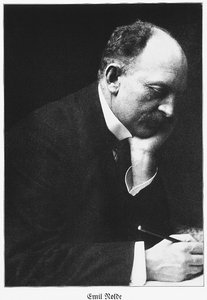
Emil Nolde
1867 - 1956 , Duitsland
Snelle feiten
- Artistic Movement Or Style: Expressionisme / Die Brücke
- Artists Or Movements Influenced By This Artist: ['Brücke']
- Artists Who Influenced This Artist:
- Van Gogh
- Gauguin
- Date Of Birth: 7 aug 1867
- Date Of Death: 15 apr 1956
- Full Name: Emil Nolde / Hans Emil Hansen
- Nationality: Duits-Denemarks
- Notable Artworks:
- Maskers
- Bekentenis van Christus
- Zee in de herfst
- Place Of Birth: Nolde, Duitsland
Gerelateerde artikelen
The Raw Emotion of Expressionism: A Deep Dive into its History, Characteristics & Enduring Influence
Explore the raw emotion of Expressionism with OriginalUniqueArt. Discover its history, key artists like Kirchner & Munch, and lasting influence on modern art. Expert insights for collectors & enthusiasts.
Unveiling the Mystery: A Journey Through the World's Most Iconic Mask Artworks
Embark on a profound journey through the world's most iconic mask artworks. Explore the spiritual depth, intricate craftsmanship, and rich cultural heritage of global traditions, from Chhau to Gomira, in this expert-led exploration of ancestral artistry and symbolic beauty.

Top 10 Expressionistische Meesterwerken: Kunst die de Ziel Raakt | OriginalUniqueArt
Ontdek de 10 meest iconische Expressionistische meesterwerken! Duik in de emotionele wereld van Kirchner, Kandinsky & Nolde. Museumkwaliteit kunst reproducties voor uw interieur. Exploreer de collectie op OriginalUniqueArt.com.

Unmasking Emotion: A Journey Through the Raw Power and Visceral Beauty of German Expressionism
Explore the raw emotional power of German Expressionism. From Kirchner to Die Brücke, discover how artists used distortion and vibrant color to unmask the human psyche. A deep dive into art history for the discerning collector and enthusiast.
The Visceral Cry of a Nation: Exploring Emotion & Distortion in German Expressionism
Explore the powerful world of German Expressionism with OriginalUniqueArt. Discover Kirchner, Nolde & Die Brücke's emotive masterpieces. Learn about this pivotal art movement and its lasting impact on modern art.

