Post-Impressionism
Garden path (Emil Nolde)
Emil Nolde (1867–1956) maakte Garden path. Het behoort tot de Post-Impressionism-stroming.

 Voorvertoning

 Met de hand geschilderd olieverfwerk
 Verstuur
 Delen
 Informatieblad


 Download
 Vergelijkbare items
 Röntgenonderzoek
 Diavoorstelling
 Vraag & antwoord

 Statistieken
Garden path, in het kort
- Titel
- Garden path
- Kunstenaar
- Emil Nolde (1867–1956)
- Geboren in [jaar]
- Nolde, Denemarken
- Beweging
- Post-Impressionism
- Onderwerp
- vibrant flowers, impasto texture, red floral art, nature painting, german art, post-impressionism
Wat stelt Garden path voor?
A Symphony of Red: Exploring Emile Nolde’s “Garden Path”
“Garden Path” by German-Danish Expressionist painter Emile Nolde is a captivating oil painting that plunges the viewer into an intensely vibrant floral world. More than a simple depiction of flowers, this artwork is an exploration of color, texture, and emotion – a hallmark of Nolde’s unique artistic vision.Subject & Composition
The composition centers around a dense cluster of brilliantly red blossoms set against a backdrop of lush green foliage. The artist eschews precise botanical representation, instead prioritizing the *feeling* of being immersed within a flourishing garden. There's an almost overwhelming abundance conveyed through the tightly packed forms and energetic brushwork. Nolde doesn’t offer a clear “path” in the traditional sense; rather, the viewer is invited to lose themselves within the floral mass itself – a path into sensation.Style & Technique: A Post-Impressionist Force
Nolde's style firmly aligns with Post-Impressionism, and particularly echoes the expressive power of Vincent van Gogh. The painting is defined by its bold, unrestrained brushstrokes and a palpable sense of movement. Impasto – the thick application of paint – is central to the work’s impact; the surface isn't merely painted *on*, it’s built *up*, creating a nearly sculptural texture that invites tactile engagement. Lines are implied rather than explicitly drawn, contributing to a dreamlike quality and blurring the boundaries between individual forms. The flattened perspective further emphasizes this immersive experience, drawing the viewer directly into the heart of the flowers.Historical Context: A Pioneer of Expressionism
Emile Nolde (1867-1956) was a pivotal figure in early 20th-century art, and a founding member of Die Brücke (“The Bridge”), a group of German Expressionist artists. This movement sought to convey subjective emotion and inner experience rather than objective reality. Nolde’s work, along with that of his contemporaries, represented a radical departure from traditional artistic conventions. Despite facing controversy – his art was deemed “degenerate” by the Nazi regime – Nolde remained committed to his unique vision, pushing the boundaries of color and form.Symbolism & Emotional Impact
The dominant use of red is particularly significant. Red often symbolizes passion, energy, vitality, and even a fleeting moment in time. Within the context of Nolde’s work, it can also be interpreted as representing the raw power of nature and the intensity of emotional experience. The overall effect is one of exuberance and unrestrained joy, yet there's also an underlying sense of wildness and untamed energy.For Collectors & Designers
“Garden Path” offers a powerful statement piece for any collection or interior space. Its vibrant color palette and dynamic texture will inject life and energy into a room. The painting’s expressive quality lends itself well to both modern and traditional settings, adding a touch of artistic sophistication and emotional depth. A high-quality reproduction would capture the essence of Nolde's technique, bringing the vibrancy and passion of this remarkable artwork into your home or office.- Style: Post-Impressionism, Expressionism
- Materials: Oil on Canvas
- Key Features: Impasto technique, vibrant color palette, expressive brushwork, flattened perspective.
Hoogwaardige afbeeldingen van Garden path

Publiek domein: de kunstenaar is overleden in 1956.
Andere formaten, uitsneden en citatie →Emil Nolde, Garden path. Publiek domein
Vragen over Garden path, beantwoord
Wat stelt "Garden path" door Emil Nolde voor?
"Garden path" door Emil Nolde toont: vibrant flowers, impasto texture, red floral art, nature painting, german art, post-impressionism, abstract blooms.
Is "Garden path" vrij van auteursrecht?
De auteursrechtelijke status van "Garden path" door Emil Nolde: het werk is bevindt zich in het publiek domein - de auteursrechten zijn verlopen. Dit bepaalt of reproducties van de afbeelding vrijelijk mogen worden gemaakt.
Aan welke kunstenaar wordt "Garden path" toegeschreven?
De kunstenaar achter "Garden path" is Emil Nolde. Het werk is gecatalogiseerd onder de naam van Emil Nolde.
Bij welke kunststroming behoort "Garden path" door Emil Nolde?
"Garden path" is een werk uit de Post-Impressionism. De stroming geeft de artistieke traditie aan waartoe het werk behoort.
Tot welke periode in de carrière van Emil Nolde behoort "Garden path"?
Binnen de carrière van Emil Nolde valt "Garden path" in de Mature Period. Deze fase helpt om het werk te vergelijken met andere werken van de kunstenaar.
Waarom heeft het kunstwerk "Garden path" deze auteursrechtelijke status?
De auteursrechtstatus van "Garden path" - bevindt zich in het publiek domein - de auteursrechten zijn verlopen - is gebaseerd op het overlijden van de kunstenaar in 1956.
Wat deelt "Garden path" met het overige oeuvre van Emil Nolde?
Binnen het oeuvre van Emil Nolde past "Garden path" binnen de Post-Impressionism-stijl, samen met de thema's van key post-impressional work, exploration of color, emotional intensity, van gogh's brushwork, expressionist color, impressionist texture, passionate energy, fleeting beauty.
Is "Garden path" typerend voor het werk van Emil Nolde?
De terugkerende thema's van Emil Nolde omvatten key post-impressional work, exploration of color, emotional intensity, van gogh's brushwork, expressionist color, impressionist texture, passionate energy, fleeting beauty; "Garden path" richt zich op vibrant flowers, impasto texture, red floral art, nature painting, german art, post-impressionism, abstract blooms.
Over de kunstenaar, Emil Nolde
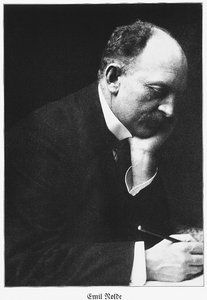
1867–1956, Denemarken
Emil Nolde
Het Leven en de Identiteit van Emil Nolde Geboren als Hans Emil Hansen op 7 augustus 1867, groeide de man die later de wereld zou veroveren als Emil Nolde op in de nabijheid van het dorpje Nolde in het hertogdom Sleeswijk. Zijn vroege jaren werden gevormd door het rurale, agrarische leven van zijn familie, een wereld van hard werken en traditie. Uiteindelijk koos hij voor een ander pad en wendde hij zich tot het vakmanschap als houtsnijder en meubeldecorateur. Dit tactiele, fysieke werk vormde de basis voor zijn latere verschuiving naar de schilderkunst en de grafiek.
Ook van Emil Nolde
 Sunset
 Sea with Red Sky
 Couple on the beach1903
 Masks1911
Essays over Garden path
 25 Masterpieces by Alexej von Jawlensky: The Soul of ExpressionismImmerse yourself in the vibrant world of Alexej von Jawlensky. Explore 25 iconic Expressionist masterpieces, from soulful portraits to bold…
 Expressionism vs. New Objectivity: Emotion vs. Precision in German ArtMaster the tension between Expressionist emotion and New Objectivity precision. Explore the soul of German modern art now.
 Amédée Masclef: Navigating Symbolism & Sentiment in Late 19th-Century French Landscape PaintingExplore the evocative landscapes of Amédée Masclef, a key figure bridging Barbizon realism & Symbolist sentiment. Discover his exquisite bo…